Quick answer
Bees are fuzzy with rounded bodies, tucked legs, and a docile temperament. Wasps are smooth and shiny, with a pinched waist, dangling legs, and a willingness to sting repeatedly. In Idaho, honeybees are protected pollinators that local beekeepers will relocate for free. Wasps, yellow jackets, and hornets are pests Green Guard treats year-round.
Key Takeaways
- Bees are fuzzy with rounded bodies. Wasps are smooth with pinched waists and dangling legs in flight.
- Honeybees defend their hive when provoked. Yellow jackets and paper wasps escalate fast and sting repeatedly.
- Honeybees are protected pollinators in Idaho. Call a Treasure Valley beekeeper for relocation, not an exterminator.
- Paper wasps under your eaves and yellow jackets in the ground are exactly what Green Guard treats.
- Most Boise wasp nests start in April. Knocking them down by June is far cheaper than a July emergency call.
In this article

Bee vs Wasp: How to Tell the Difference in Idaho
Look at three things and you'll get the answer in about five seconds.
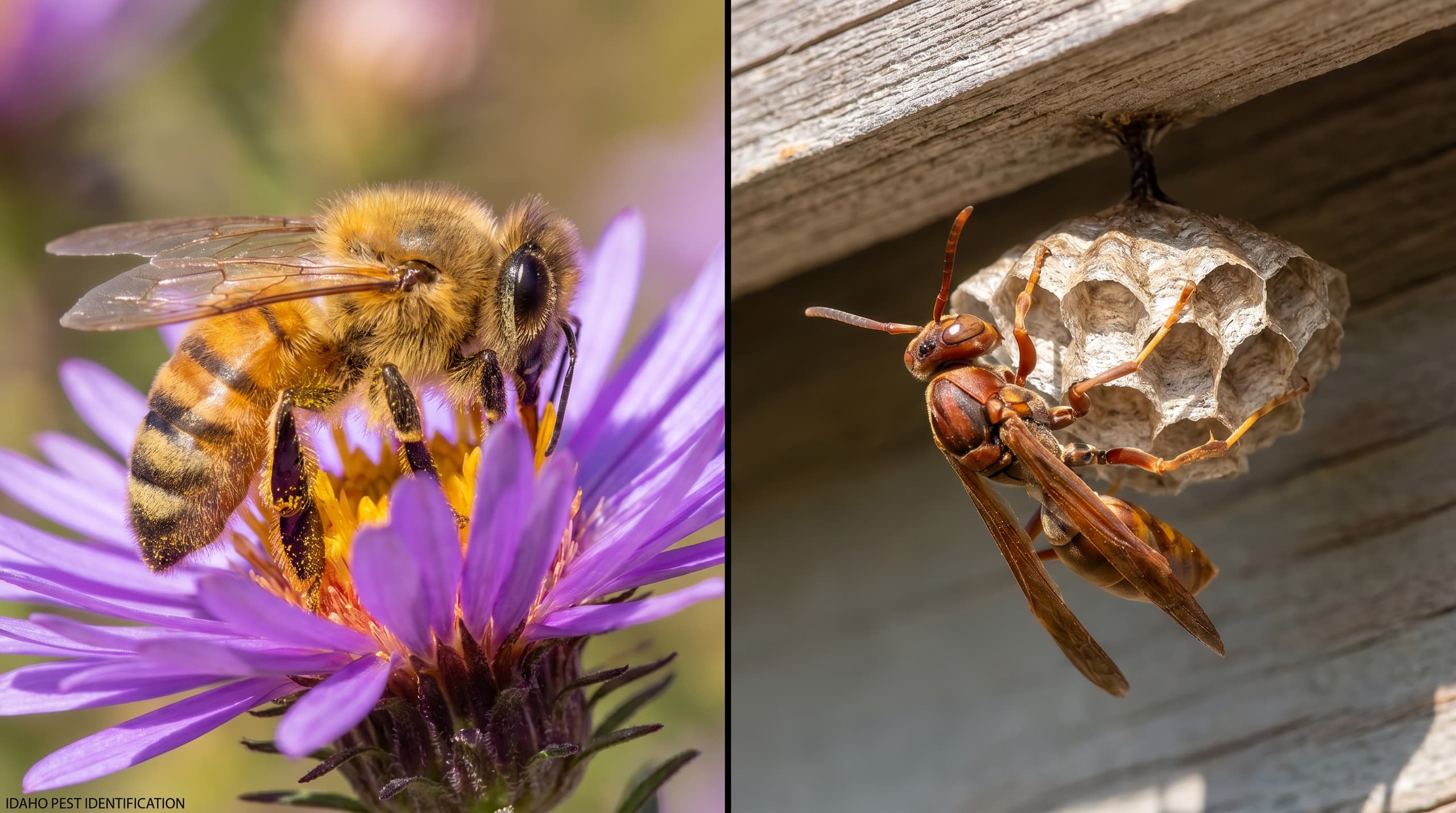
Bees are fuzzy with rounded bodies, tucked legs, and a docile temperament. Wasps are smooth and shiny, with a pinched waist, dangling legs, and a willingness to sting repeatedly. In Idaho, honeybees nest in tree hollows or wall voids and rarely chase you. Paper wasps and yellow jackets build paper nests under eaves, in the ground, or inside walls, and they get aggressive fast.
Why this matters in the Treasure Valley: honeybees are protected pollinators that a local beekeeper will relocate for free. Wasps, yellow jackets, and hornets are pests we treat. Get the ID wrong and you might kill a colony you didn't need to (or skip a call that could have saved you a sting).
Bee vs Wasp: Side-by-Side Comparison
Here's the cheat sheet. If you're standing in your backyard right now wondering what's buzzing under your eaves, scan this and you'll know.
| Trait | Bee | Wasp |
|---|---|---|
| Body | Fuzzy, hairy, rounded | Smooth, shiny, pinched waist |
| Color | Muted brown and golden bands | Bright yellow and black, or solid black |
| Legs in flight | Tucked tight against body | Dangling below the body |
| Stinger | Barbed (honeybees die after one sting) | Smooth, can sting repeatedly |
| Diet | Pollen and nectar | Other insects, sweets, meat scraps |
| Nest material | Wax comb in a cavity | Chewed wood pulp (paper) or mud |
| Common nest site | Tree hollow, wall void, chimney | Eaves, soffits, ground holes, wall voids |
| Aggression | Docile, defends hive only | Defensive, escalates near nest |
| Idaho status | Pollinator (protect) | Pest (control) |
| Green Guard treats? | No (call a beekeeper) | Yes |
Already know what you're looking at? Skip ahead to what to do if you find a nest. Otherwise, keep reading and we'll walk through each tell.
1. Body Shape: Fuzzy vs Smooth Is the Easiest Tell
If it looks like a flying teddy bear, it's a bee. If it looks like a polished jet, it's a wasp. That's the whole rule.
Bees evolved to carry pollen, so they're covered in branched hairs that grab pollen grains the way velcro grabs lint. Honeybees show muted golden-brown bands. Bumblebees are big, round, and look like fuzzy ping-pong balls.
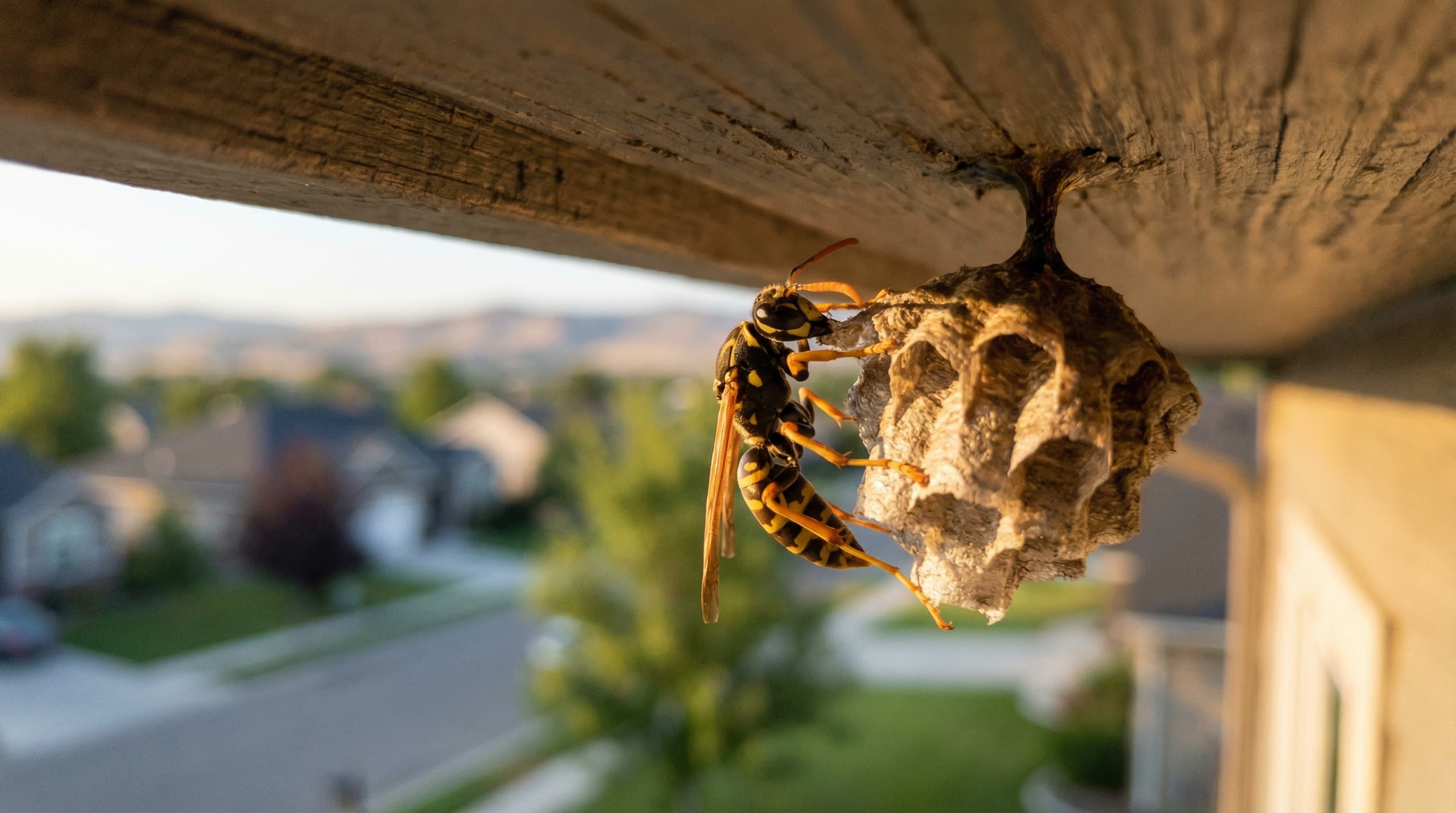
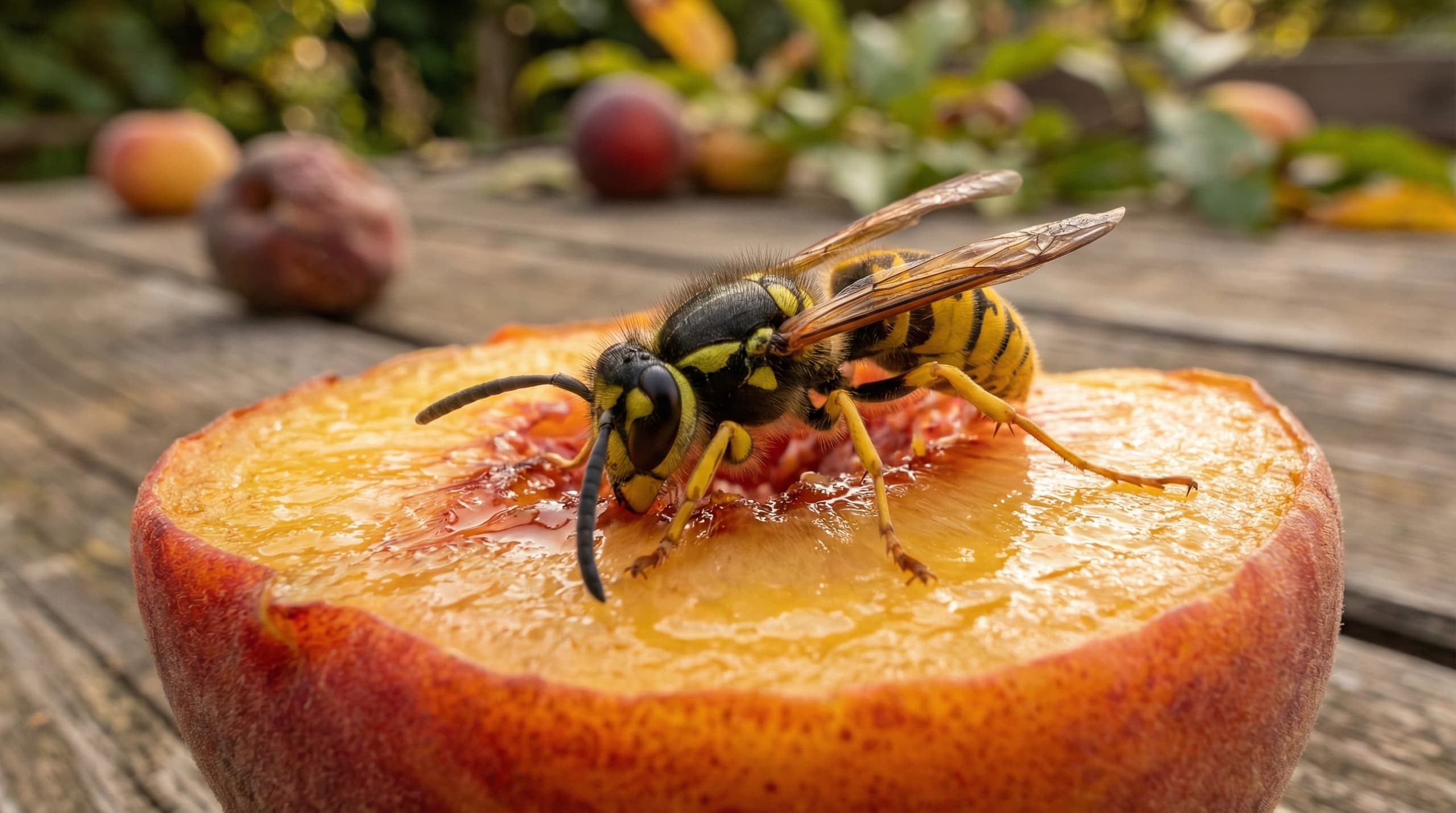
Wasps don't carry pollen. They hunt other insects and feed on sugars, so they have smooth, shiny exoskeletons and that signature narrow waist between thorax and abdomen. Paper wasps in Boise are usually a slim brown or rust color. Yellow jackets show sharp bright yellow stripes against jet black. Bald-faced hornets are black and ivory white.
Look at the Legs in Flight
Here's a tell most homeowners miss. Watch a bee fly past a flower and its legs are tucked tight to the body. Watch a wasp cruise around your patio table and its legs hang down like landing gear. Wasps are also faster and less predictable in flight, weaving and hovering. Bees fly purposefully from flower to flower.
2. Where Bees and Wasps Nest in Treasure Valley Homes
The nest is your second-best clue. Each insect builds something different, and the location often tells you what's inside before you ever see one fly out.
- Honeybees build wax comb (those classic hexagons) inside a sheltered cavity. In Boise, that means tree hollows, soffit gaps, chimney flues, and the occasional wall void. You'll see steady traffic in and out of one small entry hole and not much else.
- Bumblebees nest underground or in old rodent burrows. Small colonies, maybe 50 to 400 bees. Often in flower beds, under sheds, or in compost piles.
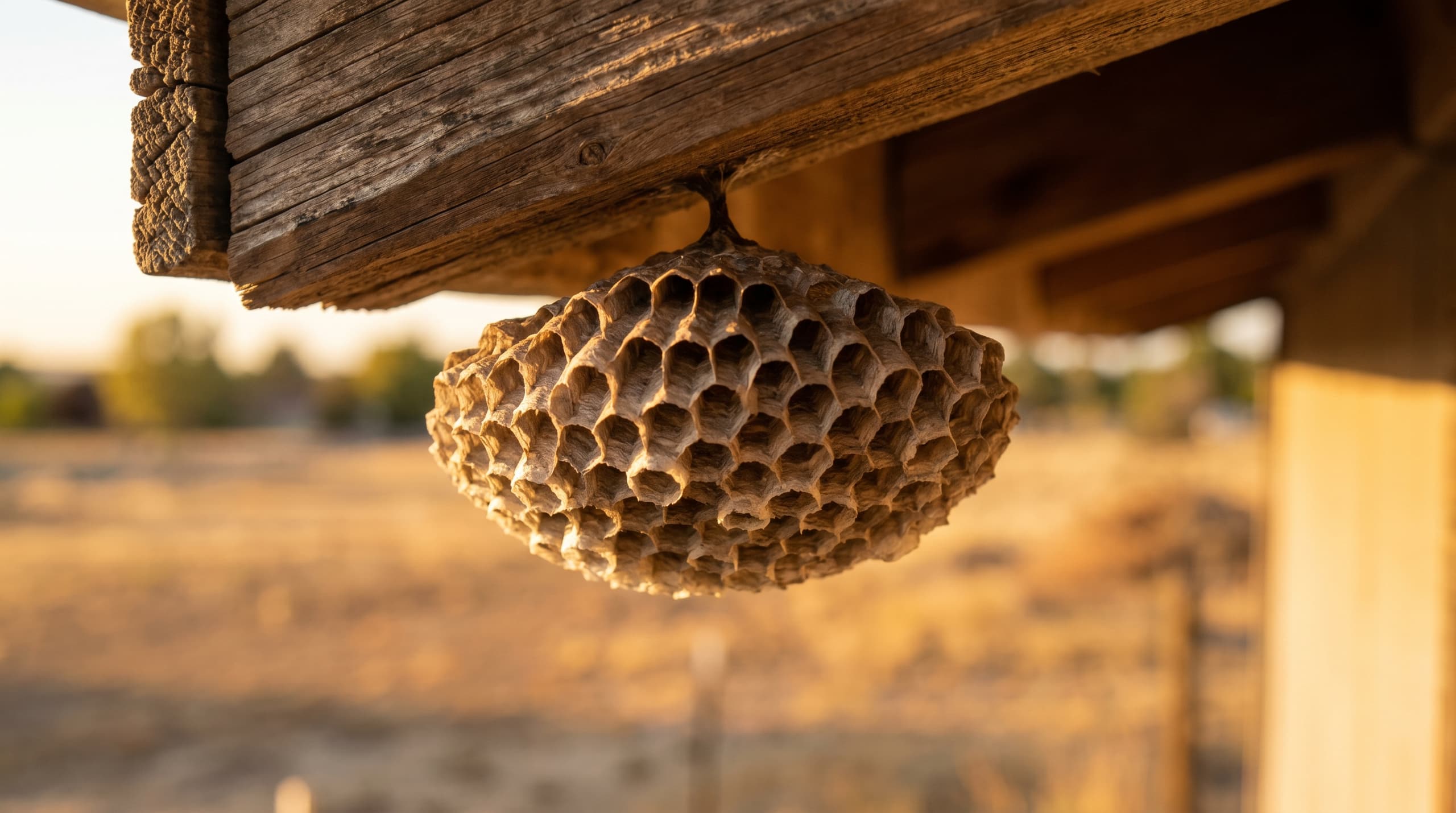
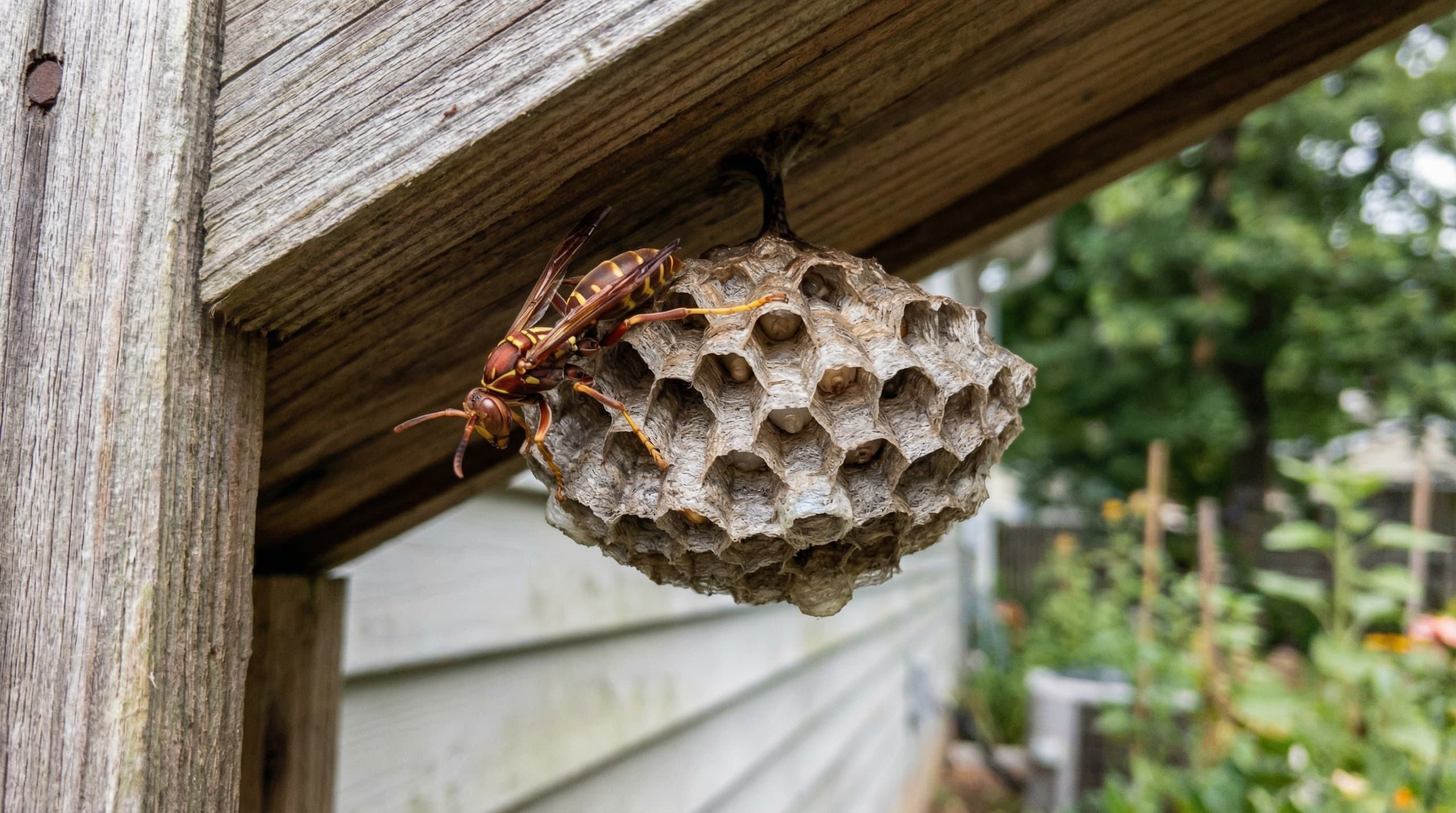
- Paper wasps build the open umbrella-shaped paper nests you see under eaves, soffits, deck rails, and patio furniture in the Treasure Valley. The cells point straight down. Read more about how to spot and treat them on our Boise spring wasp control guide.
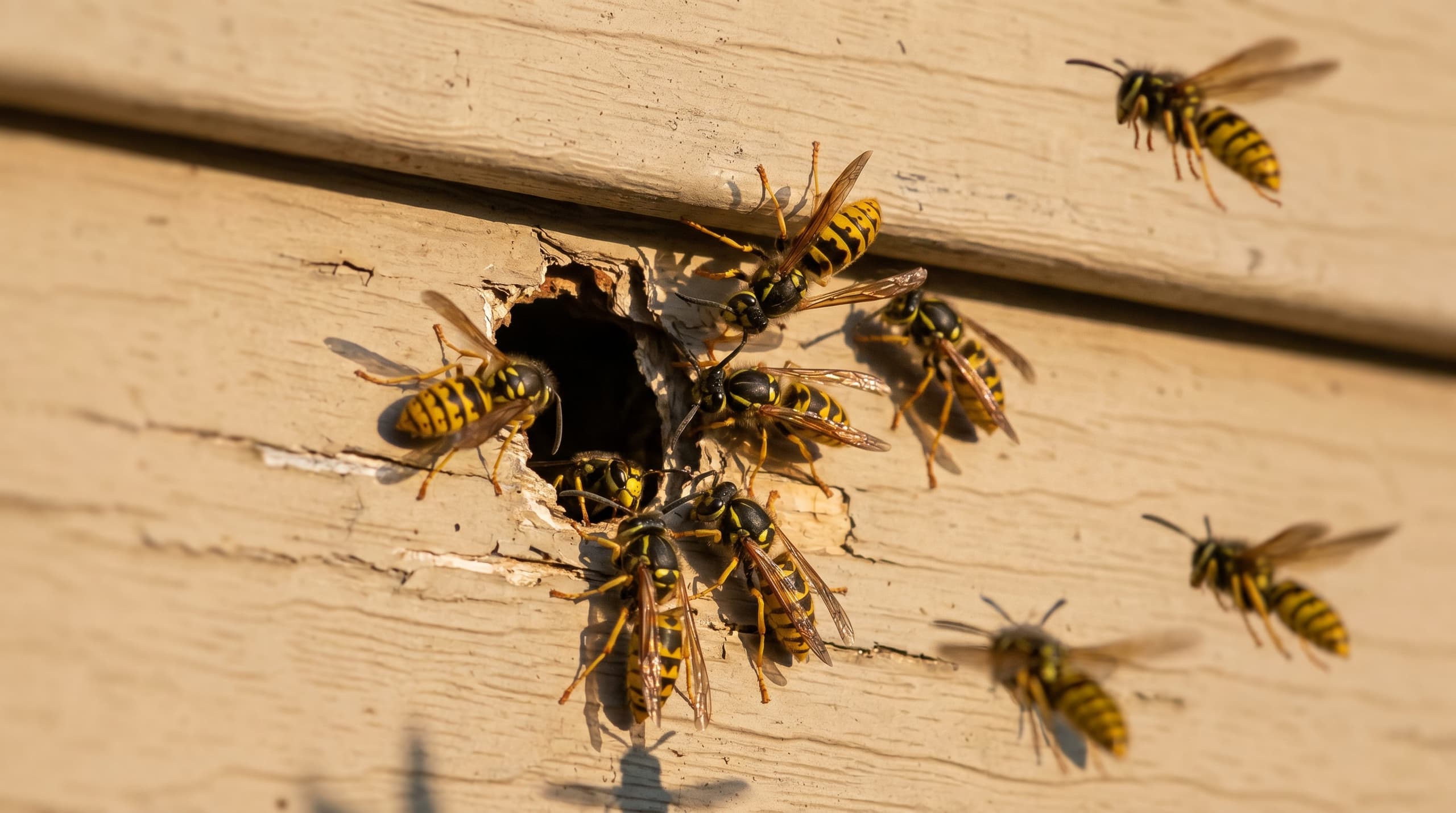
- Yellow jackets nest hidden. Ground holes in the lawn, voids inside walls, gaps under siding. You see workers funneling into a single spot. We cover this exact problem on our yellow jacket wall and ground nest guide.
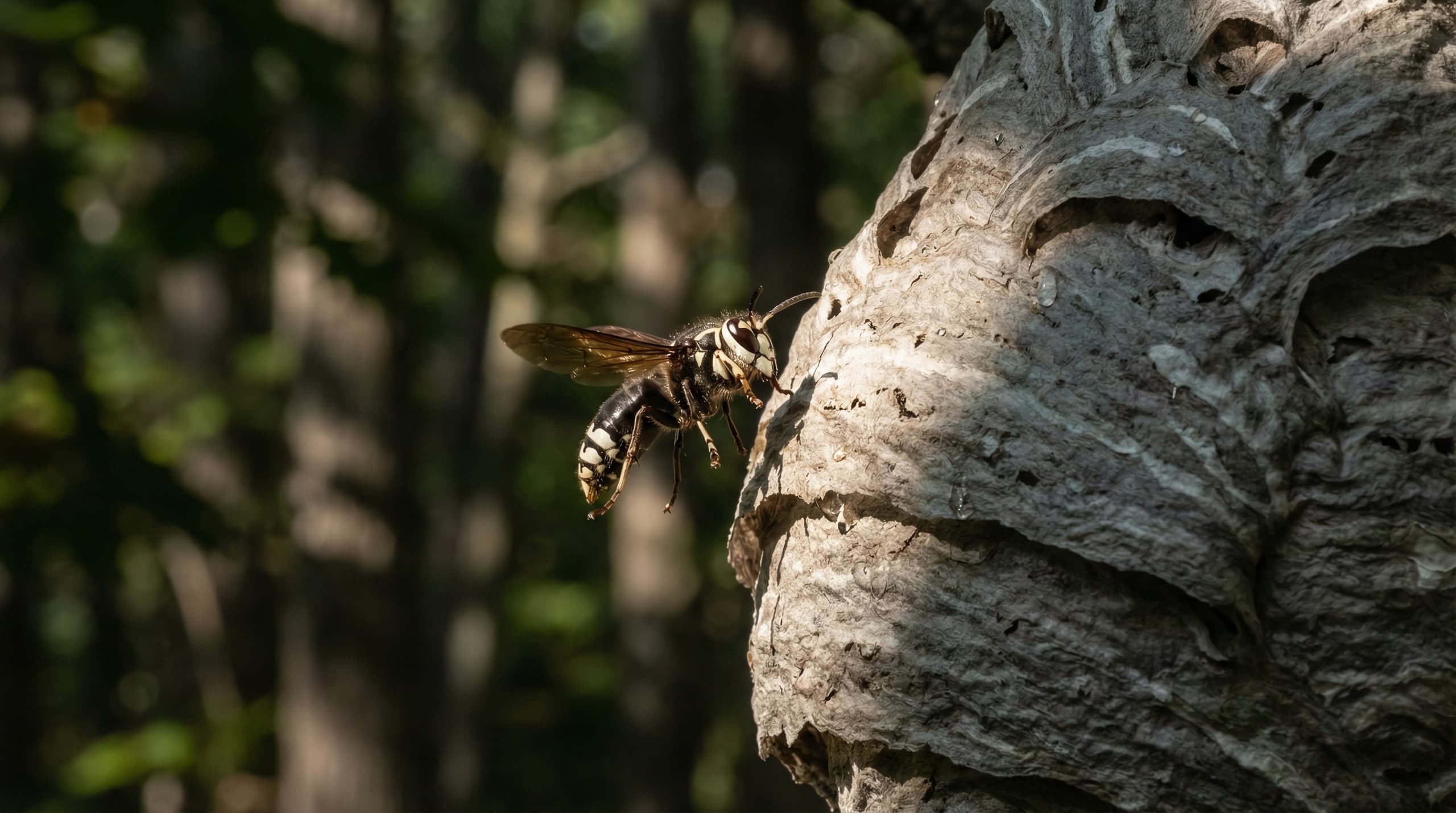
- Bald-faced hornets build huge gray football-shaped paper nests up high (trees, eaves, second-story corners). Fully enclosed with one bottom entrance.
- Mud daubers build small tubes of dried mud on stucco walls and inside sheds. They're solitary and almost never sting people.
3. Aggression and Sting Risk: Which One Is Worse?
Wasps win the aggression contest, and it's not close. Honeybees defend their hive when you get within a few feet of the entrance, but they don't go looking for trouble. A foraging honeybee on a dandelion will land on your hand and walk off again without stinging.
Paper wasps and yellow jackets are different. Get within about 10 feet of an active nest and you'll get a warning fly-by. Bump the nest or block the entrance and they pour out. Yellow jackets in particular get nasty in late July and August in the Treasure Valley, when colonies hit peak size and food sources get tight. They'll sting unprovoked at picnics, hover around grills, and ram you when you walk past their ground hole.
Honeybees can sting once. The barbed stinger pulls out and the bee dies. Wasps have smooth stingers and can sting you ten times before flying off to find a friend. If you're allergic, that distinction matters a lot.
Common Bees and Wasps in the Treasure Valley
Now that you know the rules, here are the specific species you're most likely to run into around Boise, Meridian, Eagle, Nampa, and the rest of the Valley.
Honeybees (Apis mellifera)
Golden brown with darker bands, fuzzy, about half an inch long. Idaho honeybees pollinate everything from backyard tomatoes to the seed-crop fields out toward Caldwell and Wilder. If you find a swarm hanging from a tree branch in May or June, it's almost always honeybees and almost always temporary. They'll move on within a day or two. Call a beekeeper, not us.
Bumblebees
Big, round, fuzzy, slow. Yellow and black with sometimes a touch of orange. Bumblebees are docile and excellent pollinators. A nest in a far corner of the yard is low risk. The colony dies off in fall and won't reuse the spot. A nest by a door or a play area, or near someone with a sting allergy, is different. Keep people and pets clear of it. Green Guard doesn't remove bumblebee nests, but a local beekeeper may be able to relocate it.
Paper Wasps
The most common wasp under Boise eaves. Slim, rust-brown, long legs that dangle in flight. Their open umbrella nest tucks under any flat overhang. Porch ceilings, soffits, deck rails, and patio umbrellas all qualify. Moderately defensive. They won't chase you across the yard, but they'll sting if you bump the nest with a broom.
Yellow Jackets
Bright yellow and black, smooth, fast, and the angriest stinging insect in the Treasure Valley. Workers nest in ground holes, wall voids, and gaps in siding. By August they're swarming garbage cans, hovering at picnic plates, and stinging without provocation. If you see a steady stream of yellow-and-black workers funneling into one spot in your lawn or wall, that's a yellow jacket nest.
Bald-Faced Hornets
Black and ivory white, larger than a yellow jacket. Build the gray football-shaped paper nests you see hanging from trees and second-story eaves. Highly defensive. A bumped bald-faced hornet nest is a true emergency. Do not knock these down with a stick from the ground.
Mud Daubers
Long, thin, often metallic blue or black. Solitary. Build small mud tubes on stucco walls and inside garages and sheds. They hunt spiders to feed their young, which is actually helpful. Mud daubers almost never sting people. If you see a mud tube on the side of your house, it's not an infestation.
What to Do If You Find a Nest
Once you know what you're looking at, the next move is straightforward.
If it's honeybees, don't spray. Don't seal the entry hole (the bees will chew through drywall trying to escape and you'll have honey leaking into your living room). Call a Treasure Valley beekeeper. Most will relocate a swarm or accessible hive for free, because a strong honeybee colony is worth real money to them.
If it's paper wasps, yellow jackets, hornets, or any other wasp, that's exactly what we treat. The longer you wait, the bigger the colony gets. A paper wasp nest in May is a 30-second knockdown. The same nest in August is 200 wasps and a longer treatment. See our wasp nest removal guide for the step-by-step or call us and we'll handle it.
Wasps under your eaves? Call (208) 297-7947 for a $49 initial treatment with our free re-service guarantee. If they come back between visits, we come back free. Learn more about our wasp and hornet control service.
Why Green Guard Treats Wasps but Not Bees
We get this question a lot, especially in spring. The short answer is that honeybees are pollinators and there's a free, better option: a beekeeper will come haul them away alive.
Honeybee populations across the country have been struggling for over a decade. Serving the Treasure Valley since 2010, we've watched local beekeepers build real demand for relocation calls. They want the bees. We don't have the equipment to vacuum a hive out of a wall, transport it, and re-establish it (and we shouldn't, because someone with a hive operation will do it better).
Wasps are different. Yellow jackets and paper wasps don't pollinate the way bees do, they're territorial, and they're a real safety risk for kids, pets, and anyone allergic. That's the work we're built for. Across 2,500+ Treasure Valley homes, our perimeter treatment knocks down active nests within 24 to 48 hours and keeps queens from rebuilding for the rest of the season.
When Wasps Are Worst in the Treasure Valley
One last piece of local context. As of May 2026, wasp pressure in Boise is ramping fast, and the pattern is predictable every year.
Queens emerge from overwintering in late March and April and start small starter nests in April and May. By June, you'll see the first paper-wasp umbrellas under eaves. July and August are peak. Yellow jacket colonies hit full size, paper wasp nests are at their largest, and bald-faced hornet nests can hit basketball-size. By October, most colonies die off (only fertilized queens overwinter to start the cycle again next spring).
The cheap month to treat is May. The expensive month is August. If you spotted a small nest this week, this week is the right time. For more on the spring window specifically, see our Boise spring wasp control guide.
Where Treasure Valley Stinging Insects Turn Up and When
Which insect you find depends on where you look and what month it is. Here is the typical pattern around Boise, Meridian, Eagle, and Nampa.
- Paper wasps are the easiest to spot, because they build in the open. They tuck under second-story eaves, soffits, patio covers, and behind shutters from April through October.
- Yellow jackets are at their most aggressive from August through mid-September, when colonies often reach 2,000 to 4,000 workers. Neighborhoods with mature landscaping, such as Boise's North End and the Eagle foothills, give queens plenty of hidden cavities. They also nest under decks and porches, in attics and soffits, and in dense shrubs, and vibration from foot traffic can set them off.
- Bald-faced hornets show up between July and early October, usually 10 to 20 feet up in a tree or on the gable end of a two-story house.
- Bumblebees turn up around home gardens across the Valley from May through August, usually nesting in abandoned vole tunnels or under decks.
Where Each One Shows Up in Meridian, Nampa, Caldwell, Eagle, Kuna, and Star
The mix changes a little from town to town. Here is the general picture.
- Meridian. Paper wasps under eaves and pergolas, especially in older neighborhoods with overgrown landscaping. Yellow jackets nest in ground holes along pasture edges and the outer ring of the city. New subdivisions built on former hay ground disturb ground-nesting wasps.
- Nampa. Yellow jackets near Lake Lowell and Deer Flat Wildlife Refuge, paper wasps under eaves, and mud daubers on south-facing walls.
- Caldwell. Paper wasps under porch eaves in older neighborhoods, and ground-nesting yellow jackets along pasture edges and farm fence lines toward Wilder and Notus.
- Eagle. Larger lots and mature landscaping make ideal habitat for paper wasps, yellow jackets, and bald-faced hornets.
- Kuna and Star. Ground-nesting yellow jackets along irrigation berms, pasture edges, and old fence lines, and paper wasps under the eaves of barns, sheds, and detached garages. In Star, rural properties often have a nest going somewhere by July.
One More Look-Alike: The Big Black Bee at Your Deck Rail
A big, shiny black bee hovering at a deck rail or fascia board is usually a carpenter bee, not a bumblebee. The giveaway is the abdomen. Carpenter bees are shiny and hairless. Bumblebees are fuzzy with yellow and black stripes. A perfect round hole about 1/2 inch across in the wood confirms it. Our carpenter bee guide for Boise covers the drilling and the damage.
When to Call a Professional
Call a professional if the nest is larger than a golf ball, hidden inside a wall or underground, or belongs to yellow jackets or bald-faced hornets. The same goes if anyone in your household has a sting allergy, or if the nest is near a door, patio, or play area. Call (208) 297-7947 and we will identify the species and handle the nest.
Ready to Get the Wasps Off Your House?
Identifying the bug is step one. Doing something about it is step two.
If you have honeybees, call a local beekeeper for relocation. They'll thank you for the call. If you have paper wasps, yellow jackets, hornets, or any other wasp on your property, call Green Guard at (208) 297-7947. Our $49 initial service includes a full property inspection, identification of every active nest, exterior barrier treatment, and our free re-service guarantee.
Family-owned, locally based, and backed by 4.9 stars across 170+ Google reviews. We know Treasure Valley wasps because we treat them all season, April through October.
Frequently Asked Questions
How can I tell if it's a bee or a wasp under my eaves in Boise?
Quick answerLook at the body and the nest.
Honeybees are fuzzy with rounded bodies and build wax comb (hexagonal cells) inside a cavity. Paper wasps are smooth and slim with a pinched waist and build open umbrella-shaped paper nests that hang under the eave with the cells pointing down. If the nest looks like a chewed paper bag, it's a wasp. If it looks waxy and the bees are fuzzy, it's a beehive.
Are honeybees protected in Idaho?
Quick answerHoneybees are managed pollinators and Idaho law protects beekeeping operations.
Killing a honeybee colony when relocation is available is bad practice and (if it belongs to a registered beekeeper) can carry liability. The right move is always to call a Treasure Valley beekeeper. Most beekeepers relocate accessible swarms and hives for free.
Will Green Guard remove a bee hive from my house?
Quick answerNo.
We don't remove honeybee hives. Honeybees are pollinators and a local beekeeper will relocate them alive, usually for free. We focus on wasps, yellow jackets, hornets, and paper wasps. If you're not sure what you have, call us at (208) 297-7947 and we'll help you identify it over the phone.
What time of year are wasps worst in the Treasure Valley?
Quick answerLate July and August.
Queens emerge in late March and April, starter nests show up in May, and colonies hit peak size in mid-summer. By August, paper wasp nests are at their largest and yellow jackets get aggressive around food. The best time to treat is May or June when nests are still small.
How much does it cost to remove a wasp nest in Boise?
Quick answerWasp nest removal is included in our $49 initial service for new subscription customers.
That covers the inspection, knockdown of any active nests, and full perimeter barrier treatment. If wasps come back between scheduled visits, we come back free under our re-service guarantee. Call (208) 297-7947 to book.
What is the most dangerous stinging insect in Idaho?
Quick answerYellow jackets are the most dangerous.
They nest in hidden locations (underground, in walls), can contain thousands of workers by late summer, and are highly aggressive, especially when defending food sources or their nest. They can sting repeatedly and attack in coordinated swarms.
Where are wasps and hornets most active in the Treasure Valley?
Quick answerAcross Boise, Meridian, Eagle, and Nampa, paper wasps start building in April under eaves and patio covers.
Yellow jacket and bald-faced hornet activity peaks August through mid-September, especially in older neighborhoods with mature trees (North End Boise, the Eagle foothills, and around Lake Lowell in Nampa).
Where do yellow jackets and paper wasps nest in Meridian, Nampa, Caldwell, Kuna, and Star?
Quick answerPaper wasps build under eaves, pergolas, porch eaves, and the eaves of barns, sheds, and detached garages.
Yellow jackets nest in the ground along pasture edges, irrigation berms, and old fence lines, and near Lake Lowell and Deer Flat Wildlife Refuge in Nampa. In Star, most properties have at least one nest going by July.
Is a big shiny black bee a bumblebee or a carpenter bee?
Quick answerIf the abdomen is shiny and hairless, it is a carpenter bee.
Bumblebees are fuzzy with obvious yellow and black stripes. Carpenter bees hover next to wood, such as deck rails and fascia boards, and drill round holes about 1/2 inch across. Bumblebees hover over flowers and the vegetable garden.