
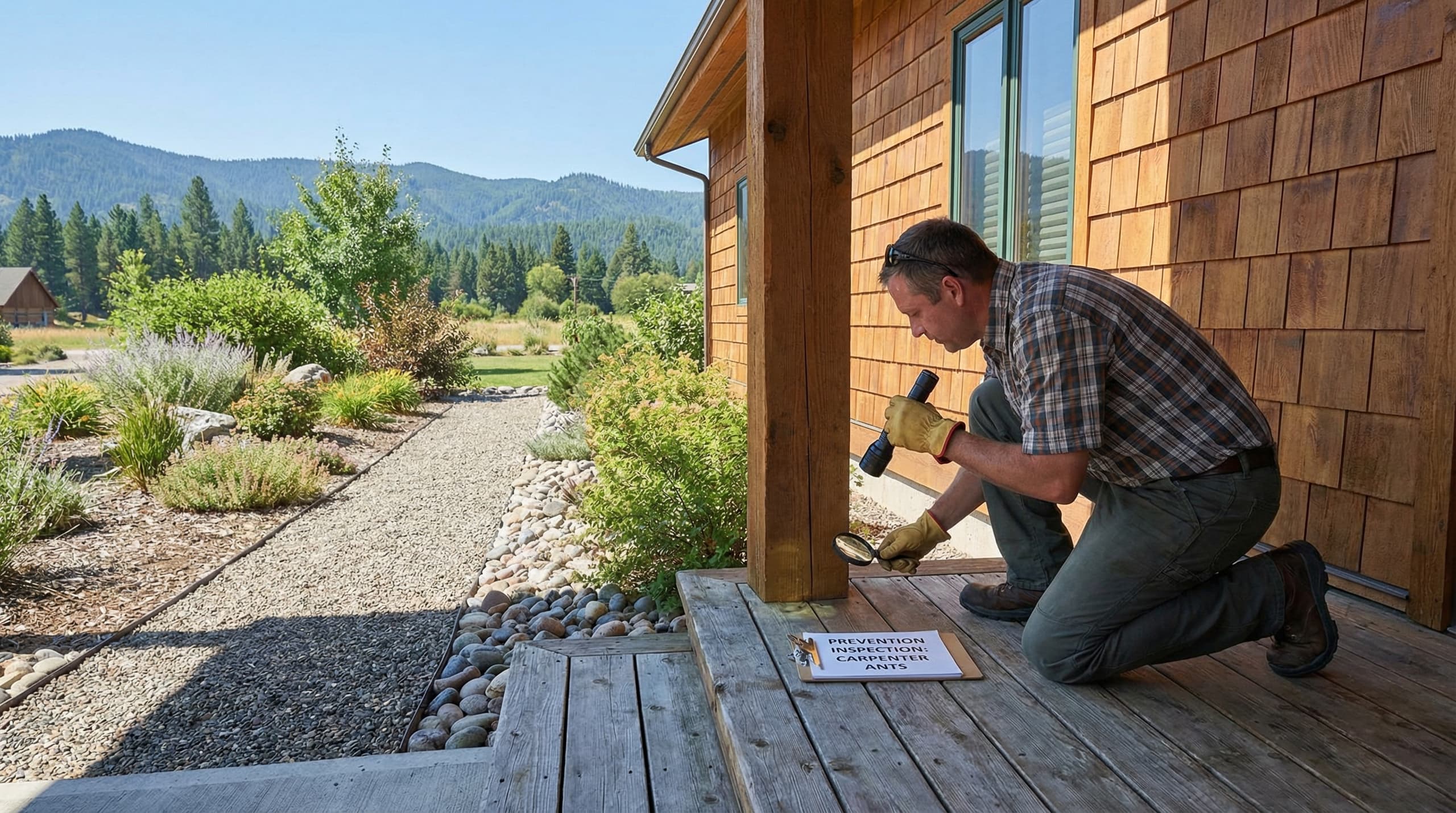

Key Takeaways
- 1Carpenter ants do not eat wood but excavate it for nests - damage accumulates over years
- 2Moisture-damaged wood is their primary target - fix water issues immediately
- 3Sawdust piles (frass) near wood structures indicate active carpenter ant galleries
- 4Parent colonies are often outdoors - indoor ants may be satellite colonies
- 5Professional treatment is necessary to locate and eliminate all colony sites
Understanding Carpenter Ant Behavior
Carpenter ants are among the largest ant species in North America, with workers ranging from 1/4 to 1/2 inch long. In Idaho, the most common species is the black carpenter ant, which is entirely black or dark brown.
Unlike termites, carpenter ants do not eat wood. Instead, they excavate galleries (tunnels) in wood to create nests. This distinction is important because carpenter ants need food sources outside their nests and create tell-tale sawdust (frass) that termites do not.
Carpenter ants establish parent colonies in damp, decaying wood - often in trees, stumps, or landscaping timbers - then create satellite colonies in drier wood, including inside homes. Eliminating only visible ants will not solve the problem; you must locate and treat all colony locations.
Moisture Control: The #1 Prevention Strategy
Wood that has been water-damaged even once remains more attractive to carpenter ants than undamaged wood. If you have had leaks, monitor those areas closely for ant activity.
Carpenter ants strongly prefer moist, damaged wood for initial nesting. Eliminating moisture problems is the single most effective prevention measure.
- Fix roof leaks immediately - Water damage in attics creates ideal carpenter ant habitat.
- Repair plumbing leaks - Under sinks, around toilets, and anywhere pipes run through walls.
- Ensure proper bathroom ventilation - Run exhaust fans during and after showers.
- Maintain gutters and downspouts - Water should flow away from foundations, not saturate soil near walls.
- Check window and door flashing - Water infiltration around openings damages wood framing.
- Address basement and crawl space moisture - Use dehumidifiers and ensure proper ventilation.
- Grade soil away from foundation - Standing water near walls creates moisture problems in adjacent wood.
Remove Outdoor Carpenter Ant Attractants
Walk your property looking for any dead wood: old fence posts, rotting deck boards, damaged trees, forgotten lumber. If parent colonies establish near your home, satellite colonies in your structure are more likely.
Parent colonies typically establish outdoors before satellite colonies appear in structures. Eliminate outdoor nesting sites:
- Remove dead trees and stumps - These are primary nesting sites for carpenter ant parent colonies.
- Clear fallen branches and wood debris - Any rotting wood can harbor colonies.
- Replace landscape timbers - Old, rotting timbers are carpenter ant magnets. Consider concrete, stone, or steel alternatives.
- Do not bury wood debris - Wood buried during construction or landscaping attracts ants.
- Address tree damage - Dead branches, cavities, and damaged areas in trees near your home can house colonies.
- Store firewood properly - At least 20 feet from structures, elevated off the ground.
Warning Signs of Carpenter Ant Activity
If you see carpenter ant swarmers (winged ants) inside your home, you have an established colony in the structure that has been present for at least 3-5 years. Professional treatment is essential.
Early detection prevents extensive damage. Know what to look for:
- Sawdust piles (frass) - Shredded wood particles, often mixed with insect parts, accumulating near wood structures. This is the most distinctive sign.
- Large black ants indoors - Especially in kitchens, bathrooms, or near water-damaged areas. Seeing them regularly indicates a colony.
- Winged ants (swarmers) indoors - Large black flying ants inside your home, particularly in spring, indicate a mature colony in the structure.
- Rustling sounds in walls - Large colonies create audible movement, especially at night.
- Hollow-sounding wood - Tap wood structures with a screwdriver handle. Carpenter ant galleries create hollow spaces.
- Small holes in wood - Ants create openings to eject frass from galleries.
Professional Carpenter Ant Treatment
Green Guard offers carpenter ant treatment starting at $49. Our thorough approach locates and eliminates all colony sites. Quarterly service at $119 includes ongoing monitoring. We guarantee our work - if carpenter ants return, so do we at no additional charge.
Professional treatment provides comprehensive carpenter ant elimination that DIY methods cannot achieve.
- Thorough inspection - Locating all colony sites, both indoors and outdoors, including wall voids, attics, and exterior areas.
- Multiple treatment methods - Baits that workers carry back to colonies, residual treatments in wall voids, and perimeter barriers.
- Moisture assessment - Identifying and recommending repairs for conditions that attracted ants.
- Follow-up treatments - Most infestations require multiple visits to ensure complete elimination.
- Ongoing monitoring - Quarterly service catches new activity before damage accumulates.
- Guaranteed results - Professional service includes warranties that DIY methods cannot match.
When to Call a Professional
Every day of delay allows more structural damage. Carpenter ant colonies work continuously once established. The ants you see represent a fraction of the colony in your walls. Call (208) 297-7947 immediately for professional treatment.
Contact Green Guard Pest Control at (208) 297-7947 immediately if you notice any of these signs:
- Large black ants indoors - Especially in kitchens, bathrooms, or near any moisture source.
- Sawdust piles near wood structures - This frass is the most definitive sign of carpenter ant activity.
- Winged ants (swarmers) inside your home - This indicates a mature colony that has been in your structure for 3-5+ years.
- Rustling or crinkling sounds in walls - Large colonies create audible movement.
- Any structural wood damage - Soft spots, hollow-sounding wood, or visible galleries.
- You have had moisture problems - Past leaks create attractive conditions for carpenter ants.
Need Professional Help?
Get Same-Day Pest Control in Boise
Our local experts are standing by. Guaranteed results or we re-treat for free.