

Key Takeaways
- 1Mice are small (2-4 inch body), rats are large (7-10 inch body)
- 2Mouse droppings are rice-grain sized; rat droppings are olive-pit sized
- 3Mice can squeeze through dime-sized holes; rats need quarter-sized or larger
- 4Mice are curious and explore new objects; rats are cautious and avoid them
- 5Both can carry diseases and require professional treatment for elimination
Why Identification Matters
Many homeowners use "mice" and "rats" interchangeably, but they're actually quite different animals requiring different control approaches. Correct identification helps you understand the severity of your problem and ensures effective treatment.
In Idaho, house mice are the most common indoor rodents, while Norway rats are found in some areas, particularly near waterways and older neighborhoods. Understanding which you have helps target control efforts effectively.
Size Comparison
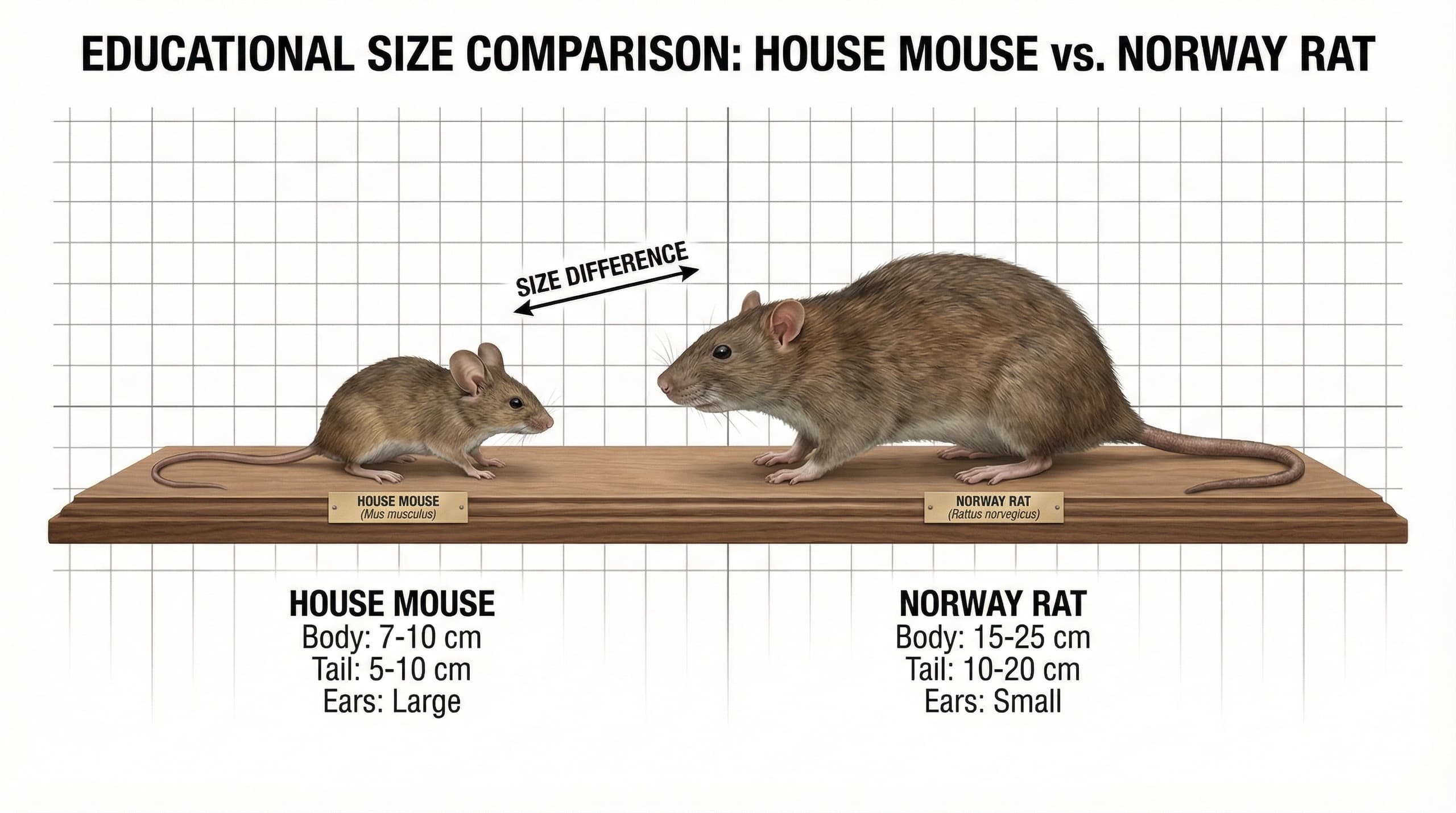
The most obvious difference is size:
Mouse
- Body length: 2.5 to 4 inches (excluding tail)
- Tail: Equal to body length, thin and scaly
- Weight: About 0.5 to 1 ounce
- Overall: About the size of your thumb (body only)
Rat
- Body length: 7 to 10 inches (excluding tail)
- Tail: Shorter than body, thick and scaly
- Weight: 10 to 17 ounces (about 1 pound)
- Overall: About the size of your fist or larger
Physical Feature Comparison
Beyond size, several features help distinguish mice from rats:
Ears
Mouse: Large relative to head | Rat: Small relative to head
Snout
Mouse: Pointed, triangular | Rat: Blunt, rounded
Eyes
Mouse: Large relative to head | Rat: Small relative to head
Tail
Mouse: Thin, equal to body length | Rat: Thick, shorter than body
Fur
Mouse: Uniform gray or brown | Rat: Coarse, brown-gray with lighter belly
Droppings: The Most Reliable Indicator
Since rodents are often not seen directly, droppings are the most common way to identify which you have:
Mouse Droppings
- Size: 1/8 to 1/4 inch (about the size of a rice grain)
- Shape: Rod-shaped with pointed ends
- Color: Dark brown/black when fresh, graying over time
- Quantity: 40-100 per mouse per day
- Location: Scattered along travel paths, near food sources
Rat Droppings
Fresh droppings are dark and shiny; old droppings are dry and gray. Fresh droppings indicate current activity. Finding only old, dried droppings may indicate past activity rather than current infestation.
- Size: 1/2 to 3/4 inch (about the size of an olive pit)
- Shape: Capsule-shaped with blunt ends
- Color: Dark when fresh, graying over time
- Quantity: 20-50 per rat per day
- Location: Concentrated in specific areas
Behavioral Differences
Mice and rats behave quite differently, which affects control strategies:
Mouse Behavior
- Curious - Will investigate new objects, including traps
- Explorers - Travel widely throughout their range
- Climbers - Excellent climbers, access upper levels easily
- Nibblers - Eat small amounts from many food sources
- Multiple nests - May have several nest sites
Rat Behavior
Rats' caution toward new objects (neophobia) means traps may be ignored for days or weeks. Professional rodent control accounts for this behavior with proper placement and pre-baiting strategies.
- Cautious - Avoid new objects for days ("neophobia")
- Creatures of habit - Follow same paths consistently
- Ground-dwellers - Norway rats prefer ground level; roof rats climb
- Gouge-eaters - Eat larger amounts from fewer sources
- Single burrow - One main nest location
Entry Point Differences
The size of entry holes helps identify which rodent you have:
Mice: Can squeeze through holes the size of a dime (1/4 inch or 6mm)
Rats: Need holes the size of a quarter (1/2 inch or 12mm) or larger
Finding small entry points suggests mice; finding large entry points, or seeing them gnawed larger, suggests rats.
Other Evidence Comparison
Additional signs help confirm identification:
Gnaw Marks
Mouse: Small, 1/16 inch tooth marks | Rat: Large, 1/8 inch or larger marks
Grease Marks
Mouse: Light smudges | Rat: Obvious greasy rub marks along walls
Tracks (in dust)
Mouse: Under 3/8 inch | Rat: 3/4 to 1 inch
Sounds
Mouse: Scratching, light scurrying | Rat: Heavier scratching, gnawing, squeaking
When to Call a Professional
Professional rodent control includes elimination AND exclusion - sealing entry points to prevent re-infestation. Treatment starts at $49 with quarterly plans at $119 for ongoing protection. We guarantee results or re-treat for free.
Both mice and rats warrant professional treatment. Contact Green Guard at (208) 297-7947 if:
- You see a rodent - Where there's one, there are usually more
- You find droppings - Indicates active infestation
- You hear scratching in walls - Rodents are established
- You find gnaw marks - Active damage occurring
- You see a rat - Rats indicate more serious infestation
- DIY traps aren't working - Professional approach needed
Need Professional Help?
Get Same-Day Pest Control in Boise
Our local experts are standing by. Guaranteed results or we re-treat for free.