Quick answer
Rodent control in Boise is a fall problem that starts in August. Seal entry points before nighttime lows hit the mid-50s (usually early September in the Valley) and you skip most of the October wall-scratching calls. Real control leads with locked, tamper-resistant bait stations, plus sealing every gap the size of a dime or bigger. We pack copper mesh into the obvious gaps. Bigger repairs are a job for you or a handyman. Snap traps come out only rarely, when a situation calls for it. Green Guard starts with a $49 first service, full inspection included, then $119 per quarter for homes up to 2,500 sq ft.
Key Takeaways
- Rodent pressure in Boise ramps up hard between early September and mid-October, once nighttime lows drop into the mid-50s. Sealing in August, before the push, is roughly a third of the cost and time of trapping in October.
- Boise homes deal with four rodents: house mice in denser neighborhoods, deer mice in the rural outskirts of Eagle and Star, Norway rats near the Boise River corridor, and voles chewing up lawns.
- Real rodent control leads with locked, tamper-resistant bait stations. Snap traps come out only rarely, when a situation calls for it. Sealing entry points matters too. We pack copper mesh into the obvious gaps, and bigger repairs are a job for you or a handyman.
- DIY store traps rarely finish an active infestation. Mice breed every 3 weeks with 5 to 8 pups per litter, so catching 2 out of 20 just buys time while the colony rebuilds faster.
- Most Treasure Valley infestations clear in 2 to 3 weeks with a proper plan. Green Guard's $49 first service includes the inspection, and quarterly protection runs $119 for homes up to 2,500 sq ft.
In this article

Why August Sealing Beats October Trapping in Boise
The cheapest, fastest version of rodent control in Boise happens in August. Seal the exterior now, before mice actually push indoors, and you skip the October scratching, the November drywall smells, and the $200 emergency service call. Wait until you hear something in the wall and you are paying to solve the problem twice: once to trap what is inside, and again to seal what should have been sealed six weeks earlier.
Here is the biology behind the timing. Boise mice track nighttime temperatures more than calendar dates. Once overnight lows drop into the mid-50s (usually the first or second week of September in most of the Valley), house mice and deer mice start looking for indoor shelter with urgency. By the first hard frost in late October, the push is over. Anything that got in is in, and it is breeding.
As of August 2026, we are in the pre-push window right now. Colonies are still small. Food sources are still outdoors. The gaps mice will use are visible in daylight, without snow. A home sealed up in August is far less likely to turn into an October trapping call. The reverse (October trappers who wish they had sealed in August) is a common fall story.
This guide is the bigger picture: how sealing fits with trapping, baiting, and quarterly service to actually finish the problem.
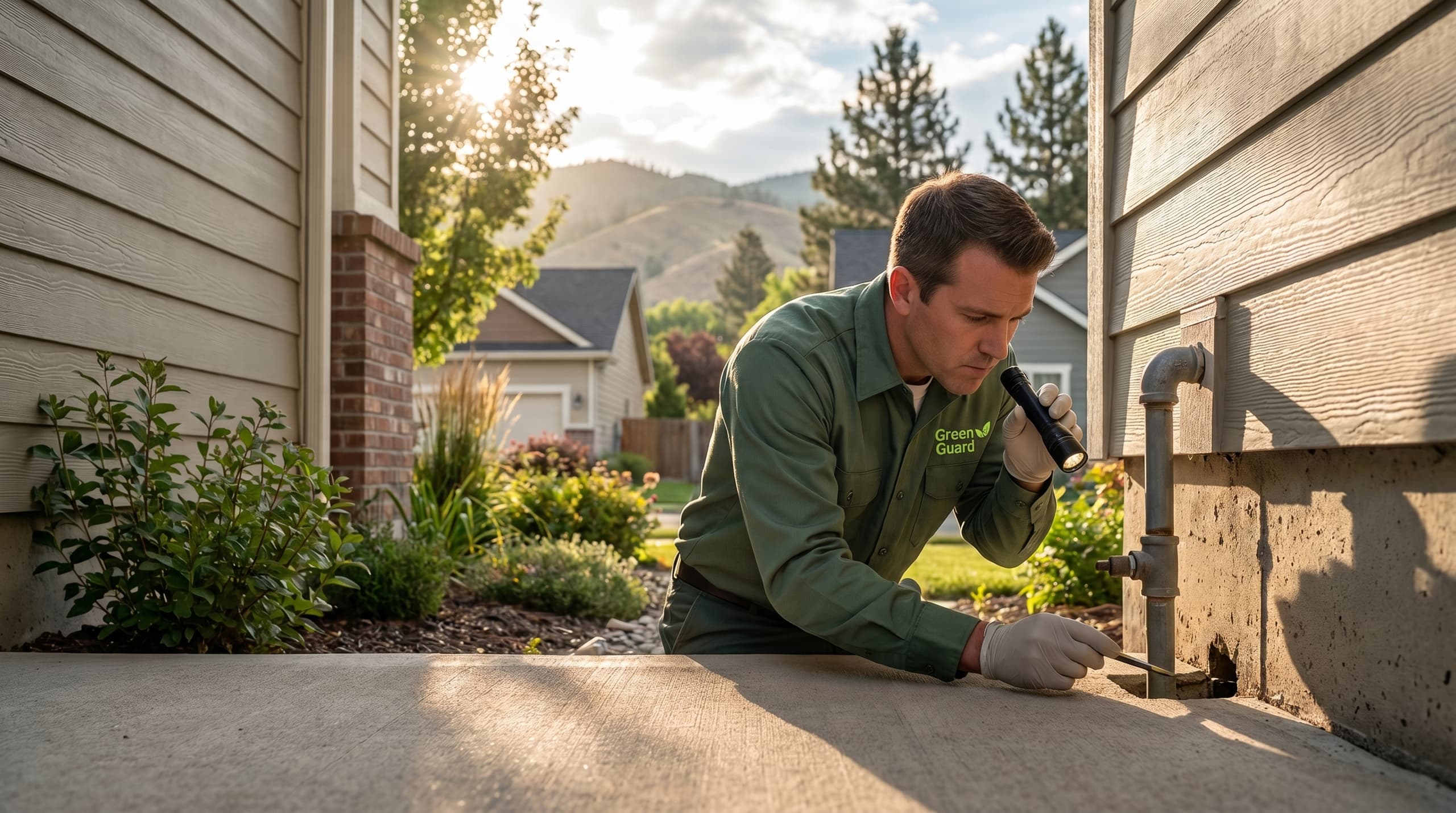
The Fall Entry-Point Inspection Checklist (Print This)
These are the spots mice use most on Boise homes, condensed into a checklist you can print and run yourself. Start at the front door, walk clockwise around the exterior, then finish with the interior. Bring a flashlight, a No. 2 pencil, and a roll of painter's tape.
- Foundation seams and cracks. Walk the base of every exterior wall. Look for gaps at the concrete-to-siding line, cracks in older stucco, and settlement gaps in poured foundations. Anywhere the pencil goes in, tape it.
- Weep holes and vent screens. Brick veneer weep holes should be capped with stainless mesh weep covers. Foundation vents should have intact 1/4-inch hardware cloth, not the plastic factory screen that mice can chew through in a night.
- Utility penetrations. Every spot where a pipe, cable, or wire enters the house. Gas line, main water, HVAC lineset, electrical conduit, cable and fiber, exterior spigots. These are the number one entry point on Boise homes because contractors leave the gap unsealed behind trim rings.
- Dryer vent and range hood exhaust. The flapper alone is not enough. Louvered vent covers with rodent screens are the fix. Check that the flapper is not stuck open from lint buildup.
- Garage door bottom and side seals. Stand inside the garage in daylight with the door closed. If you can see a strip of daylight anywhere along the bottom or sides, mice can get in. Bottom sweep replacement is a 15-minute job.
- Garage service door and man-door thresholds. Same test. Sun-degraded weatherstripping around the exterior garage door is one of the easiest entry points on a Treasure Valley home.
- Soffit and fascia gaps. Look up. Missing soffit vent screens, gaps where soffit meets brick, and rot near gutter corners are all deer mouse access points, especially on foothills homes.
- Roof-line penetrations. Plumbing vent boots, satellite dish mounting, gable vents, chimney flashing. Cracked rubber vent boots are common on Boise homes older than 15 years.
- Crawlspace access door. Check the seal and the latch. A rodent-proof crawlspace door is intact plywood or steel, tight-fitting, with a functional latch. Warped or damaged doors are a highway.
- Interior travel paths. Once you are done outside, walk the interior: under sinks (look at the sink drain penetration into the wall), behind the fridge, behind the stove, under the water heater, around the washer and dryer connections. Any gap around a pipe or wire needs steel wool packed in and caulk over the top.
- The garage-to-house door and cold-air returns. Rodents that get into the garage often walk into the house through gaps around the door frame or through unsealed HVAC returns. Weatherstrip and seal.
Which Rodents Actually Show Up in Treasure Valley Homes?
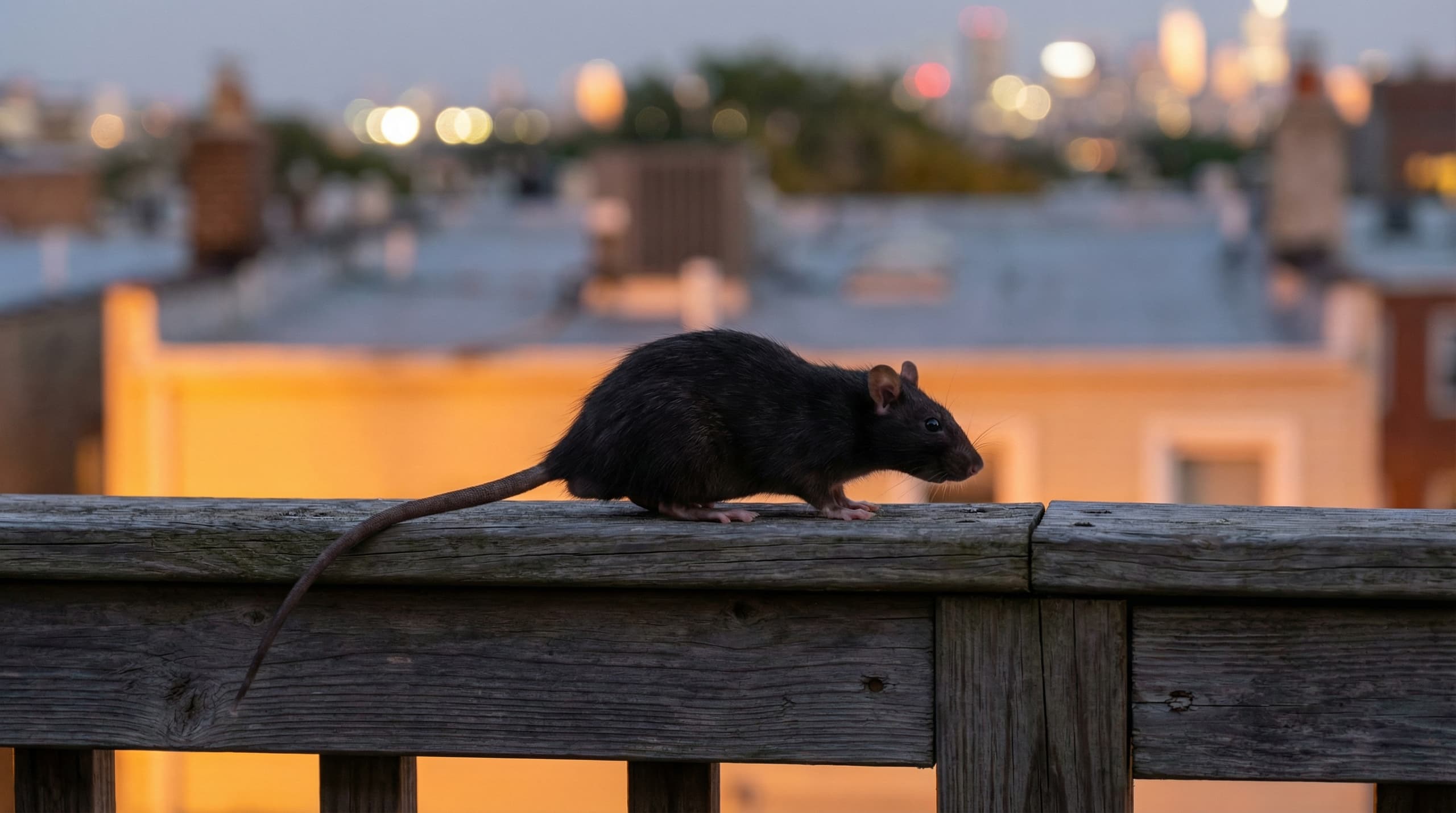
Rodent control in Boise comes down to four species: house mice in denser neighborhoods, deer mice in the rural outskirts of Eagle, Star, and Meridian, Norway rats in a handful of homes near the Boise River and commercial dumpsters, and voles tearing up lawns. Each one needs a slightly different approach, which is why a single trap strategy rarely solves a real problem.
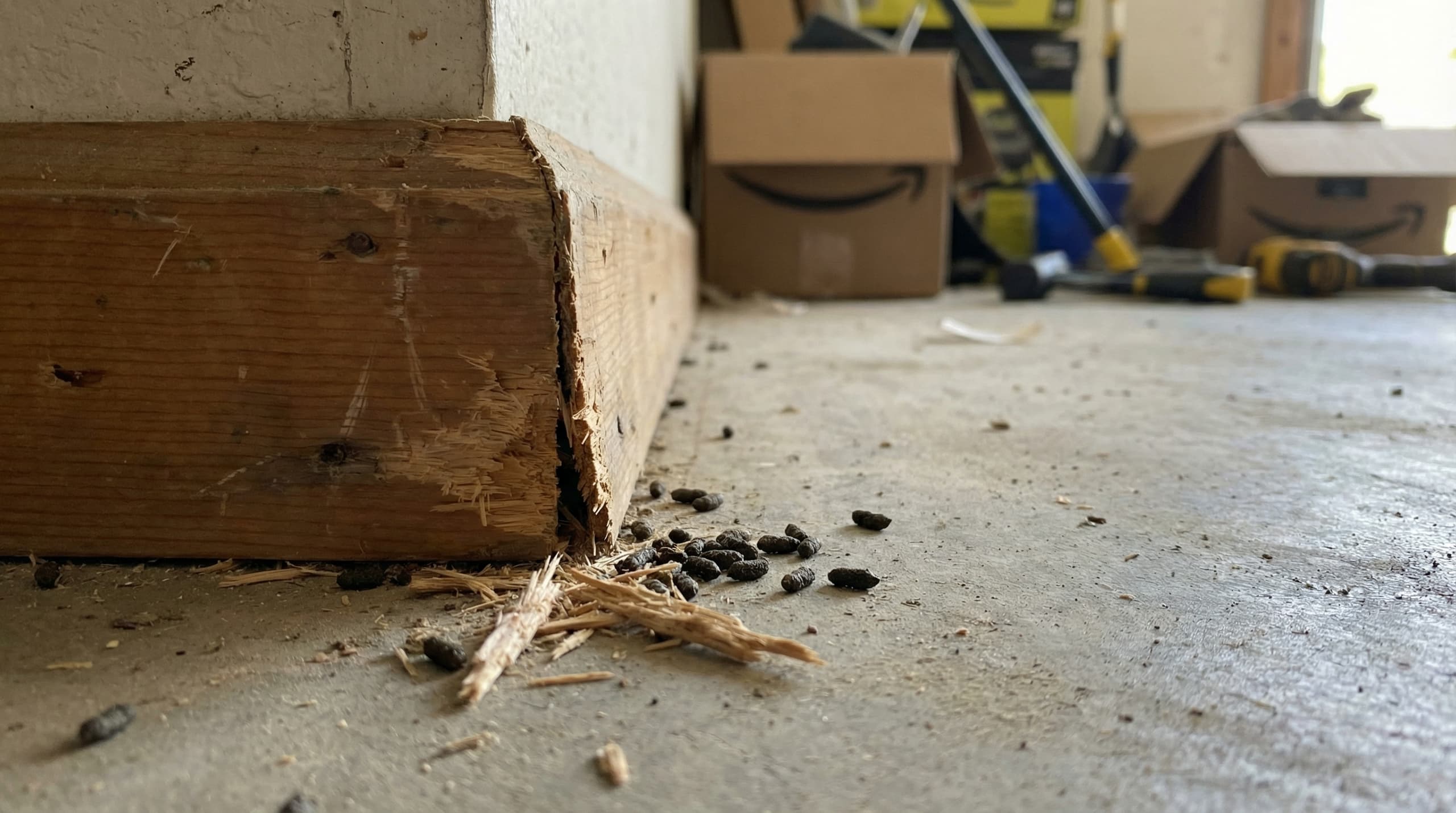
House mice are the bread and butter of Boise rodent work. They're small, gray or brown, with a mostly hairless tail and a musty odor that homeowners often notice before they see the mouse itself. They breed year-round indoors and stay close to food sources. Garages, pantries, behind appliances, under water heaters. Finding dark rice-shaped droppings along a baseboard in a Boise kitchen? It's almost always a house mouse.
Deer mice are the rural cousin. They live outdoors in brushy and wooded areas, then push into homes hard in fall and winter. Out in Star, the Eagle foothills, the rural stretches around Kuna and south Meridian, deer mice are the dominant species. You can spot them by the bicolored tail and white belly. One important detail: deer mice are the main carrier of hantavirus in Idaho. Don't sweep up dry droppings without a mask. Dampen them with a bleach solution first, then bag them.
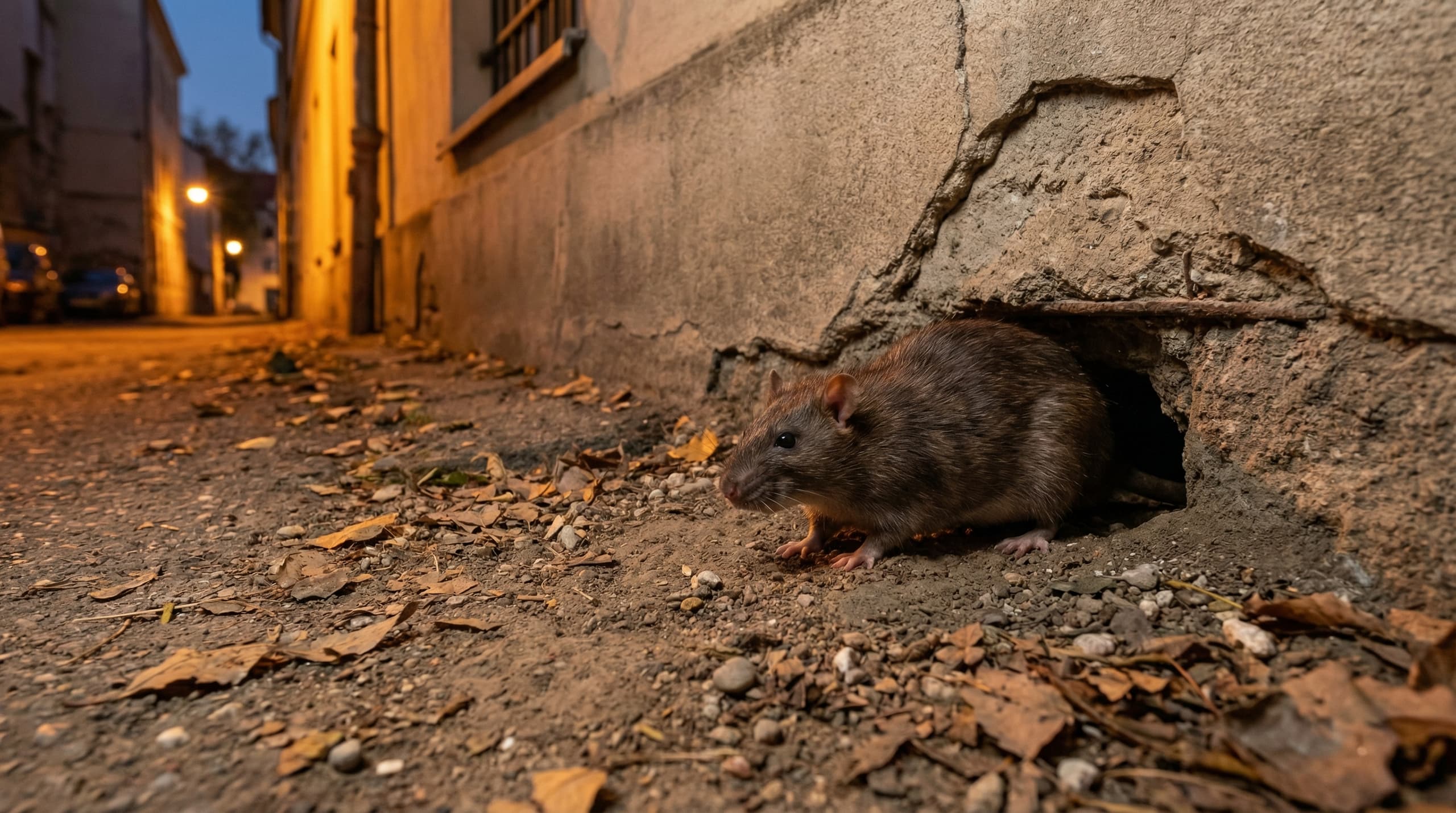
Norway rats are rare in Boise compared to coastal cities, but they do turn up. They favor the Boise River corridor, commercial dumpsters, and older neighborhoods with detached outbuildings, including parts of Nampa and Caldwell. They're big, heavy rodents that chew through softer building materials and need more aggressive trapping than mice.
Voles are the odd one out. They're not really an indoor problem at all. Voles destroy lawns by running shallow tunnels just under the turf and feeding on grass roots and bulbs. Homeowners often call after seeing the tracks in the yard come spring thaw. Vole control is exterior-only work, with targeted bait stations around the perimeter and landscape beds. At Green Guard it's usually a separate service with its own price, not part of the home plan. Another lawn pest that causes confusion is the pocket gopher, which leaves different mound signatures and peaks in damage during April through July.
If you want to dig into visual identification, our rodent identification guide for Idaho breaks down the differences with photos and size charts.
House Mouse, Deer Mouse and Norway Rat at a Glance
Size and droppings tell you which rodent you have before you ever see one.
| Rodent | What It Looks Like | Droppings | Where It Nests |
|---|---|---|---|
| House mouse | 3 to 4 inches, light brown or gray, large ears, pointed nose | About 1/4 inch, rod-shaped with pointed ends | Walls, insulation, storage boxes, undisturbed areas |
| Deer mouse | Two-toned, white belly and brown or gray back, large eyes | Similar to house mice, often in clusters | Outdoors naturally, then into structures in winter |
| Norway rat | 7 to 10 inches not counting the tail, brown or gray, small ears | About 3/4 inch, blunt ends, capsule-shaped | Burrows, basements, lower levels of structures |
House mice are curious and investigate anything new. Norway rats are cautious of new objects and are excellent swimmers and climbers.
Where Rodent Pressure Hits Hardest in the Treasure Valley
Rodent pressure is not flat across the Treasure Valley. The trigger is the foothill grass browning out, which happens well before fall. Deer mice living in the sagebrush and dry cheatgrass along the rim start moving downhill toward homes as soon as the seed heads shatter. In Highlands, Hidden Springs, and rural Eagle, that is when mice start moving, and the pressure keeps climbing into fall as temperatures drop. Here is where it hits hardest each late summer and fall:
- Boise foothill rim subdivisions. Highlands, Avimor, Hidden Springs, Somerset, and anything backing to BLM land. Deer mice come down from the foothills as the grass dries.
- Rural Eagle north of Hwy 44. Open pasture, irrigation ditches, and outbuildings drive heavy fall traffic toward attached garages.
- Kuna and south Meridian. Old dairy and ag ground turned residential. Field mice push into new subdivisions as crops get cut in September.
- Star and Middleton. Same pattern as Kuna. Rural transition zones see the heaviest pressure from late August through October.
- Older Boise neighborhoods (North End, East End, Bench, Hyde Park, Vista). House mice, not deer mice. Older foundations and crawlspaces give them access year-round, and fall drives the numbers up.
How Do You Know You Actually Have Rodents?
One dead mouse in a garage is not an infestation. A real rodent problem shows up as a pattern, not a single incident. If you've got three of the five signs below, you've moved past the random visitor stage and you've got an active population. Our detailed guide to signs of mice in your Boise home breaks down each warning sign in detail and what to do immediately if you find them.
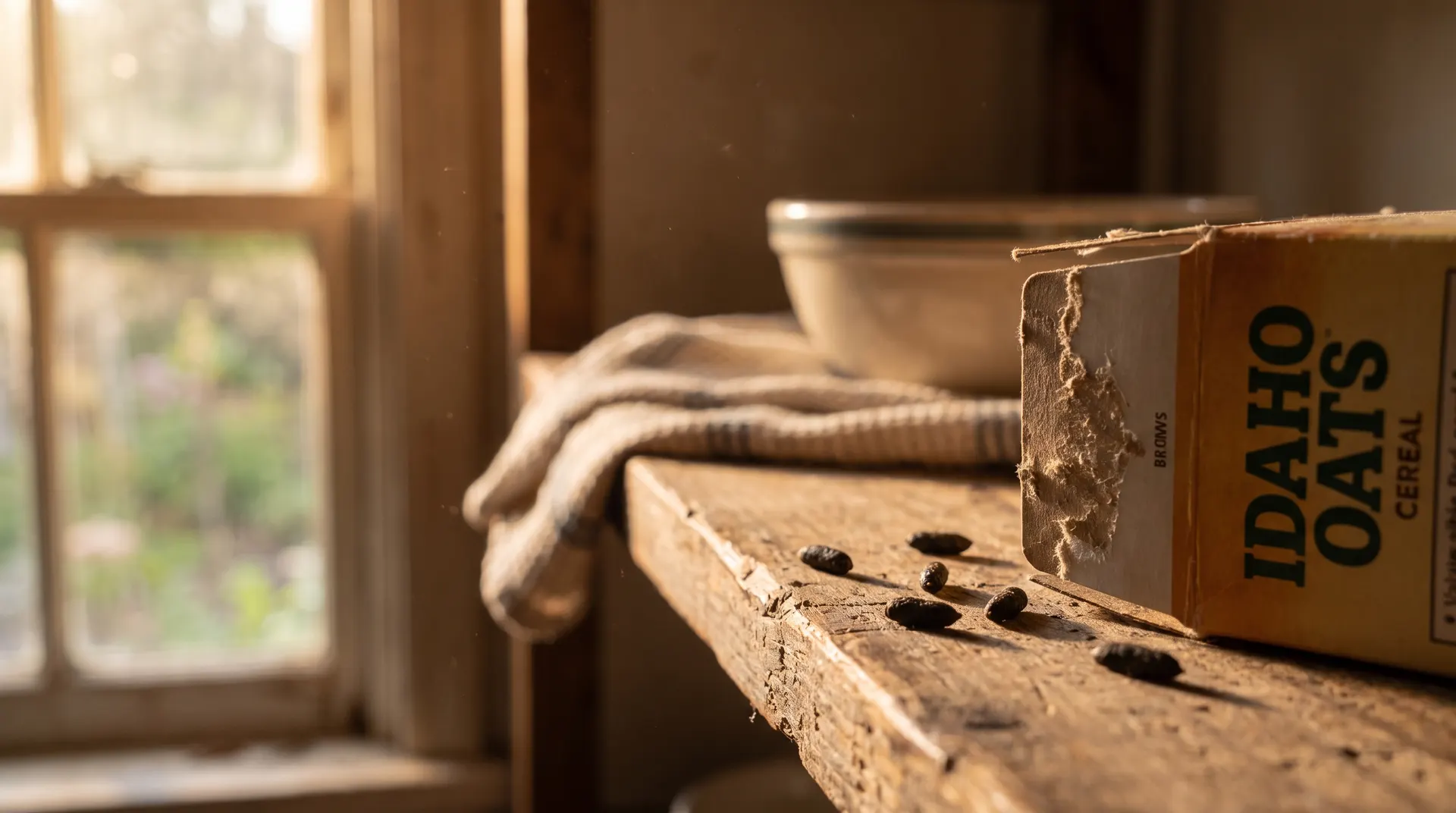
- Fresh droppings in more than one room. House mouse droppings are dark, rice-shaped, about 1/4 inch long. Fresh ones are soft and shiny. Old ones turn gray and crumble. Droppings in both the pantry AND the garage means more than one mouse.
- Gnaw marks on baseboards, cabinets, or food packaging. Rodents chew constantly to keep their teeth filed down. Small paired teeth marks on a wooden baseboard, or a clean hole chewed through a cereal bag, are dead giveaways.
- Scratching or scurrying in the walls and ceiling at night. Rodents are most active between dusk and 2 AM. Hearing movement after the house quiets down is almost never settling lumber.
- Greasy smudge marks along baseboards and pipes. Mice run the same paths over and over. Their fur leaves oily dark streaks along walls, pipes, and the lower edges of cabinets. Those streaks are highway markers.
- Your cat or dog is losing its mind in one spot. A dog staring at a specific stretch of wall, or a cat parked in front of the stove for hours, is worth taking seriously. Pets hear and smell them before you do.
Why Winter Is When Indoor Rodent Problems Get Serious
Most homeowners think of mice as a fall problem and wonder if rodents die in winter, but winter is when indoor infestations get serious. The mice and rats that came in during fall are now breeding inside walls, attics, and basements, with steady warmth and easy food, and December through February is the peak. Every winter, rodent problems still turn up across Boise, Meridian, Nampa, and Caldwell from homeowners who waited too long.
Take Away the Food and the Hiding Spots
Mice enter seeking food and stay when they find it, and they prefer cluttered, undisturbed areas for nesting. Removing both makes a home far less appealing and makes activity easier to spot.
- Store food in airtight containers. Mice chew through cardboard, thin plastic, and paper with ease.
- Secure pet food. Pick up bowls overnight and store kibble in sealed bins.
- Move bird feeders at least 20 feet from the house. Spilled seed draws mice straight to the foundation.
- Clean up fallen fruit. Outdoor food sources attract mice to the property before they find a way in.
- Use trash cans with tight-fitting lids inside and out, and empty them regularly.
- Switch to plastic storage bins. Cardboard boxes give mice nesting material and easy chewing access.
- Keep items off floors. Shelves make inspection easier, and the garage is the most common mouse entry point in Boise homes.
- Check stored items once a year for droppings, gnaw marks, and shredded nesting material.
Why DIY Store Traps Rarely Solve an Active Infestation
A pack of snap traps from the hardware store can kill a few mice. It cannot finish an active infestation. The math is brutal.
Mice breed every 3 weeks with 5 to 8 pups per litter, and those pups start breeding themselves at 6 weeks old. If you've got 20 mice in a crawlspace and your traps catch 2 per week, the colony is adding 15 to 20 new mice in that same stretch. You're running up a down escalator.
The other DIY problem is poison without sealing. A bucket of bait bricks from the hardware store will kill mice. It will also leave some of them to die inside a wall cavity where you can't reach them. Two weeks later, the smell is telling you exactly how many got in.
And neither approach does anything about the hole they used to get in. Seal nothing, and a fresh wave shows up three weeks after the first die-off, especially in fall and winter when new mice are looking for shelter. The short version is this: killing mice without sealing entry points is a temporary fix.
What Professional Rodent Control Actually Includes
Real rodent control leads with bait stations, not traps. Here's what that looks like when it's done right.
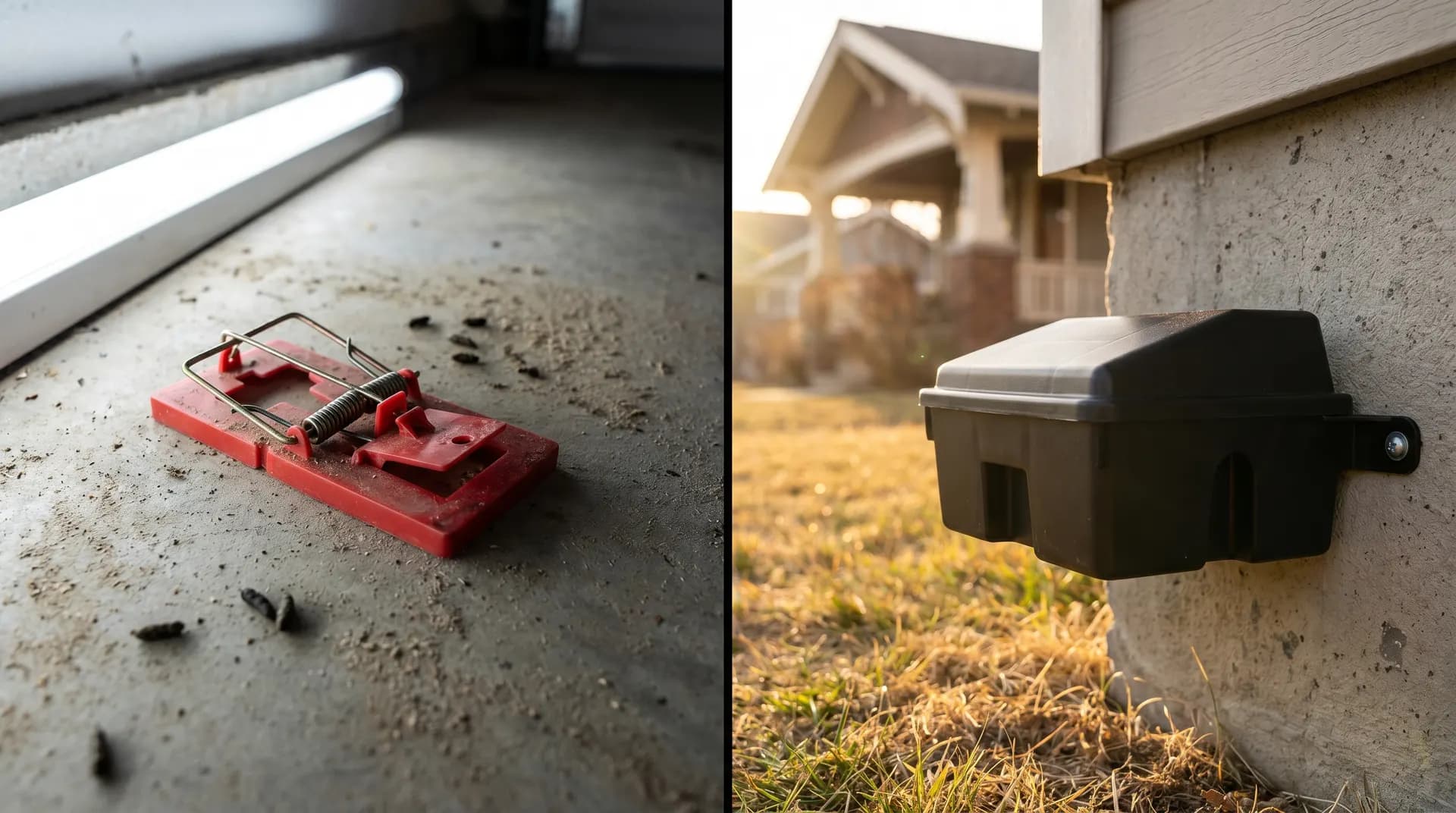
- Exterior tamper-resistant bait stations. Placed every 25 to 50 feet around the perimeter, locked, and anchored down. They pull mice out before they reach the house. Bait is contained so kids, pets, and non-target wildlife can't access it.
- Snap traps only when a situation calls for it. We use them rarely. When we do, they go where rodents actually travel: along walls, behind the stove, in the garage against baseboards. Not in the middle of the kitchen floor where the package directions say. Mice run walls, not open spaces.
- Entry-point inspection and copper mesh. Mice squeeze through gaps the size of a dime. Our techs walk the foundation, utility penetrations, garage door seals, dryer vents, weep holes, and eave soffits. Obvious gaps get packed with copper mesh as part of a comprehensive barrier treatment. Bigger repairs, like vent screens or mortar work, are a job for you or a handyman.
- Free re-service when you need it. There's no set return schedule. If you're still seeing activity, call and we come back at no charge.
- Ongoing quarterly prevention. Once the active problem's solved, quarterly exterior service keeps bait fresh and catches new pressure before it gets inside. This is how you stay rodent-free through winter.
How Green Guard Handles Rodent Control in Boise
As of August 2026, our rodent service starts with a $49 initial visit. That gets you a full property inspection, locked exterior bait stations, and copper mesh in the obvious gaps we find. Right now, before the fall push, is the highest-value moment of the year to book one. From there, quarterly service keeps the problem from coming back.
A few things that matter about how we work:
- Organic-based products. The same hospital-grade formulations we use for general pest control. Safe for kids and pets once applied.
- Same-day service is often available. An active rodent problem doesn't need to wait until next week. Call (208) 297-7947 and we usually get a tech out within 24 to 48 hours.
- Free re-service guarantee. If mice come back between your scheduled quarterly visits, we come back and retreat at no charge. Nobody should pay twice to solve the same problem.
- Local, family-owned. We are not a national franchise dispatch center. The owner runs the trucks, and you talk to a Boise team when you call. Over 2,500 Treasure Valley families have used us since we opened, with a 4.9 star average across 170-plus Google reviews.
- Full service area coverage. Boise, Meridian, Eagle, Nampa, Caldwell, Kuna, Star, Garden City, Middleton, and the surrounding Valley. Eagle residents can read more on our Eagle pest control page.
How Much Does Rodent Control Cost in Boise?
Rodent control in Boise starts with a $49 initial service at Green Guard, the same first-visit price for all home sizes. That's the lead-in to our subscription plans, which are the real answer for an active rodent problem.
Here's what ongoing service looks like after the initial visit:
- Quarterly, up to 2,500 sq ft: $119 per treatment (four visits per year).
- Quarterly, 2,501 to 4,000 sq ft: $139 per treatment.
- Quarterly, 4,001 to 5,500 sq ft: $159 per treatment.
- Bimonthly, up to 2,500 sq ft: $99 per treatment (six visits per year). A good fit for homes with ongoing rodent pressure, like rural properties near open fields.
- One-time service, up to 2,500 sq ft: $200 flat, with a 30-day warranty. Not a real fix for an active infestation, but it works for a single incident.
Green Guard Plan Prices at a Glance
| Plan | Home size | Price |
|---|---|---|
| Initial Service with a quarterly or bimonthly plan | Any home size | $49 |
| Quarterly Service | Up to 2,500 sq ft | $119 |
| 2,501 to 4,000 sq ft | $139 | |
| 4,001 to 5,500 sq ft | $159 | |
| Bimonthly Service | Up to 2,500 sq ft | $99 |
| 2,501 to 4,000 sq ft | $119 | |
| 4,001 to 5,500 sq ft | $139 | |
| One-Time Service | Up to 2,500 sq ft | $200 |
| 2,501 to 4,000 sq ft | $225 | |
| 4,001 to 5,500 sq ft | $250 |
How Long Until the Mice Are Actually Gone?
Most Treasure Valley rodent infestations clear in 2 to 3 weeks once a proper plan is in place. Here's how the timeline usually plays out inside a typical Boise home with an active problem:
- Day 1 to 7. Bait stations hit the active population hard. Scratching in the walls at night tapers off fast.
- Day 7 to 14. Activity drops by half or more. Droppings in the main living areas stop appearing fresh. You might still hear occasional movement as the last few forage.
- Day 14 to 21. Activity hits zero in most homes. Copper mesh in the obvious gaps makes it harder for stragglers outside to get back in.
- Beyond day 21. Still seeing activity? We come back and dig deeper, free of charge thanks to the re-service guarantee. Usually it's a missed entry point, like a gap at a crawl space vent or an attic soffit, that still needs to be closed off.
Health Risks Rodents Bring Into a Home
Rodent infestations present real health risks, which is one more reason to act early.
- Hantavirus. Carried by deer mice, potentially fatal, and spread by breathing contaminated dust.
- Salmonella. Spread when droppings contaminate food surfaces.
- Allergens. Rodent urine and dander trigger allergies and asthma.
- Contamination. Food and food preparation surfaces are the biggest exposure point.
- Secondary pests. Rodents carry fleas, ticks, and mites into homes.
Safe Cleanup Steps After Rodents
Follow these steps for any significant rodent activity, and call a pro for a bigger infestation.
- Do not vacuum or sweep droppings. That puts pathogens in the air.
- Ventilate the area. Open windows for 30 minutes before cleaning.
- Wear gloves. Rubber or plastic gloves work.
- Spray with disinfectant. Soak the droppings thoroughly before wiping.
- Wipe with paper towels and dispose of them in a sealed bag.
- Disinfect the area with a mop or wipe and disinfectant solution.
- Wash hands thoroughly after removing the gloves.
What We Don't Handle (Call a Wildlife Specialist)
Mice and rats inside your home are covered by the plan. Voles, and rats that live only outside, fall under a separate yard service with its own price. That's it on the mammal side. A few things that are not in our wheelhouse, so you know when to call someone else:
- Squirrels and gophers. That covers the red squirrels and ground squirrels common in the Boise foothills, plus pocket gophers in the lawn. Those go to a wildlife specialist or a gopher trapper.
- Raccoons. Especially ones in attics or crawlspaces. They require trapping and relocation under Idaho Fish and Game rules.
- Bats. Idaho has several protected bat species. Getting bats out of a home needs a permitted wildlife company.
- Skunks, opossums, and larger mammals. Not something we treat.
- Termites and bed bugs. Different pest class entirely. We don't do either, and we'll refer you to a specialist if you call us about them.
Ready to Get Ahead of Fall Rodent Season?
August is the window. Every week you wait pulls the calendar closer to the first cold snap, and the first cold snap is when scattered mice turn into a wall-scratching problem. Call us at (208) 297-7947 and we can walk your foundation this week. The $49 first visit on a quarterly or bimonthly plan includes the full inspection, locked exterior bait stations, and copper mesh in the obvious gaps.
Same-day service is often available, and we usually get a technician to your door within 24 to 48 hours. Free re-service between visits if mice come back. And you talk to a local Boise team, not a call center three states away.
For more on our approach, see our main rodent control service page, or read our Idaho rodent identification guide. The winter and cleanup sections above cover the cold-season side.
Frequently Asked Questions
How much does rodent control cost in Boise?
Quick answerGreen Guard's rodent control starts with a $49 initial service, which includes a full property inspection, locked exterior bait stations, and copper mesh in the obvious gaps.
Ongoing quarterly service is $119 per treatment for homes up to 2,500 sq ft, $139 for 2,501 to 4,000 sq ft, and $159 for 4,001 to 5,500 sq ft. Bimonthly plans run $99 per treatment for the smallest tier. One-time service without a subscription is $200 to $250 by home size, with a 30-day warranty. A year of quarterly protection costs less than three emergency one-time visits, which is why quarterly service makes sense for any home with a rodent history.
What keeps mice out of a house in Idaho?
Quick answerThree things, in this order.
First, seal every exterior gap larger than a No. 2 pencil (about 1/4 inch) using copper mesh or stainless steel wool packed tight, then caulked over. Foam alone will not hold. Second, remove the outdoor food and shelter that draws them close, meaning firewood stacked 20 feet from the house, grass seed sealed in metal cans, and pet food off the porch. Third, run a quarterly exterior bait station route so any mouse that scouts your foundation dies before it finds a way in. Sealing plus baiting is the combination that actually keeps a Boise home rodent-free through winter.
When should you start rodent prevention in Boise for fall?
Quick answerAugust is the ideal window in the Treasure Valley.
Overnight lows drop into the mid-50s around the first or second week of September, and that is the temperature threshold that pushes house mice and deer mice toward indoor shelter. Sealing entry points in August (before the push) is roughly a third of the cost and time of trapping in October (after the push). If you missed August, September still works, but the biology is working against you every night that gets colder.
Does Boise have a rat problem?
Quick answerNot on the scale of coastal cities like Seattle or Portland, but yes, Norway rats do turn up in specific Boise micro-zones.
The most common spots are along the Boise River greenbelt corridor, near commercial dumpsters in Garden City and downtown, and in older Nampa and Caldwell neighborhoods with detached outbuildings. Most residential rodent calls in the Valley are still house mice or deer mice. If you are seeing large droppings (over 1/2 inch) or hearing heavier movement, that is when we switch to larger, rat-sized bait stations.
Are your rodent baits safe for kids and pets?
Quick answerYes.
We use tamper-resistant, locked exterior bait stations that kids and pets cannot access. In the rare case a snap trap makes sense, it goes behind an appliance or somewhere else pets do not reach. Our general pest products are organic-based and hospital-grade, the same ones used in daycares and hospitals. Tell us about pets or small kids at the inspection and we adjust placement accordingly.
Will I hear dead mice in my walls after treatment?
Quick answerSometimes, and we will not promise you absolutely will not.
Exterior bait is the first line of defense, and it's what we lead with. Any smell is typically gone in 1 to 3 weeks. If you are sensitive to that, tell us upfront and we'll talk through whether snap traps make sense for your home. We use them rarely, but this can be one of those times.
Can you come out the same day for a rodent problem?
Quick answerYes, same-day service is often available, and we usually get a technician out within 24 to 48 hours.
Do you handle squirrels, raccoons, or bats?
Quick answerNo.
Squirrels (tree or ground), raccoons, bats, skunks, and other nuisance wildlife need a licensed Idaho wildlife specialist. Mice and rats inside the house are covered by your plan, and voles or rats living only outside are handled as their own yard service, priced separately. Not sure what you have? Call us at (208) 297-7947 and we tell you who to call on the phone, no appointment needed.
Is it worth hiring a rodent control company in Boise?
Quick answerYes, once you have a confirmed active infestation.
Mice breed every 3 weeks with 5 to 8 pups per litter, so a DIY trap plan that pulls out 2 mice a week loses ground to a colony adding 15 to 20. Professional service pairs locked bait stations with copper mesh in the obvious entry gaps. Green Guard's $49 first visit on a quarterly or bimonthly plan covers both. Quarterly follow-up at $119 for homes up to 2,500 sq ft costs less than three one-time visits over a year. For a random mouse in the garage, DIY snap traps are fine. For scratching in the walls, hiring out is the cheaper answer.
Is rodent-proofing worth it?
Quick answerYes.
In Idaho, where deer mice carry hantavirus and a single chewed wire can start an electrical fire, prevention costs a fraction of one mouse problem left to run. A quarterly plan with locked exterior bait stations and copper mesh in the obvious gaps beats reactive trapping on money, time, and stress.
What material can mice not climb?
Quick answerMice cannot climb clean vertical smooth metal, glass, glazed tile, or new PVC pipe.
Everything else on a typical house (brick, stucco, wood siding, vinyl siding, stone veneer, Hardie board) gives them enough grip to walk straight up, and they can reach roof vents and soffits. That is why rat guards are smooth metal cones. For your home, assume mice can reach any point up to about 8 feet without effort.
How do mice get into my house?
Quick answerMice can squeeze through gaps as small as 1/4 inch, about the width of a pencil.
Common entry points include garage door seals, utility line entries, foundation cracks, gaps around doors, and soffit and fascia gaps. A careful walk around the property often turns up entry points homeowners never suspected.
Are mice in Idaho dangerous?
Quick answerYes.
Beyond property damage and food contamination, deer mice in Idaho can carry hantavirus, a potentially fatal respiratory illness, so any rodent problem deserves prompt attention. For a bigger infestation, bring in a pro for the mice and wet droppings down with disinfectant before wiping them up. Never vacuum or sweep dry droppings.
Why do traps stop catching mice?
Quick answerSeveral things can change trap results.
Mice become trap-shy after failed captures, bait goes stale, placement may not match their travel patterns, or the population outgrows what traps can handle. A professional assessment identifies why DIY efforts are stalling.
Are electronic mouse repellents effective?
Quick answerScientific studies have consistently shown that ultrasonic and electromagnetic repellent devices do not work on rodents, and scent products such as peppermint oil fade within days.
Locked bait stations and copper mesh in the obvious gaps are the proven approach.
Sources
Green Guard call and web request log, Jul to Sep 2026; Green Guard call and web request log, Apr to Jun 2026