
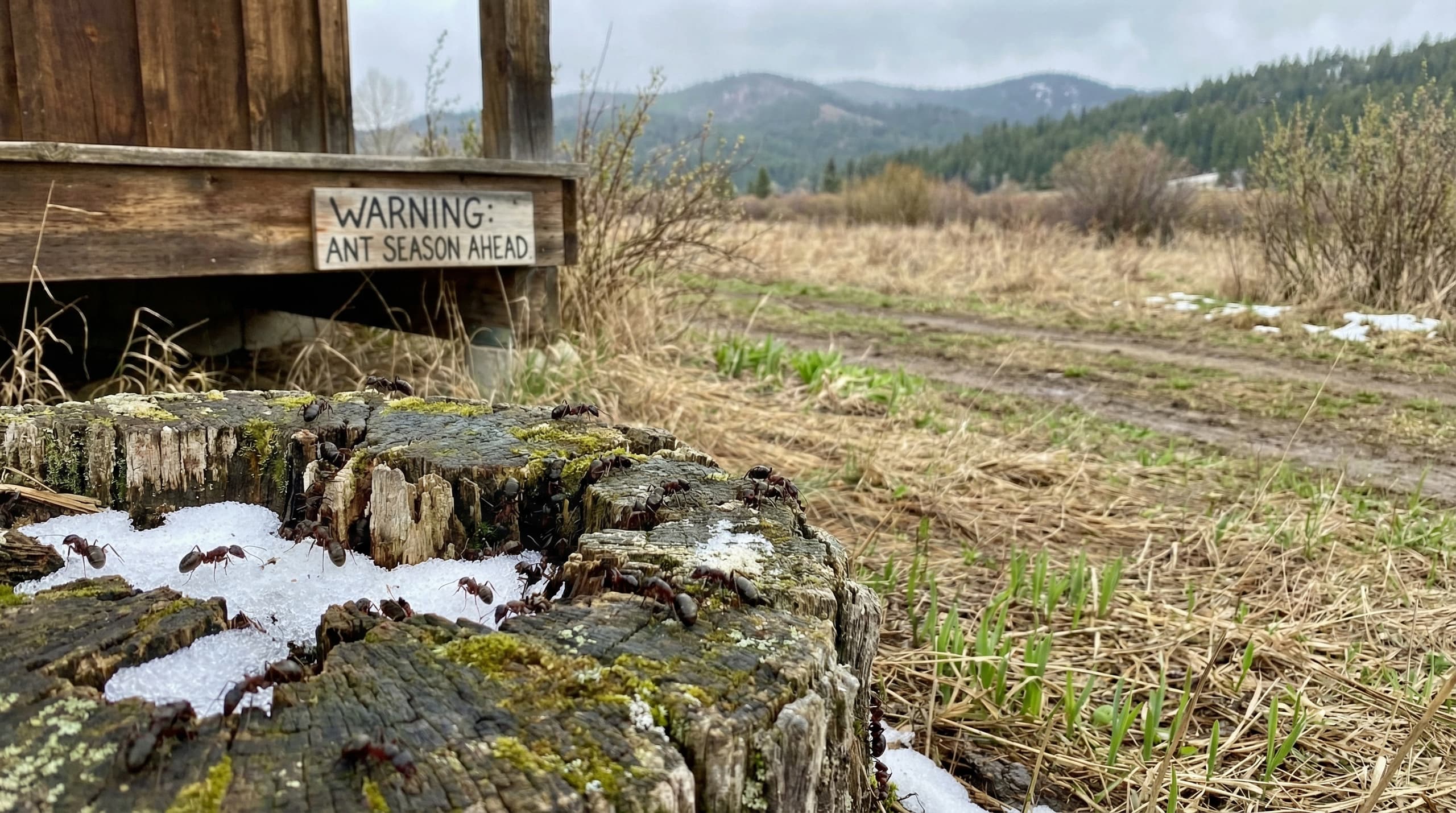

Key Takeaways
- 1Carpenter ants emerge in March when wall temperatures warm - indoor sightings mean a colony is likely present
- 2Large black ants (1/4 to 1/2 inch) with smooth thorax are carpenter ants - not common house ants
- 3Sawdust-like piles (frass) near wood indicate active excavation and structural damage
- 4Flying carpenter ants (swarmers) indoors in spring confirm an established, mature colony
- 5Professional treatment is essential - DIY methods don't reach hidden colonies. $49 to start, $119/quarter.
Why Carpenter Ants Emerge in March
March brings a significant change to Idaho's pest landscape. As exterior temperatures climb above freezing during the day and interior wall temperatures warm from heating, carpenter ant colonies that have been dormant begin to stir. This is the time when homeowners often first discover they have a serious problem.
Carpenter ants don't appear out of nowhere in March - they've likely been in your home since the previous year. The warming temperatures simply trigger increased activity, bringing workers into visible areas as they resume foraging and colony expansion.
How to Identify Carpenter Ants
Carpenter ants are Idaho's largest ant species and are often confused with other ants or even termites. Accurate identification is critical because treatment approaches differ significantly:
Physical Characteristics
- Size: Large - 1/4 to 1/2 inch long (much larger than common house ants)
- Color: Usually solid black, though some species are reddish-brown or bicolored
- Body shape: Single node (waist segment), evenly rounded thorax when viewed from side
- Antennae: Elbowed (bent) antennae
- Workers: Vary in size within the same colony (polymorphic)
Carpenter Ants vs. Termites
While termites are less common in Idaho than other regions, carpenter ants cause similar structural damage. Don't dismiss large ants as "just ants" - they may be causing significant damage.
Understanding the difference is important for treatment:
- Waist: Carpenter ants have a pinched waist; termites have a broad waist
- Antennae: Carpenter ant antennae are elbowed; termite antennae are straight
- Wings: If winged, carpenter ants have larger front wings; termite wings are equal size
- Galleries: Carpenter ant galleries are smooth and clean; termite galleries are rough with mud
- Frass: Carpenter ants leave sawdust-like debris; termites leave mud tubes
Early Warning Signs of Carpenter Ant Infestation
Flying carpenter ants (swarmers) appearing inside your home in March is a serious sign. It indicates a mature colony - typically 2+ years old - has established in your structure. This requires immediate professional treatment.
Detecting carpenter ants early prevents extensive damage. Watch for these signs, especially in March:
- Large black ants indoors - Especially on warm days when you're not seeing them outside
- Sawdust piles (frass) - Fine, sawdust-like material appearing near wood surfaces
- Rustling sounds in walls - Audible movement, especially at night
- Flying ants indoors - Winged reproductives (swarmers) indicate a mature colony
- Damaged wood - Galleries that are smooth and clean, following the wood grain
- Shed wings - Near windows, doors, or light sources from swarming activity
Where Carpenter Ants Nest in Idaho Homes
Carpenter ants often maintain satellite colonies connected to a main colony. The ants you see may be traveling from one nest to another. Professional treatment must address all colony locations.
Carpenter ants prefer moist, damaged wood but will excavate sound wood as colonies grow. Common nesting locations include:
- Window and door frames - Especially those with water damage or condensation
- Wall voids - Behind siding, particularly near moisture sources
- Roof areas - Under damaged shingles or near clogged gutters
- Around plumbing - Beneath sinks, around tubs, near leaky pipes
- Deck and porch structures - Where wood contacts soil or traps moisture
- Foam insulation - They readily tunnel through foam board insulation
The Structural Damage Carpenter Ants Cause
A mature carpenter ant colony can contain 10,000-50,000 workers. At this size, structural damage accelerates rapidly. The cost of early treatment is a fraction of the cost of structural repairs.
Unlike termites, carpenter ants don't eat wood - they excavate galleries for nesting. However, the damage is just as serious:
- Progressive damage - Colonies grow annually, expanding galleries continuously
- Hidden destruction - Damage often hidden until severe, as they work from inside out
- Structural weakening - Weight-bearing members can be compromised
- Repair costs - Typically $500 to $5,000+, depending on extent
- Moisture spread - Their galleries can allow water infiltration, causing additional damage
March Prevention and Control Strategies
If you haven't seen signs of carpenter ants, March is the ideal time for prevention:
Prevention Steps
- Address moisture problems - Fix leaky pipes, improve drainage, repair roof issues
- Replace damaged wood - Remove and replace any water-damaged or rotting wood
- Eliminate wood-to-soil contact - Ensure siding, deck posts, and structures don't touch soil
- Trim vegetation - Keep shrubs and trees from touching your home
- Move firewood - Store at least 20 feet from your home, elevated off ground
- Seal entry points - Caulk cracks and gaps around the foundation
Why DIY Carpenter Ant Treatment Fails
Store-bought products consistently fail against carpenter ants for several reasons:
- Hidden colonies - Sprays kill visible ants but don't reach the colony in your walls
- Multiple nests - Satellite colonies may exist in several locations
- Colony budding - Some products cause colonies to split, creating multiple infestations
- Queen protection - Workers protect the queen; she must be eliminated for true control
- Misidentification - Wrong products used because species wasn't properly identified
Professional Carpenter Ant Treatment
Green Guard carpenter ant treatment is just $49 to start your service. Quarterly treatments at $119 provide ongoing protection. If carpenter ants return between visits, we re-treat at no additional charge. Call (208) 297-7947 for same-day service.
Effective carpenter ant control requires professional expertise:
- Thorough inspection - Locating all colony sites, not just visible activity
- Species identification - Confirming carpenter ants vs. other large ant species
- Targeted treatment - Professional products that reach hidden colonies
- Satellite colony elimination - Addressing all connected nesting sites
- Prevention barriers - Exterior treatment to prevent re-infestation
- Follow-up monitoring - Ensuring complete colony elimination
When to Call a Professional Immediately
Every day of delay allows more structural damage. Carpenter ant colonies work continuously once active. The ants you see represent a fraction of the colony in your walls. Call (208) 297-7947 immediately.
Contact Green Guard immediately if you observe:
- Large black ants indoors during March - Don't wait to see more
- Sawdust piles appearing - Active excavation is occurring
- Flying ants inside your home - Mature colony confirmed
- Rustling sounds in walls - Audible colony activity
- Multiple ants over several days - Not an isolated incident
Need Professional Help?
Get Same-Day Pest Control in Boise
Our local experts are standing by. Guaranteed results or we re-treat for free.