Quick answer
Paper wasps in Idaho are slender, brown-and-yellow wasps with dangling legs in flight. They build open, umbrella-shaped nests under eaves, pergolas, and inside vents. In May, a colony is one queen and a quarter-sized nest. By late July it is 30 to 75 wasps and ten times harder to treat. Treat early or call Green Guard at (208) 297-7947 for $49 initial service.
Key Takeaways
- Paper wasps are brown-and-yellow with long legs that dangle below them in flight. That dangling-leg flight is the field tell.
- Nests are open umbrellas with visible cells, not the wrapped paper footballs that bald-faced hornets build.
- A May nest in Boise is one queen and 10 cells. A late-July nest is 30 to 75 wasps and ten times harder to treat.
- DIY removal works at dusk for early, small nests. Call a pro once a nest hits golf-ball size or you see 10+ wasps on it.
- Green Guard treats paper wasps across the Treasure Valley starting with a $49 first service and a free re-service guarantee.
In this article

What Paper Wasps Look Like in Idaho
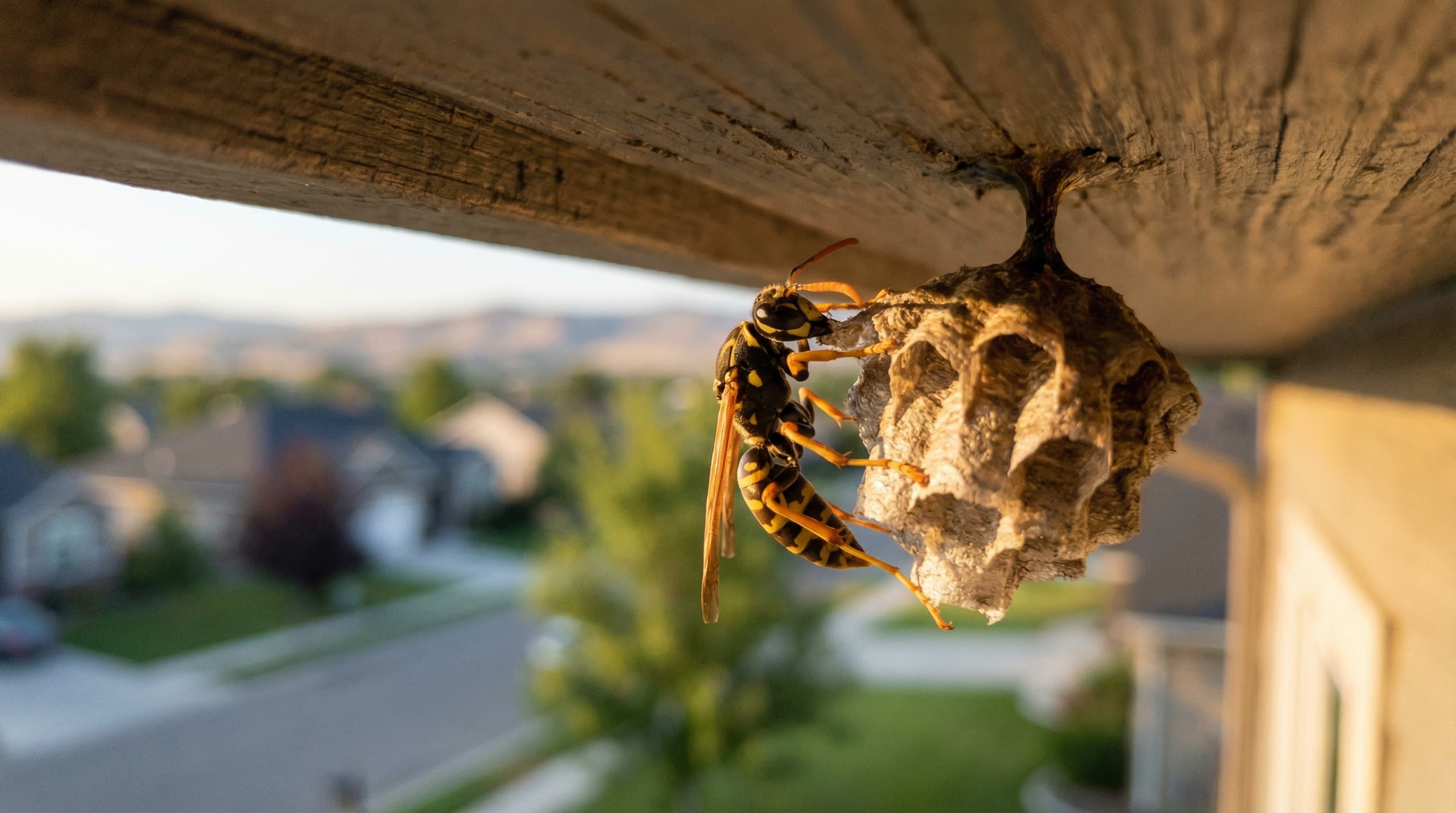
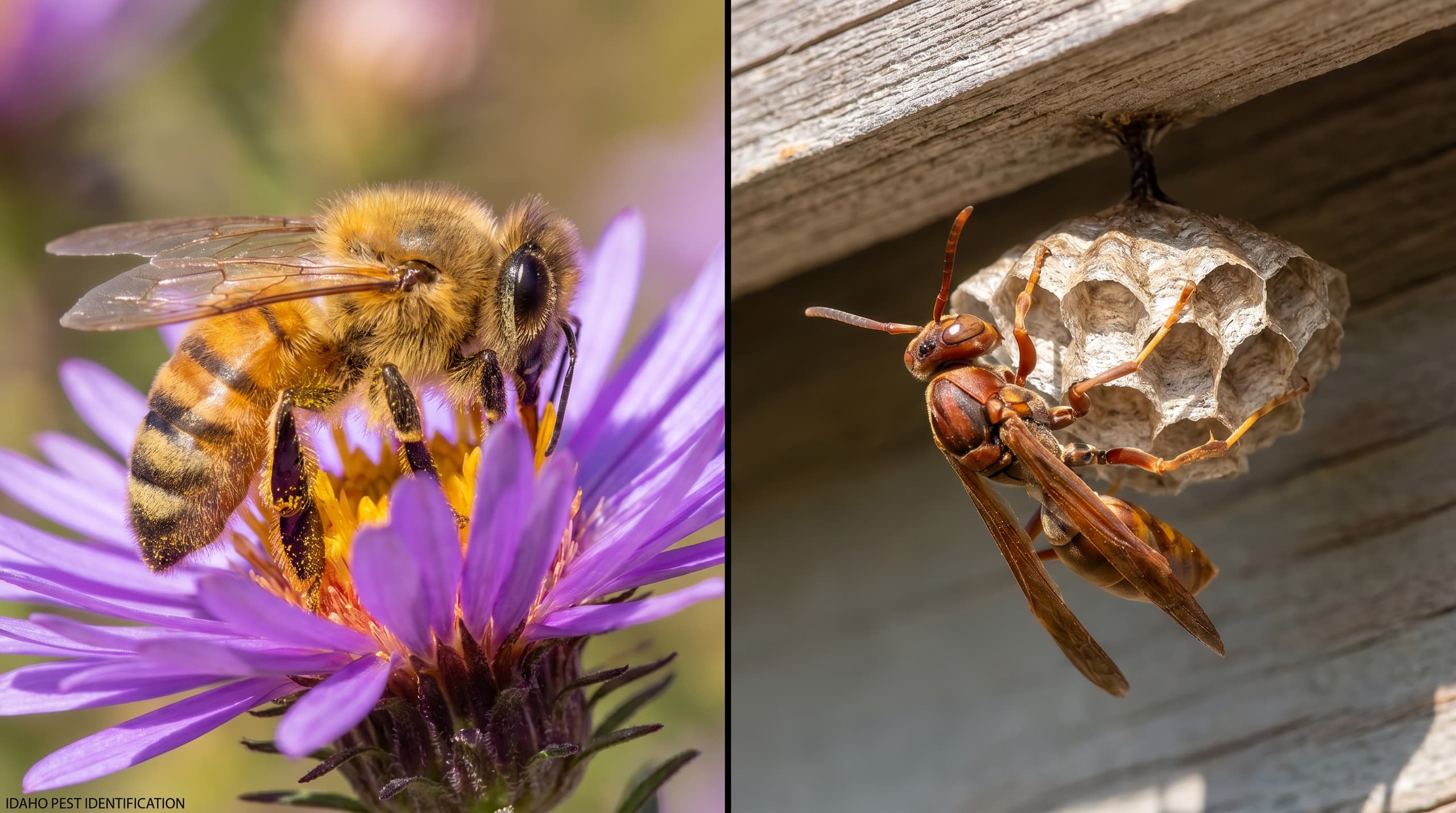
Paper wasps are slender, brown-and-yellow wasps with long legs that dangle below them in flight. That dangling-leg flight pattern is the easiest way to spot one from across the yard. Idaho is home to about half a dozen Polistes species, and Treasure Valley homeowners see them every May through September. Not sure it is a wasp at all? Bees are fuzzy with rounded bodies, and wasps are smooth with pinched waists, as our bee vs wasp guide shows side by side.
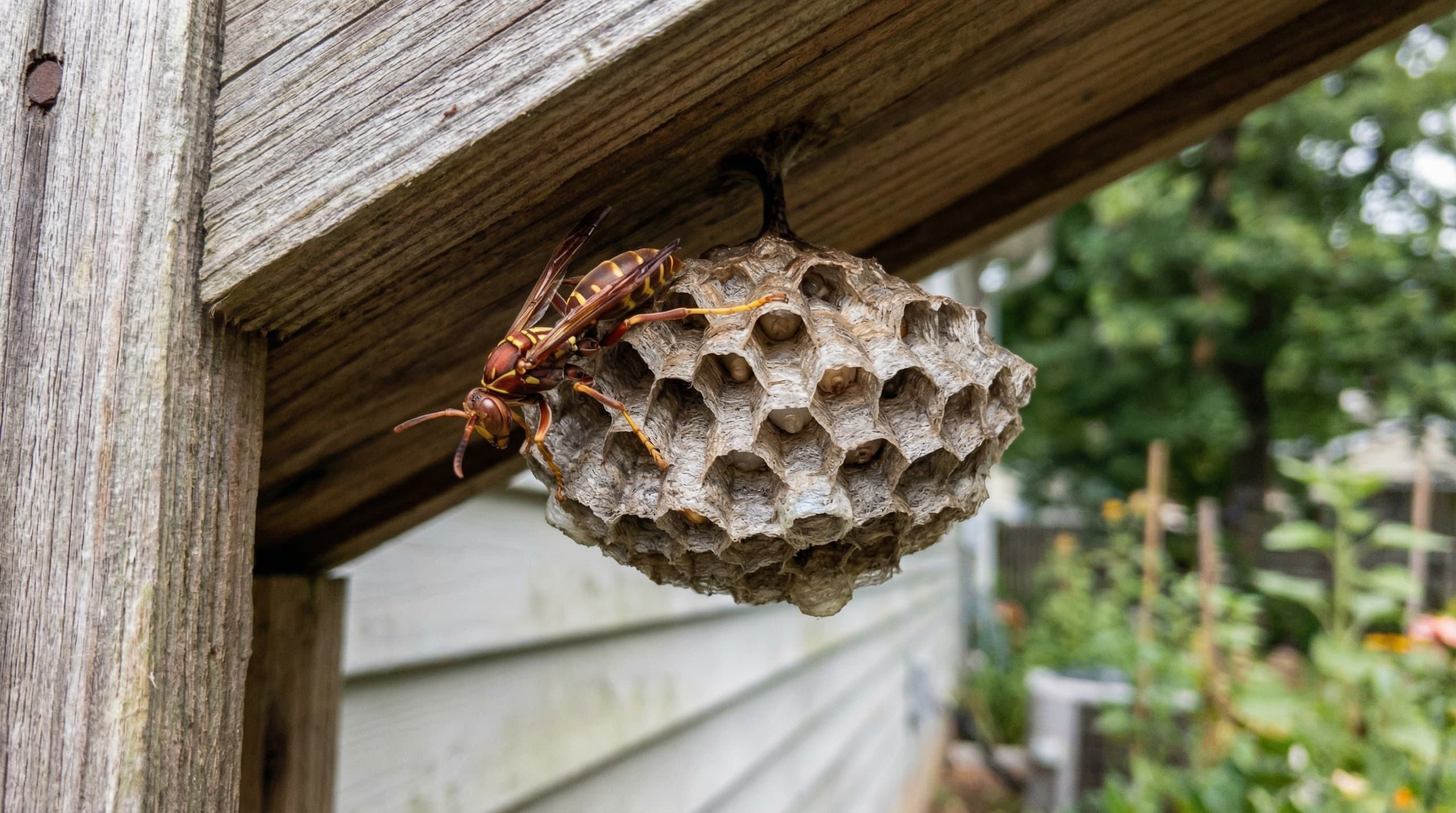
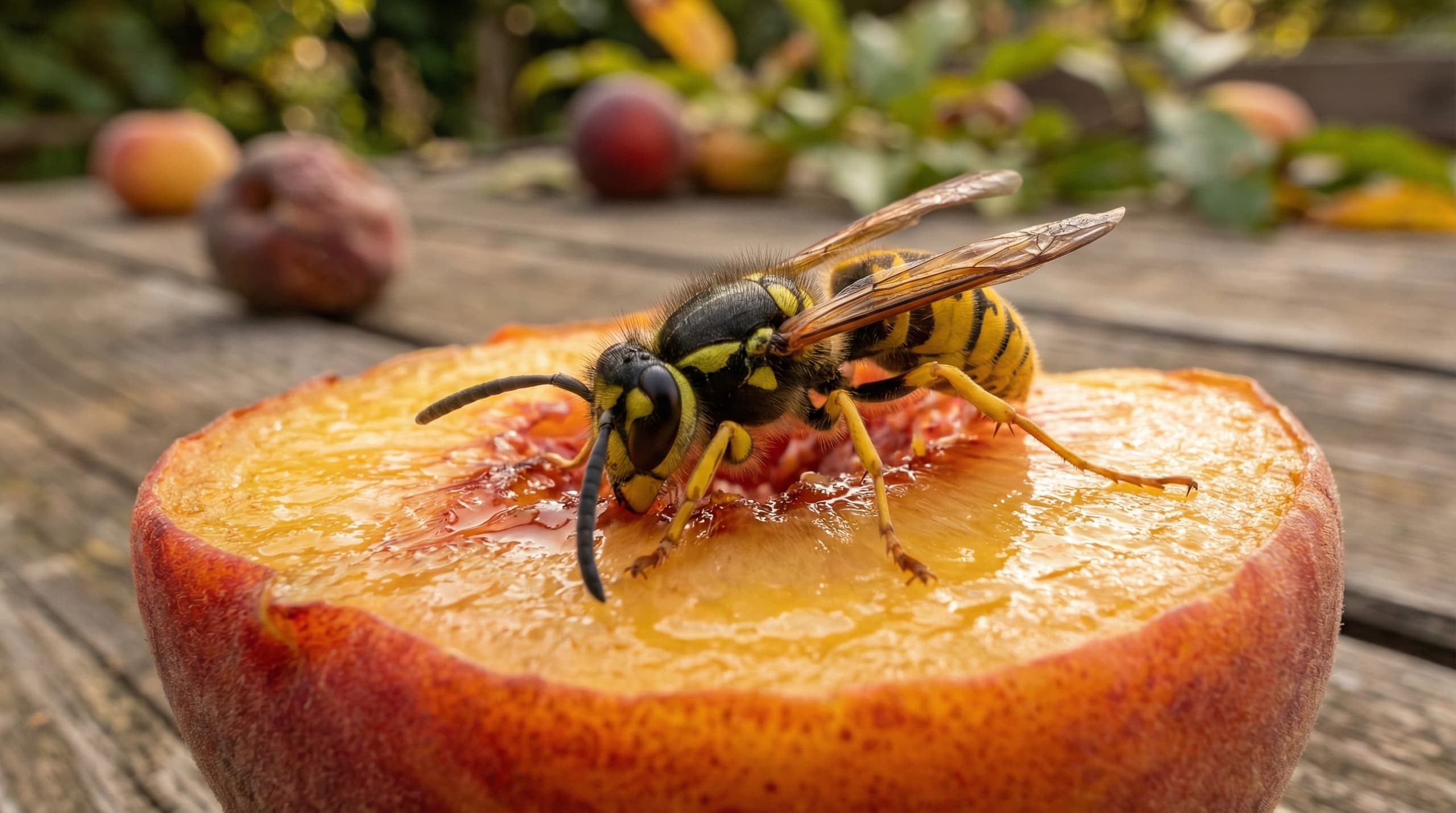
Up close, a paper wasp looks nothing like the yellow jacket people often confuse it with. The body is reddish-brown with thin yellow rings, and the waist is sharply pinched. The wings fold lengthwise along the back when the wasp lands. Flight is slow and floaty, not the tight zigzag of a yellow jacket.
The three species we identify most often around Boise, Meridian, and Eagle homes are the northern paper wasp (Polistes fuscatus), the European paper wasp (Polistes dominula), and the golden paper wasp (Polistes aurifer). The European species is the one most people see. It's the bright yellow-and-black one homeowners start noticing in May. In much of the West, the European paper wasp has overtaken the native species.
Paper Wasp Nests: The Umbrella Tell
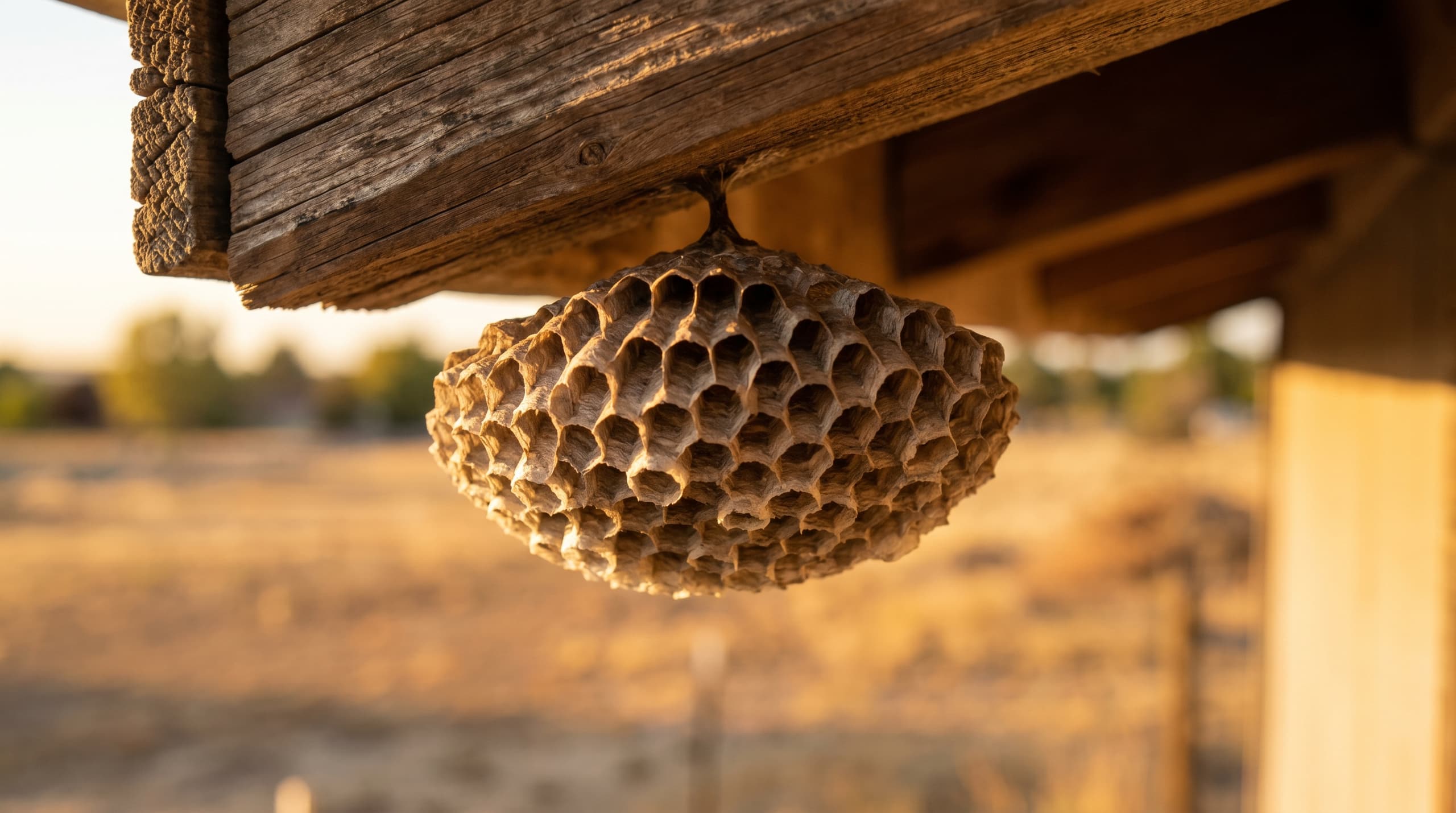
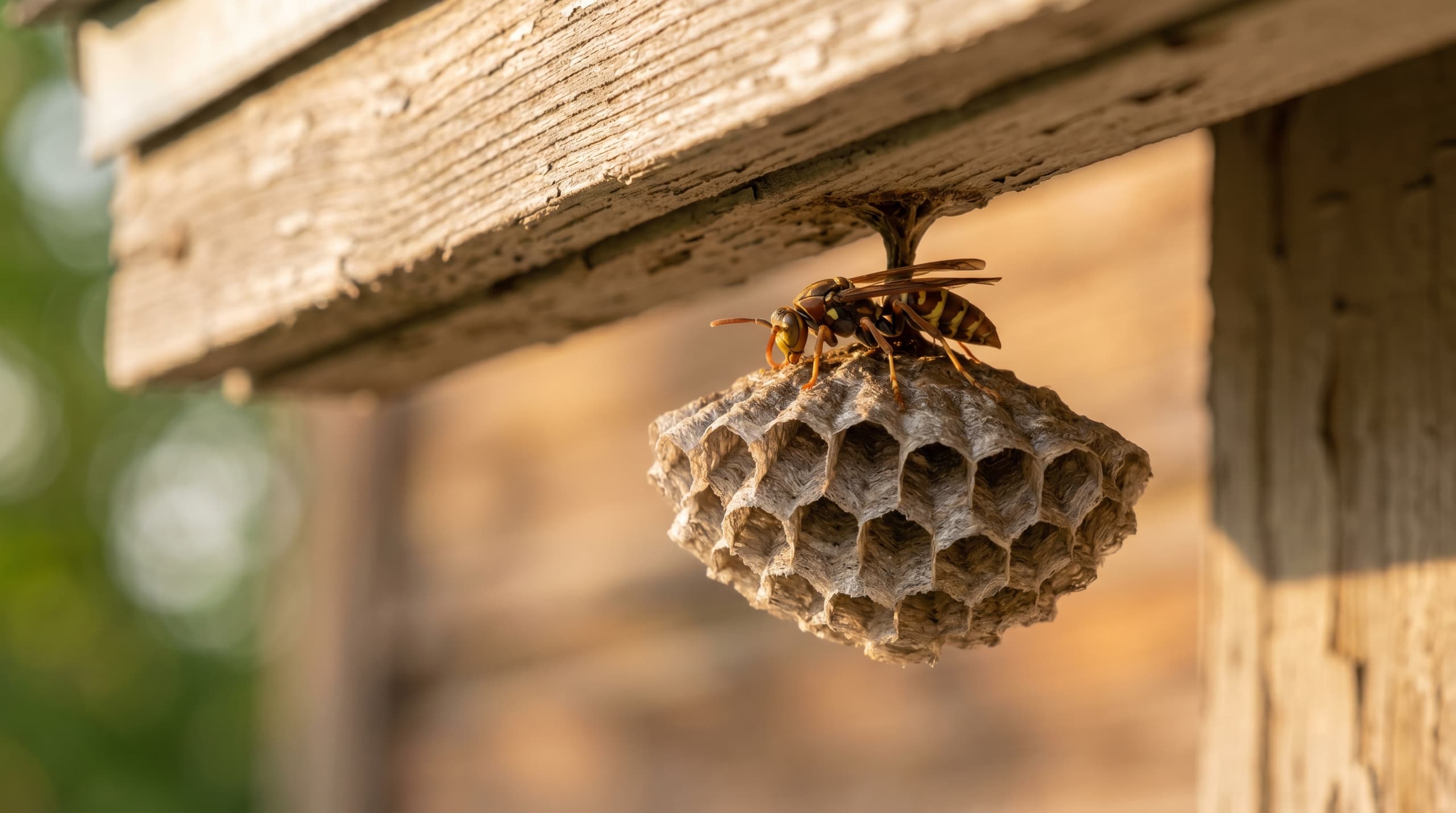
The nest is the other dead giveaway. Paper wasps build open-cell, umbrella-shaped nests that hang from a single stem. Look straight up from below and you can see right into every cell. There's no outer paper shell wrapping the whole thing.
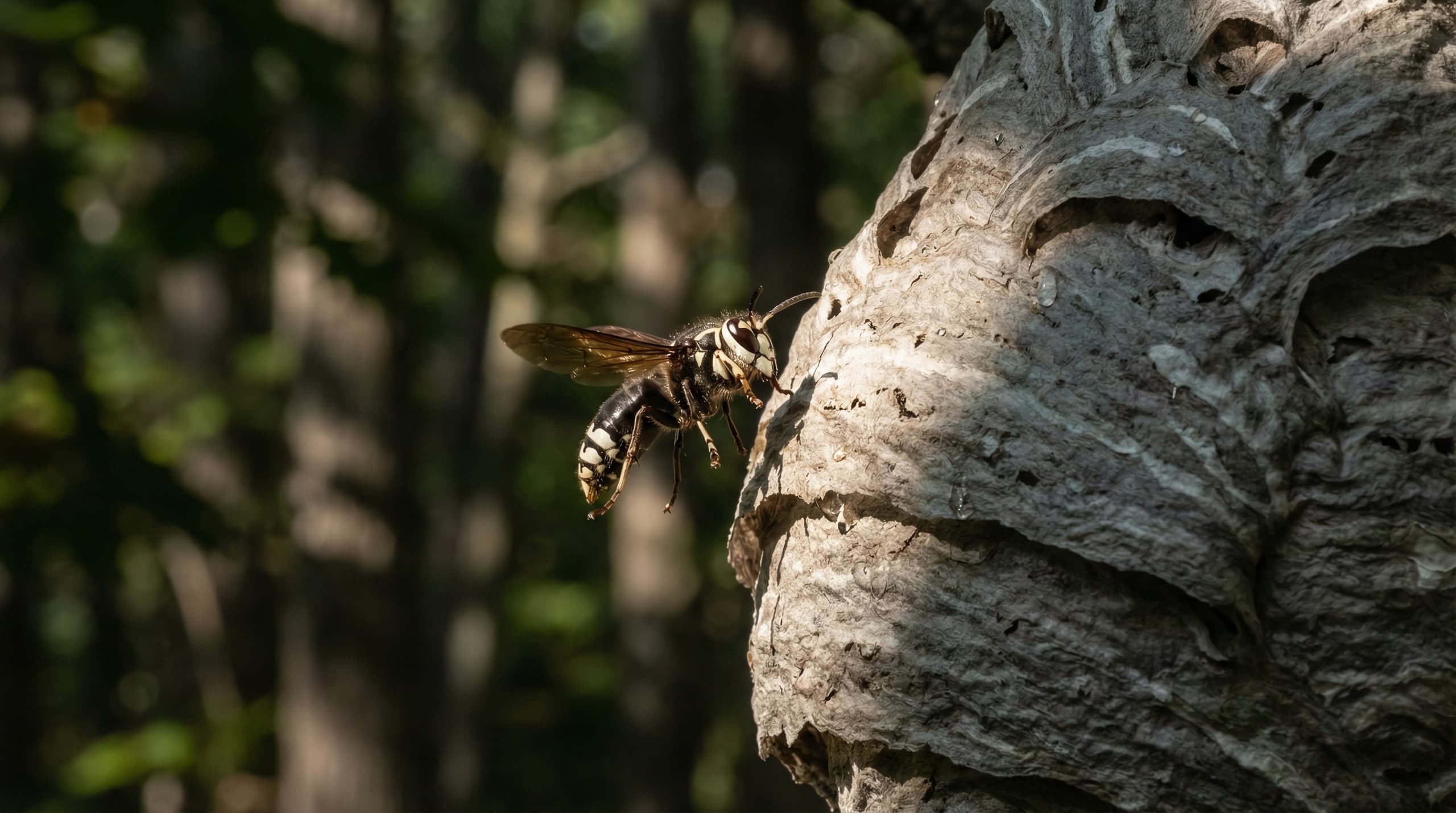
That's the key difference from bald-faced hornets and yellow jackets, which both build closed paper envelopes around their nests.
- Under second-story eaves and soffits. The classic spot for paper wasp nests on Boise homes
- Behind shutters and inside louvered vents. Easy to miss until you hear them inside the wall
- Under pergolas, patio covers, and deck railings. Common in Eagle and Meridian backyards
- Inside open garden sheds and pump houses. Quiet, sheltered, perfect for a queen
- Tucked into gas grill covers. Check yours before May ends. Seriously.
- Under the rim of trampolines and play structures. Kid-height nests are the calls that scare us most
Paper Wasps vs Yellow Jackets, Hornets, and Mud Daubers
Get the ID wrong and you can end up swatting at a nest you should call us about. Here's how the four common Treasure Valley wasp types stack up side by side.
- Paper wasp. Slender, brown with yellow rings, legs dangling in flight. Open umbrella nest under an eave. Moderately defensive. Will sting if you bump the nest.
- Yellow jacket. Stocky, bright yellow and black, fast direct flight. Ground nests, wall voids, or inside soffits. Very aggressive. Will swarm a threat from 20 feet away.
- Bald-faced hornet. Black with a white face. Big football-shaped gray paper nest hanging from a tree or eave. Aggressive and stings repeatedly.
- Mud dauber. Long, thin, almost wire-waisted. Stacks of mud tubes on south-facing walls or in garage corners. Solitary and almost never stings.
How Aggressive Are Paper Wasps Really?
This is where paper wasps get a reputation they only half deserve. Paper wasps are not aggressive away from the nest. You can walk past a foraging paper wasp on a flower and it will ignore you completely. They actually do good work in the yard, eating aphids, caterpillars, and other garden pests.
The problem is the nest. Brush the eave, swing a broom, or run a pressure washer within a few feet and the colony will defend itself. A paper wasp sting feels like a hot needle pressed into the skin. The pain stays sharp for an hour or two, then fades to an itchy welt for a day or two.
Compare that to yellow jackets, which will chase you 50 yards and call backup. Paper wasps usually break off pursuit after 5 to 10 feet. That's a real difference when you're mowing the lawn or unloading the truck.
Why May Is the Critical Treatment Window in Idaho
This is the part most homeowners miss. Paper wasp colonies start with a single overwintered queen in late April and early May. She builds the first 10 to 20 cells by herself. Eggs hatch into workers about 5 weeks later.
What that means for you: in May, the nest on your eave is the size of a quarter, and there is exactly one wasp on it. By late July, that same nest is the size of a coffee saucer with 30 to 75 wasps defending it. The treatment difficulty between those two stages is night and day.
Right now, in mid-May 2026, we're at the very start of the build cycle across the Treasure Valley. Queens are scouting south and west-facing eaves where the afternoon sun warms them up early. This is the easiest treatment window of the entire wasp season.
Wait until July and you're dealing with a defended colony. Wait until August and you're dealing with peak aggression and a nest you can't safely remove without protective gear. Every queen knocked down in May is a colony of dozens you don't have to deal with in August. For the full spring playbook, see our spring wasp control guide for Boise.
DIY Paper Wasp Removal (and When Not to Try)
You can knock down a small, early-season paper wasp nest yourself if you do it right.
- Time it for after dark. All workers are on the nest at night. None will be flying back.
- Use a wasp-and-hornet aerosol that sprays 20 feet or more. No fly swatters, no flame, no garden hose.
- Wear long sleeves, pants, gloves, and closed-toe shoes. No exceptions, even for a small nest.
- Spray the nest until soaked. Walk away. Don't return for at least 24 hours.
- Knock it down the next evening with a long pole, scrape the attachment point clean, and bag the debris.
When to Stop the DIY Plan and Call a Pro
The DIY method works fine for an early May nest the size of a quarter or smaller. Once a nest hits the size of a golf ball, or once you can see more than 5 wasps on it, the math changes. Now you're aiming at moving targets in the dark with one aerosol can. We don't recommend it.
- The nest is larger than a golf ball, or longer than 3 inches across
- You see 10 or more wasps on it at any one time
- It's inside a wall void, soffit, or vent and you can't reach it from outside
- Anyone in your house is allergic to stings
- It's higher than 12 feet off the ground (ladder + wasps is a bad combo)
- You have already sprayed once and the colony came back
How Green Guard Treats Paper Wasps in the Treasure Valley
If you're seeing paper wasps building under your eaves right now, that's the cue. The longer you wait, the bigger and meaner the nest gets.
Our wasp and hornet treatment covers Boise, Meridian, Eagle, Nampa, Caldwell, Kuna, and Star. We knock down every active nest we can reach, spray a 3-foot-high barrier around the full perimeter, and sweep eaves to remove old paper that attracts new queens. Products are organic-based and family-safe once dry, the same formulations used in hospitals and daycares.
Start with a $49 first treatment. Quarterly plans run $119, $139, or $159 depending on home size, with a free re-service guarantee. If wasps come back between visits, so do we, no charge.
Call (208) 297-7947 or book online. Same-day service is often available. We're locally owned in Boise, 4.9 stars across 170+ Google reviews, and 2,500+ Treasure Valley families on the books.
Frequently Asked Questions
Should I worry about paper wasps?
Quick answerYes, if a nest is on your house, in a play area, or anywhere people walk within 5 feet of it.
Paper wasps will defend the nest if disturbed and a sting hurts for hours. Away from the nest they ignore you. A foraging paper wasp on a flower is no threat and is actually eating garden pests for you.
What is the most common wasp in Idaho?
Quick answerThe European paper wasp (Polistes dominula) is the most common wasp on Idaho homes, followed by the western yellow jacket.
The European paper wasp showed up in the Treasure Valley a couple of decades ago and has spread fast. It's the bright yellow-and-black one most people mistake for a yellow jacket every May.
How do you tell a paper wasp from a yellow jacket?
Quick answerThree quick tells.
Body shape: paper wasps are slender with a pinched waist, yellow jackets are stockier. Flight: paper wasps fly slowly with their legs dangling below, yellow jackets fly fast and tight. Nest: paper wasps build open umbrella nests under eaves, yellow jackets nest in the ground or inside walls.
When should I remove a paper wasp nest in Idaho?
Quick answerMay is the best treatment window in the Treasure Valley.
A May nest has one queen and 10 cells, so a single spray or knock-down finishes the colony. Wait until July and the nest holds 30 to 75 wasps and is far harder to remove safely. If a nest is already past golf-ball size, call a pro instead of trying it yourself.
Are paper wasp stings dangerous?
Quick answerFor most people, a single paper wasp sting is painful but not dangerous.
It feels like a hot needle and leaves an itchy welt for a day or two. About 1 to 3 percent of adults are allergic and can have a serious reaction. Multiple stings, stings near the eye or throat, or any swelling and trouble breathing after a sting need an ER visit.
Can paper wasps remember who you are?
Quick answerThe northern paper wasp (Polistes fuscatus), one of the species we see around the Treasure Valley, is famous for facial recognition.
University of Michigan research showed they recognize and remember individual faces of other wasps in their colony. Whether they remember you specifically is less clear, but they absolutely remember the location of a threat. Disturb a nest once and the colony stays defensive for hours, sometimes days.