Quick answer
Kid safe pest control in Boise comes down to three things: the EPA signal word on the label, how the product is applied, and how long before kids can be back in the treated area. Green Guard uses CAUTION-labeled, hospital-grade products (the EPA's lowest-toxicity tier, Category III or IV), applies almost everything to the exterior 3-foot barrier your child never touches, and clears the yard for re-entry in 30 to 60 minutes once dry. We never use foggers or bug bombs. Ever.
Key Takeaways
- Look for the word CAUTION on any pest control product label. That is the EPA's lowest-toxicity signal word (Toxicity Category III or IV), and it is what Green Guard uses on every Boise home
- Kids and babies can safely re-enter a treated yard once the sprayed surface is dry, typically 30 to 60 minutes depending on Boise humidity and sunshine
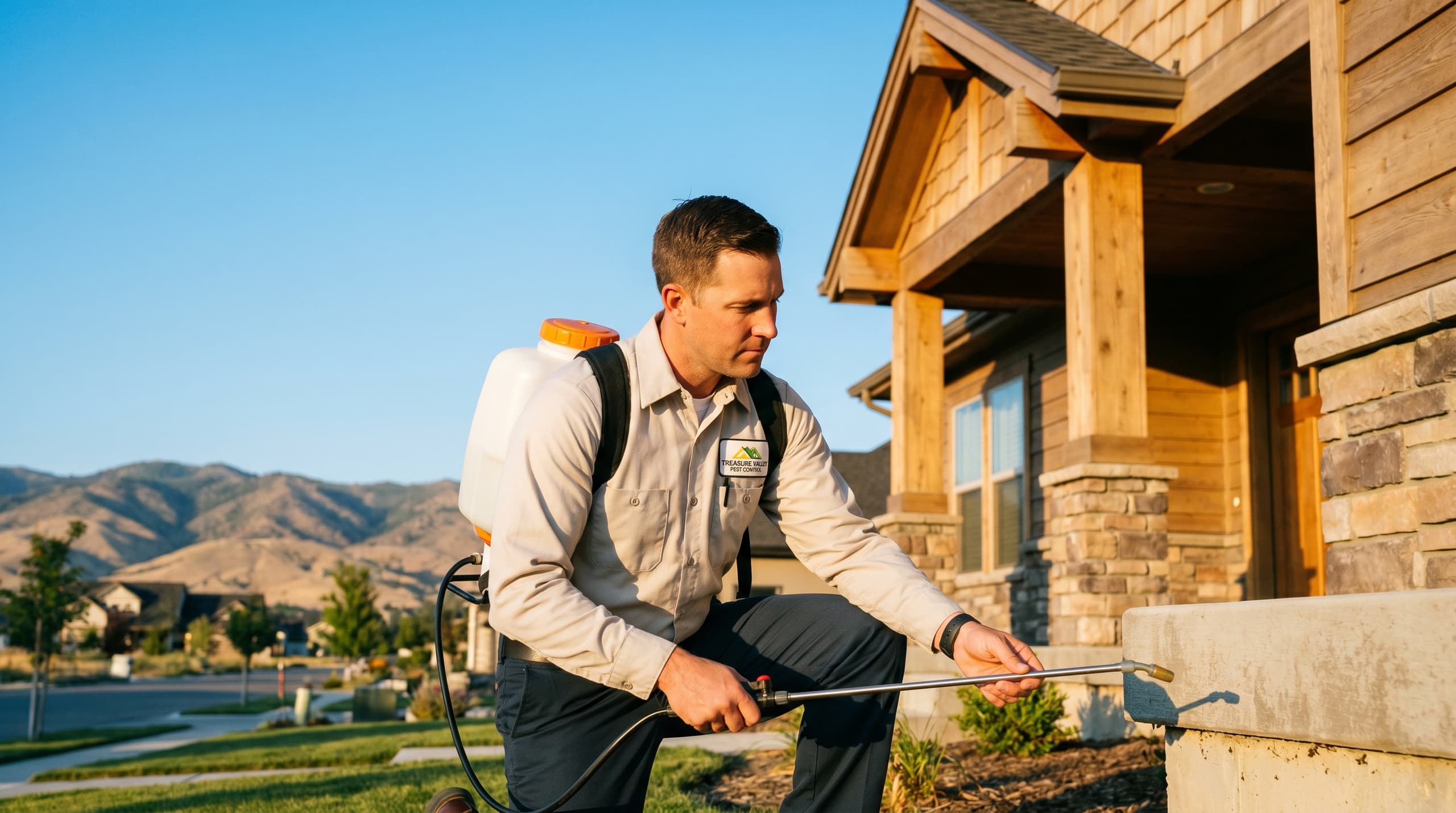
- Most of our work is on the outside of your home: perimeter barrier, eave sweeping, and granular bed treatment. Kids rarely play on the exact 3-foot foundation strip we spray
- We never carry foggers, bug bombs, or aerosol perimeter cans on our trucks. These are the exact products that create the parent-worry stories you have heard about
- The same product class we use in your home is used in NICUs and licensed Idaho daycares, which set the highest bar in the state for family-safe pesticide standards
In this article

Is Pest Control Safe for Kids and Babies in Boise? The Direct Answer
Yes. Professional pest control is safe for kids and babies when the product carries the EPA's CAUTION signal word, the application is exterior-focused, and everyone stays off the treated surface until it is dry (about 30 to 60 minutes in Boise). Green Guard checks all three boxes on every home we service.
That's the featured-snippet answer. Now let's get into the details a Treasure Valley parent actually cares about. Because when you've got a nine-month-old who puts everything in their mouth and ants marching across the kitchen counter, "trust me, it's fine" isn't good enough.
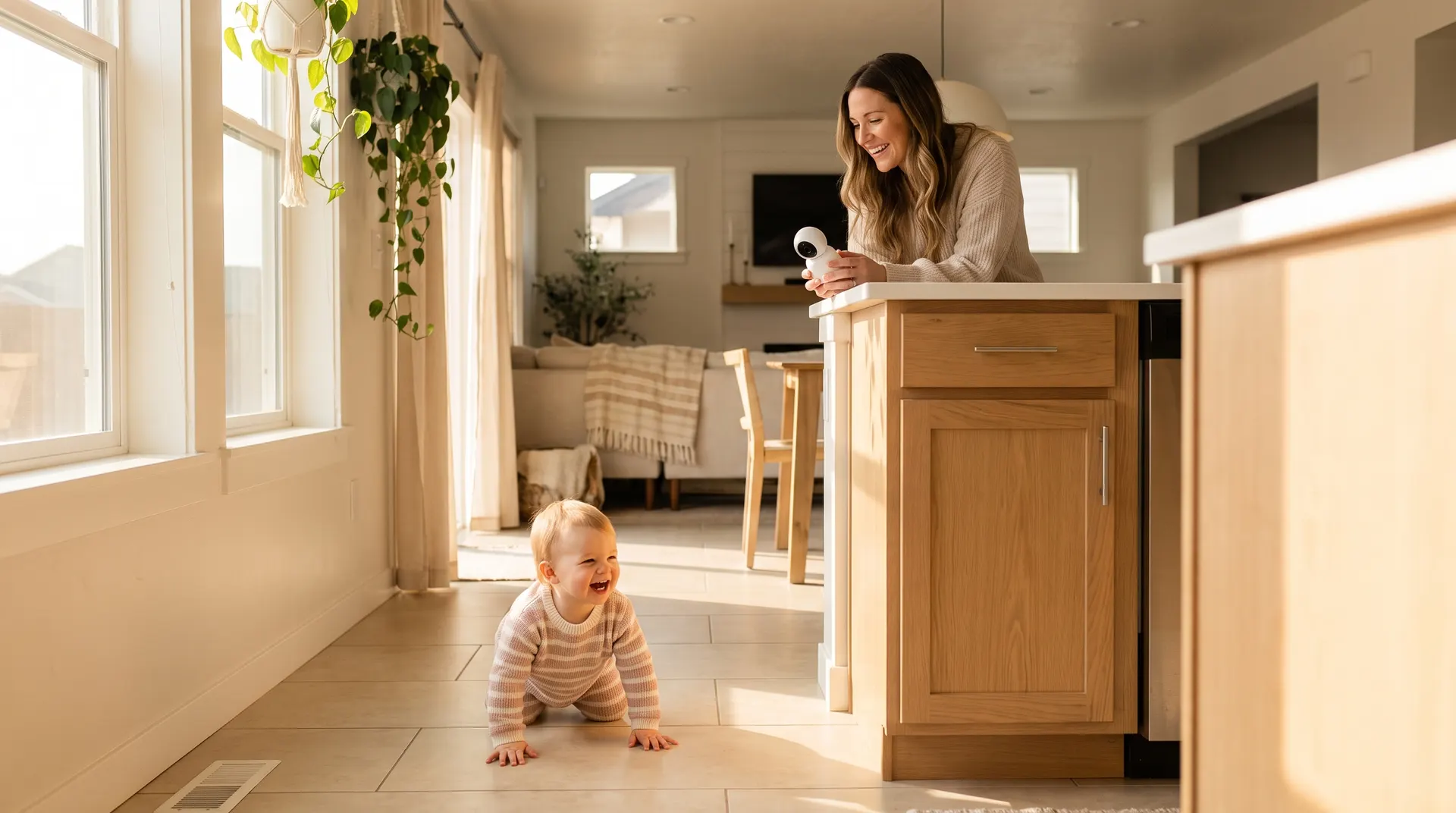
We've served 2,500+ Treasure Valley homes since 2010, and a lot of those homes have babies, toddlers, and elementary-schoolers running around. This post walks through exactly why professional treatment is safe around them, using EPA data, the actual label language on our products, and the practical stuff (like what to do with the pack-and-play).
The EPA Signal Word Test Every Boise Parent Should Know
Every EPA-registered pesticide sold in the United States is required to display one of three signal words on the front of the label: DANGER, WARNING, or CAUTION. The word tells you the product's toxicity class in one glance. If you learn nothing else from this post, learn this test. It works at the hardware store, on our truck, and on any bottle any pest company hands you.
| EPA Signal Word | Toxicity Category | What It Means for Your Family |
|---|---|---|
| DANGER / POISON | Category I (highest) | Severe toxicity. Restricted-use, mostly agricultural. Should never enter a home with kids |
| WARNING | Category II | Moderate toxicity. Longer re-entry intervals. Common on hardware store concentrates and total-release foggers |
| CAUTION | Categories III and IV (lowest) | Lowest toxicity tier. Short re-entry, typically 30 to 60 minutes. This is what Green Guard uses |
Ask any pest control company (us included) to show you the label before they start work. A reputable company will hand you the can. Look at the front panel. If it says CAUTION, you are in the safest tier the EPA recognizes.
The 30 to 60 Minute Rule: When Your Kids Can Come Back Outside
After a Green Guard exterior treatment, kids can play in the treated area once the sprayed surface is dry. In Boise's climate that is typically 30 to 60 minutes. Dry time depends on sun exposure, temperature, and humidity. On a July afternoon in Meridian at 92 degrees, the foundation strip is dry in 20 minutes. On a cool overcast April morning in the North End with dew on the grass, give it the full hour.
Here's the science, in one paragraph. Our products come as a liquid concentrate mixed with water. When we spray the perimeter, the water carrier evaporates and the active ingredient binds to the surface. Once it's bound, it's not airborne, not migrating into the grass blades your baby might grab, and not on anything a toddler can rub off onto their hands. Dry equals stable equals safe.
Why Kids Barely Touch Anything We Actually Spray
This is the part most parents don't realize until they watch a treatment happen. Most of a Green Guard service happens outside, and the exterior barrier is a 3-foot vertical strip on the foundation, plus a 3-foot horizontal sweep out from the wall. That's it. We're not carpet-bombing your yard. We're treating a narrow band right where pests actually enter.
Now think about where your kids play. On the lawn. On the play structure. On the driveway. In the sandbox at Ann Morrison Park. None of those surfaces get sprayed. The barrier strip runs against the wall of the house, past the sprinkler heads and window wells. It's the zone your child almost never touches.
Interior treatment, when it's needed at all, follows the same principle. We do crack-and-crevice work: the seam behind the fridge, the gap under the dishwasher, the void where the pantry baseboard meets the wall. Nothing sprayed on the open floor. Nothing on countertops. Nothing on anything within a crawling baby's reach.
- Exterior barrier: 3-foot vertical strip on the foundation, 3-foot horizontal sweep on the ground next to the wall
- Eaves and window frames: hand-applied to sweep down cobwebs and treat wasp landing zones. Well above kid height
- Landscape beds: granular product tucked into mulch, not broadcast on the lawn
- Interior (only when requested): crack-and-crevice only. Behind appliances, inside cabinet voids, along baseboard gaps. Zero product on open surfaces
What to Do With Baby Gear, Cribs, and Toys Before Treatment
Most of this is common sense, but new parents ask us about it often and we want it written down. If you are only getting exterior service, you can skip most of this. If you have opted in for any interior work (a spring ant push through the kitchen, for example), do the following before we arrive.
- Nursery and crib. Close the nursery door. If we are not treating that room, we do not go in. If we are, remove the crib sheet, bumpers, stuffed animals, and pacifiers to a closed room. The crib itself can stay
- High chair, playpen, pack-and-play. Move to a room we are not treating, or fold and set on a countertop. These are the surfaces a baby's face touches, so they should be nowhere near even crack-and-crevice work
- Bottles, sippy cups, teething toys. Put them in the dishwasher or a closed cabinet before we arrive. Same for pacifiers. Anything that goes in a mouth
- Bouncers, activity mats, floor toys. Roll them up and set them on the couch or move them to an untreated room. Do not leave them on the kitchen floor
- Diaper changing pad and wipes. Fine to leave in place if the changing table is in a room we are not treating. Otherwise move both
- Pet food and water bowls. Same treatment as baby dishes. Off the floor, into a cabinet, or into a room we are skipping
Why We Never Use Foggers or Bug Bombs in a Home With Kids
Foggers and total-release aerosol "bug bombs" are banned from every Green Guard truck. They fail every parent-safety test we care about, and we have said no to them since day one. If a pest company shows up with foggers, ask them to leave.
Here's why. A fogger coats every horizontal surface in the room with a fine mist of pesticide. That includes the high chair tray, the crib mattress, the changing pad, the crawling floor, the coffee table, and the pacifier that fell under the couch this morning. A crawling baby then interacts with every one of those surfaces within an hour of being back inside.
Foggers also work poorly. Roaches and ants live inside walls and voids where the fog can't penetrate. So you get maximum contamination of the surfaces you care about, and minimum contact with the pests you're trying to kill. It's the worst possible combination for a home with children.
Hospital-Grade: The NICU and Idaho Daycare Standard
You've probably seen "hospital-grade" used in a lot of pest control marketing. Here's what it actually means in practical terms, and why it should matter to a Boise parent.
The same class of EPA-registered products we use on your home is approved for use in hospitals, neonatal intensive care units, and licensed Idaho daycares. Those facilities operate under state and federal safety standards that far exceed anything a homeowner needs to worry about. Idaho licensed childcare centers are regulated by the Department of Health and Welfare, which sets strict pesticide-use rules for any center serving children under school age.
The logic works like this. If a product's approved for use around premature babies breathing filtered air in a NICU, it's approved for use around a healthy toddler in your Boise kitchen. The safety margin on the NICU application is orders of magnitude tighter than on the home application. That's why the standard exists and why we use products that meet it.
None of this is a marketing claim. It's written on the label, verified through the EPA registration, and enforced by state licensing. Any pest control company can tell you exactly what tier their products fall in. If they can't or won't, that tells you something.
Special Situations: Newborns, Kids With Asthma, and Pregnancy
Some family situations deserve a little more thought than the standard 30 to 60 minute rule. None of them rule out service. They just shape how we do it.
- Newborns and infants under 6 months. The product safety margin does not change, but many Treasure Valley pediatricians recommend leaving the home during any pesticide application and returning after the standard air-out window. That is a fine, cautious approach. Schedule service for a day you can be out for 60 to 90 minutes
- Kids with asthma or reactive airways. Exterior-only service is a great fit here because there is zero airborne exposure inside the home. Even for interior work, our low-pressure application produces almost no aerosol, but ventilating the room for 30 minutes after treatment is a good idea
- Pregnancy. Our CAUTION-labeled products are EPA-rated for use around pregnant women and infants. That said, many Boise OBs advise expecting mothers to be out of the home during any pesticide application and return after the dry window. We fully support that. Send the technician a note and pick a day someone else can be home
- Kids with sensory or immune sensitivities. Tell us in advance. We can extend the re-entry window, focus entirely on the exterior, or split the work into two visits (one for the yard, one for the interior on a day the child is out). None of this changes the price
Pets and Pest Control: Dogs, Cats, Birds, and Fish
We are pet safe and pet conscious in both how we treat and what we treat with.
Pets follow the same rule as kids. Once the sprayed surface is dry, typically 30 to 60 minutes, dogs and outdoor cats can use the yard again. A handful of situations need more than that standard rule. None of them rule out service. They just shape how we do it.
- Dogs can stay home during the visit as long as they are in a different room or a fenced-off part of the yard from where the technician is working. Food bowls, water bowls, toys, and bedding get moved out of any work area first, and it is smart to wash pet bowls before use.
- Cats metabolize pyrethrins much more slowly than dogs do, so we give them extra runway. Keep cats in a closed room during interior work and for 2 hours after. Outdoor cats can use the treated yard once it is dry.
- Birds are sensitive to airborne particles of any kind. Move cages to a different room with the door closed before we arrive, and bring them back after the home has aired out for an hour.
- Fish and reptiles in glass tanks: cover the tank completely (a wet bath towel works), shut off the air pump, and keep it off during interior work. Restart it once you have ventilated the room. We will not begin interior service until the tank is covered.
- Puppies, kittens, senior pets, and pets on medication: tell your technician. We may adjust application areas or extend the re-entry window. None of this changes the price.
- Indoor treatment with pets in the house is rarely needed, and when it is, it is crack-and-crevice only, in spots your pet physically cannot reach. Bait stations go in tamper-resistant boxes or in voids pets cannot access, and pets are moved to a different part of the house for the visit rather than vacated.
Warning Signs Your Pet Got Into Something They Shouldn't
Exposure incidents from professional pest control are vanishingly rare. They are more common with DIY products that pets find unattended in the garage. Either way, you should know what to look for. If you see any of these symptoms within a day of any pest control work (yours or ours), call your vet right away.
- Drooling, foaming at the mouth, or excessive lip-licking
- Vomiting or diarrhea, especially within the first few hours
- Tremors, twitching, or seizure-like episodes
- Rapid or labored breathing
- Sudden lethargy, weakness, or wobbly walking
- Pinpoint pupils in cats (specific to pyrethrin sensitivity)
How Long Does Pest Control Smell Last?
With Green Guard's organic-based products, most Boise families notice no smell at all after the visit. If there is a faint scent, it's a mild botanical (chrysanthemum, cedar, or a light citrus note) that fades within 30 to 60 minutes with normal airflow.
You may notice a slight scent for a few reasons, all short-lived:
- Closed rooms hold the scent longer. Crack a window for 15 minutes and it's gone
- Bathrooms and laundry rooms hold humidity, which extends dry time and any scent by about 30 minutes
- Warm interior temperatures speed up the volatile-oil release from botanical actives, so the smell is stronger for a shorter window
- Sensitive noses (pregnancy, migraines, asthma) notice the botanical scent longer than the average person. Tell us and we'll adjust product selection
Store-Bought DIY vs Professional: An Honest Comparison for Parents
A lot of Boise parents assume DIY is the "safer" route because they get to control what goes on the property. In practice, the opposite is usually true. Here's why, using the numbers that matter for a home with kids.
| Factor | Typical Hardware Store DIY | Green Guard Professional |
|---|---|---|
| EPA Signal Word | Often WARNING (Category II) | CAUTION (Category III or IV) |
| Fogger / bug bomb available | Yes, sold right next to the sprays | Never carried or used |
| Kid re-entry time on label | Some require 24 hours | 30 to 60 minutes once dry |
| Application precision | Broad spray, often over-applied | Perimeter barrier, crack-and-crevice, targeted |
| Concentrate storage | Sits in garage or under sink | Nothing left on your property |
| Odds of a kid finding the bottle | Real and common | Zero. Nothing to find |
That last row is the one parents underestimate. Almost every pediatric pesticide-exposure call to Poison Control involves a child finding a DIY concentrate in a garage or utility closet, not professional treatment residue on a surface. Professionals apply, pack up, and leave. Nothing sits around your house waiting for a curious three-year-old.
For the deeper breakdown, see the DIY vs. professional section of our Boise exterminator guide. The pets section above covers the dog and cat side of the equation.
What Actually Happens During Your First Visit
Curiosity about the process is the number one thing that eases parental anxiety. Here's the short version of a first Green Guard visit at a Boise home with kids in the house.
- Arrival and walkthrough. Our technician introduces themselves, asks about any kid, pet, or medical concerns, and looks at problem spots you have flagged
- Exterior work. Foundation barrier, eave sweeping, granular treatment in landscape beds, wasp nest checks. Takes 30 to 45 minutes on a typical home
- Interior work if requested. Only where you have asked for it. Crack-and-crevice application in kitchens, baths, and utility areas. Rooms with kids and cribs can be skipped entirely
- Sign-off. Technician confirms the dry time, walks you through what to expect the next 24 to 48 hours, and gives you a card with the free re-service number
- Air out. Open a couple of windows for 15 to 30 minutes after interior work. Not required, but it helps with the fresh-spray smell
Warning Signs to Watch For (and What They Actually Mean)
Professional pesticide exposure incidents in kids are extremely rare. Almost all of the pediatric calls to Poison Control involve DIY products, not professional service. Still, it is worth knowing what to look for. If your child shows any of these symptoms within a day of any pest control work (ours or a DIY project), call the pediatrician. Do not wait it out.
- Skin redness, hives, or rash where they may have touched a treated surface
- Watery eyes, sneezing, or coughing that starts after the treatment
- Nausea, vomiting, or unusual stomach upset
- Headache, dizziness, or unusual sleepiness
- Any strong chemical smell on the child's hands or clothing that will not wash off
Ready to Protect Your Family Without the Anxiety?
Ants in the pantry with a nine-month-old crawling under the highchair. Wasps building a nest right above the play structure. Spiders in the corner of the nursery. These situations come up all the time in Boise, Meridian, Nampa, and Eagle, and they are all fixable without the kind of chemical exposure parents worry about.
Get started with our $49 initial service. It covers all home sizes, includes a full property inspection, exterior barrier, and any first-visit interior work you want. If pests come back between scheduled visits, so do we, at no charge. That's our free re-service guarantee in plain English.
Call the Green Guard team at (208) 297-7947. We're locally owned in Boise, family-oriented, and we use the same class of products in your home that hospitals and licensed Idaho daycares use in theirs.
What Family-Safe Pest Control Costs
| Plan | Home size | Price |
|---|---|---|
| Initial Service with a quarterly or bimonthly plan | Any home size | $49 |
| Quarterly Service | Up to 2,500 sq ft | $119 |
| 2,501 to 4,000 sq ft | $139 | |
| 4,001 to 5,500 sq ft | $159 | |
| Bimonthly Service | Up to 2,500 sq ft | $99 |
| 2,501 to 4,000 sq ft | $119 | |
| 4,001 to 5,500 sq ft | $139 | |
| One-Time Service | Up to 2,500 sq ft | $200 |
| 2,501 to 4,000 sq ft | $225 | |
| 4,001 to 5,500 sq ft | $250 |
Frequently Asked Questions
Is pest control safe for kids?
Quick answerYes, when the product carries the EPA's CAUTION signal word (the lowest-toxicity tier), the application is exterior-focused, and kids stay off treated surfaces until dry.
Green Guard's Boise service checks all three boxes. Our CAUTION-labeled products are the same class approved for use in NICUs and licensed Idaho daycares. Kids can be back in the treated yard 30 to 60 minutes after treatment.
Should children be away when pest control comes?
Quick answerFor exterior-only service, no.
Kids can be in the house during the treatment because there is no interior application at all. For interior crack-and-crevice work, kids should be in a different room during the visit and back after 30 to 60 minutes once surfaces are dry. Many Treasure Valley parents just schedule during nap time or a school day and it works out fine.
Is pest control safe for babies and infants?
Quick answerYes, when it is done with CAUTION-labeled products and exterior-focused application.
That said, many Boise pediatricians recommend leaving the home for 60 to 90 minutes with a newborn during any pesticide work, out of caution. That is a fine approach and one we support. Schedule the visit for a day you can be out running errands with the baby, and you are well inside the safety margin.
How long until my baby can crawl on the floor after pest control?
Quick answerFor exterior-only service, the floor is never treated so there is no waiting period at all.
For interior crack-and-crevice work, wait 60 minutes after the technician leaves before letting a crawling baby back on the treated-room floor. The active ingredient is bound to surfaces once dry, and open-floor areas were never sprayed to begin with.
Do I need to wash baby toys and pacifiers after pest control treatment?
Quick answerNot if you moved them to a closed room or closed cabinet before we arrived, which we ask you to do.
If a toy or pacifier was left out in a treated area, a normal wipe-down or dishwasher run is enough. There is no special decontamination required with CAUTION-labeled products, but common-sense cleanup is a good habit.
Is there such a thing as non-toxic pest control?
Quick answerNothing that kills pests is truly non-toxic to everything, and the EPA does not certify any product as non-toxic.
What exists is low-toxicity, family-safe pest control that uses CAUTION-labeled products (Toxicity Category III or IV, the EPA's safest tier) applied in a way that keeps kids and pets off the surface until dry. That is what Green Guard delivers in the Treasure Valley.
How do you get rid of roaches safely in a home with kids?
Quick answerEnclosed gel bait stations and crack-and-crevice application.
The bait is inside a tamper-resistant container that a child cannot open. The crack-and-crevice work goes into cabinet voids, behind appliances, and along baseboard gaps that kids cannot access. We never fog for roaches (foggers make roach problems worse by pushing them deeper into walls), and we do not spray open surfaces where a toddler might crawl. Roaches aren't a typical Green Guard service, so a technician assesses each job and quotes it before any work.
Can my dog be home during pest control treatment?
Quick answerYes, your dog can stay home during the visit as long as they're in a different room or a fenced-off part of the yard from where the technician is actively working.
Green Guard's technicians will not begin work in a room your dog is in. Most Boise families crate the dog inside during exterior service, or keep the dog in the backyard while we treat the front (and vice versa). Once the treated area is dry (30 to 60 minutes for exterior work), your dog can be back in that space with no restriction.
When can my dog go back in the yard after pest control?
Quick answerMost dogs can be back in the yard 30 to 60 minutes after treatment, as soon as the sprayed surfaces are dry to the touch.
Our exterior barrier work uses CAUTION-labeled products that bind to the surface once the water carrier evaporates. On a sunny Boise day, that's typically 30 minutes. On a cool or overcast morning, give it the full hour to be safe.
Do you spray inside my home with pets in the home?
Quick answerRarely, and only with your permission.
Exterior-only service is common on quarterly plans because the barrier work outside handles most pest pressure. When interior treatment is genuinely needed, it's crack-and-crevice only (behind appliances, in cabinet voids, along baseboard gaps), in spots pets can't reach. Pets stay in a different room for 30 to 60 minutes, then everyone goes back to normal.
What if my dog licks a treated surface or eats a dead bug?
Quick answerOnce surfaces are completely dry, incidental contact is not a concern with our products.
A dead bug contains an extremely small amount of active ingredient, far below any toxic threshold for a dog or cat. That said, discourage repeated licking and don't let pets eat handfuls of dead insects. If your pet shows any symptoms (drooling, vomiting, tremors), call your vet right away.
Is pest control safe for pregnant women?
Quick answerYes, the EPA-registered, CAUTION-labeled products we use are rated for use around pregnant women and infants when applied as directed.
That said, many Treasure Valley OBs advise leaving the home during any pesticide application as a precaution and returning after the standard air-out window. We fully support that. Schedule service for a day you can be out of the house for an hour, and you're well inside the safety margin.
How long does pest control smell last?
Quick answerWith Green Guard's organic-based products, most families notice no smell after the visit.
If you do notice a faint scent (usually a mild botanical, cedar, or citrus note), it fades within 30 to 60 minutes with normal airflow. Cracking a window for 15 minutes speeds it up. Bathrooms and laundry rooms hold humidity, which can extend the scent by about 30 minutes. If anyone in your home is scent-sensitive, ask for our unscented rotation. Same efficacy, no smell.
Why don't you use bug bombs or foggers, even when they say "safe"?
Quick answerFoggers spread product across every surface in the room, including pet bowls, bedding, and toys.
They fail hospital-grade safety standards because of that exact issue. They also work poorly: pests survive in the spots foggers can't reach (wall voids, behind appliances), which is exactly where we treat. We get better results with less product and zero coating of household surfaces. Foggers are banned from our trucks.