Quick answer
Tick season in Idaho's Treasure Valley starts in late April and peaks through June. Effective tick control runs three layers: a yard perimeter treatment with bifenthrin or permethrin around shaded edges, a vet-recommended preventative for every dog and outdoor cat, and DEET or picaridin plus permethrin-treated clothing for anyone heading into tall grass. A professional treatment knocks down both adult ticks and the rodents that host juvenile ones.
Key Takeaways
- Tick season in the Treasure Valley starts in late April and peaks through June, so the time to treat your yard is now
- A perimeter spray with bifenthrin or permethrin protects 30 to 90 days, applied to shaded edges, brush lines, and the foundation
- Permethrin-treated clothing is the single most effective personal prevention. One application lasts six washes
- Oral isoxazoline preventatives kill ticks within 12 hours. Seresto-style collars repel and last up to eight months. Your vet picks the right fit
- Never put dog tick products on cats. Permethrin is toxic to cats
In this article

Tick Season in Idaho Just Started. Here's the Plan.
Tick activity in the Treasure Valley starts in late April and peaks through June. If you waited until you found one on the dog, you're already behind. The good news is that effective tick control is a layered routine, not a one-time fix, and you can knock the risk down to almost zero with three moves: treat the yard, protect the pets, and prep the family before time outside.
This is the action playbook for Boise, Eagle, Meridian, Nampa, and the rest of the Valley. We cover hotspots, professional yard treatments, vet-grade pet preventatives, the right repellents for kids and adults, and when calling a pro pays off.
If you want the species and disease side of the story, the sections below cover which ticks live here, the diseases that matter in Idaho, and a symptom timeline. The rest of this post focuses on prevention and treatment.
Why Late April Is the Window That Matters in Idaho
Idaho ticks become active once daytime temperatures hold above 45 degrees. That threshold hit Ada and Canyon counties the second week of March in 2026, and Boise vet clinics started pulling ticks off dogs by mid-March. Bites and yard reports usually peak between late April and the third week of June.
Why does the timing matter for control? Because adult ticks lay eggs in May. If you treat the yard before that egg-laying window, you cut the next generation off at the source. Wait until July and you're reacting to a population you could have prevented.
The Idaho tick calendar:
- March: First adults emerge in the Boise foothills. Activity light but real.
- Late April through June: Peak season. Adult bites and egg-laying happen here.
- July: Activity drops as the Valley dries out and grass goes dormant.
- August through February: Minimal activity at lower elevations. Mountain trails can stay live a few weeks longer.
Treasure Valley Tick Hotspots Where Your Family Picks Them Up
Most ticks in the Valley don't come from deep wilderness. They come from spots families visit every week. Here are the Treasure Valley hotspots where ticks hitch a ride.
- Boise foothills trails: Hulls Gulch, Camel's Back, Table Rock, the Military Reserve. Tall grass on both sides of the trail is prime tick habitat. Stick to the path.
- Boise River Greenbelt and riparian corridors: The brushy sections away from manicured paths hold ticks all spring. Dogs running off-leash bring them home.
- BLM-adjacent neighborhoods: Eagle, Hidden Springs, Avimor, parts of east Boise. Lots that back up to undeveloped land catch ticks riding in on deer and rodents.
- Agricultural edges in Nampa, Caldwell, and Star: Properties next to pastures, hay fields, or old orchards have higher rodent traffic, which means higher juvenile tick numbers.
- Dog parks and off-leash fields: Especially Ann Morrison and Together Treasure Valley dog park. Dogs share ticks the same way they share kennel cough.
- Your own backyard: Tall grass against a fence line, leaf litter under a deck, a woodpile next to the house. Ticks ride in on rodents, then drop into shaded zones waiting for the next host.
Yard Tick Control: 7 Steps That Actually Move the Needle
Yard treatment is where you get the biggest bang for your buck. Ticks need humid, shaded vegetation to survive, so most of the work is removing habitat and treating the few zones that remain.
- Mow weekly through peak season. Keep grass under three inches. Short, sun-exposed lawn is hostile habitat. Ticks dehydrate fast in dry Idaho air.
- Clear leaf litter and tall weeds from fence lines, around sheds, under decks, and along the foundation. These are the moist, shaded zones where ticks wait. A leaf rake and 30 minutes does more than any spray.
- Move woodpiles, bird feeders, and compost away from play areas. All three attract rodents, and rodents are the host for juvenile ticks. Stack wood at least 20 feet from the house and off the ground.
- Build a hardscape buffer. Three feet of wood chips or gravel between your lawn and any wooded edge or tall-grass field breaks the tick migration path. Ticks rarely cross dry, sun-exposed ground.
- Treat the perimeter with bifenthrin or permethrin. The professional choice is a high-pressure perimeter spray applied to shaded edges, brush lines, fence rows, and the first three feet up the foundation. One treatment lasts 30 to 90 days. Open, sunny lawn doesn't need treatment.
- Control rodents. Juvenile ticks feed on mice and voles before they ever reach a human. Cutting your rodent population cuts next year's tick population. Our rodent ID guide walks through what is in your yard.
- Fence out deer if you back to BLM or foothills. Adult ticks ride deer in. An eight-foot deer fence is overkill for most lots, but a four-foot fence with motion-activated lighting helps in trouble spots.
Protecting Your Dog and Cat From Idaho Ticks
Dogs are the number one tick carrier into Treasure Valley homes. They run through brush, pick up ticks, and walk them into the kitchen. Pet preventatives are not optional during tick season here. Talk to your vet about which type fits your dog or cat. Here is how the three categories compare.
Oral Preventatives (NexGard, Simparica, Bravecto, Credelio)
Chewable tablets in the isoxazoline family. They don't repel ticks, but once a tick attaches and feeds, the medication kills it within 12 hours. Bravecto is the standout because one chew lasts 12 weeks instead of four. Best fit for dogs with skin sensitivities or families who don't want topical residue on the dog's coat.
Topical Preventatives (K9 Advantix II, Vectra 3D, Frontline)
Liquid drops applied between the shoulder blades once a month. Permethrin-based topicals like K9 Advantix II actually repel ticks before attachment, which is a meaningful advantage if your dog hits foothills trails weekly. Frontline (fipronil) doesn't repel, so you may still see ticks crawling. Permethrin-based topicals are toxic to cats. Never share between species.
Tick Collars (Seresto)
The Seresto collar releases active ingredients gradually and lasts up to eight months. Good for dogs that swim or get bathed often. Good for owners who want to set it and forget it. Make sure it sits snug enough to contact the skin or the active ingredient doesn't transfer.
Post-Walk Tick Checks (Do Not Skip This)
No preventative is 100 percent. Run your hands through the dog's coat after every walk in brush or foothills. The five spots ticks love on dogs:
- Inside and behind the ears
- Under the collar and along the neck
- Armpits and groin
- Between the toes
- The base of the tail
Protecting Your Family When You're Outside
Yard treatment handles your property. Personal prevention handles everywhere else. Layer these whenever you're heading into tall grass, foothills trails, or anywhere the dog will be off leash.
- Treat clothing with permethrin. This is the single most effective thing you can do. Spray hiking pants, socks, and boots the night before. One application lasts six washes. Permethrin kills ticks on contact. You can buy pre-treated clothing or spray your own.
- Use 20 to 30 percent DEET or picaridin on skin. Both work. Picaridin feels less greasy and doesn't melt plastic gear. Apply to exposed skin, hands, neck, and behind the ears.
- Tuck pants into socks. It looks ridiculous. It works. Most ticks climb up from boot height, so closing that gap is the most useful clothing move you can make.
- Wear light colors so a crawling tick is easy to spot before it attaches.
- Stay on trails. Ticks wait in the brush at the edges of paths, not on the bare dirt itself.
- Do a full-body tick check within two hours of coming inside. Behind ears, scalp (especially on kids along the hairline), armpits, waistband, behind knees, between toes.
- Shower and tumble-dry your clothes on high heat for 10 minutes. Heat kills any ticks you missed. Washing alone doesn't.
If You Find an Attached Tick: Remove It the Right Way
The right method takes 30 seconds and a pair of fine-tipped tweezers. Forget petroleum jelly, matches, and nail polish. None of it works and most of it makes the tick regurgitate into the bite, which is exactly the opposite of what you want.
- Grab fine-tipped (pointy) tweezers, not the flat slanted kind from your bathroom drawer.
- Get the tweezers as close to the skin as possible, right at the mouthparts.
- Pull straight up with steady, even pressure. No twisting, no jerking.
- Clean the bite with rubbing alcohol or soap and water.
- Drop the tick in a small ziploc with a damp paper towel. Write the date on the bag in case symptoms appear in the next two weeks.
Which Ticks Live in the Treasure Valley?
Idaho is home to roughly a dozen tick species, but only four regularly show up on people and pets in the Treasure Valley. The Rocky Mountain wood tick is the one you will find most often. American dog ticks turn up too. Brown dog ticks ride in on pets, and the western blacklegged tick lives mostly in north Idaho's panhandle.
Rocky Mountain Wood Tick
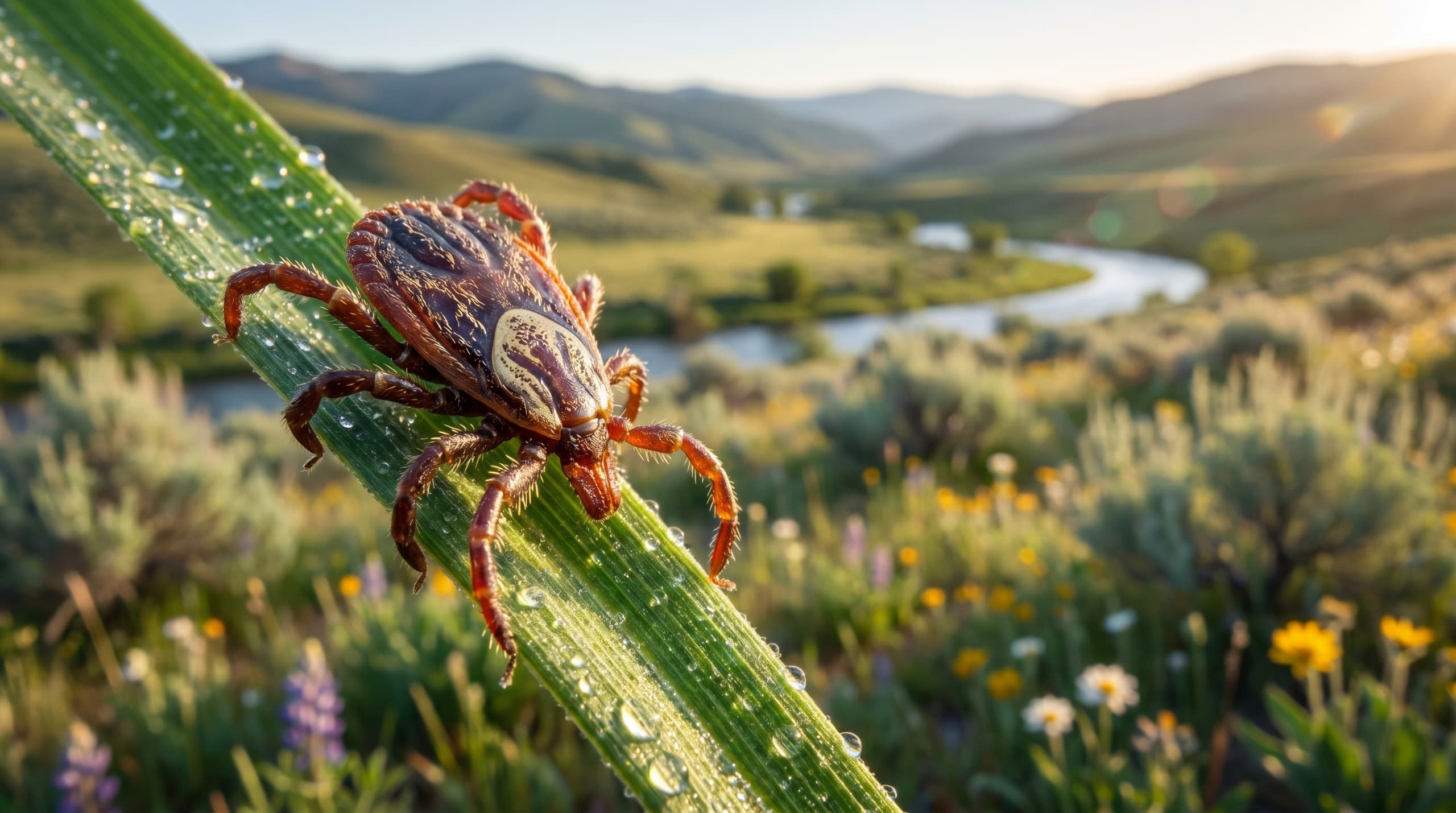
The Rocky Mountain wood tick (Dermacentor andersoni) is Idaho's most common and most medically important tick. It is about 1/8 inch long unfed, with a brown body and gray-white markings on the back. You find them in brush, tall grass, and forest edges, especially in the foothills above Boise and Eagle. Adults bite humans and dogs from March through July.
American Dog Tick
The American dog tick (Dermacentor variabilis) looks similar to the wood tick but turns up less often. Females have a larger white patch on the scutum. It prefers grassy meadows and trail edges, and it bites humans even though dogs are the preferred host.
Brown Dog Tick
The brown dog tick (Rhipicephalus sanguineus) is the only tick that can complete its full life cycle indoors. It rides home on dogs from kennels or dog parks and can infest a house. It is reddish-brown, about 1/8 inch, and rarely bites humans, but it is a real problem for dogs.
Western Blacklegged Tick
The western blacklegged tick (Ixodes pacificus) is the only Idaho tick that can carry Lyme disease, and it lives almost exclusively in northern Idaho. It is essentially absent from the Treasure Valley. We mention it for completeness because people search for it, but if you live in Ada, Canyon, or Gem County, this is not your tick.
What Diseases Do Idaho Ticks Carry?
Idaho ticks transmit a handful of diseases. Most local cases involve Rocky Mountain spotted fever, Colorado tick fever, or tularemia. Lyme disease is rare here because the tick that carries it is not established in southern Idaho. Tick paralysis is rare but worth knowing about.
- Rocky Mountain spotted fever (RMSF): Bacterial infection from Rocky Mountain wood ticks and American dog ticks. Causes high fever, headache, and a rash that often starts on wrists and ankles. Treated with doxycycline. Can be fatal if untreated.
- Colorado tick fever: Viral infection from the Rocky Mountain wood tick. Fever, chills, headache, and muscle pain. Usually self-limiting but can knock you out for a couple of weeks.
- Tularemia: Bacterial infection sometimes called rabbit fever. Rare but serious. Causes a sore at the bite site, swollen glands, and fever.
- Tick paralysis: Not an infection. A toxin in tick saliva causes ascending weakness that can mimic a stroke. It clears once the tick is removed.
- Lyme disease: Rare in Idaho. The Idaho Department of Health and Welfare reports most local cases come from people who picked up the tick while traveling to the Northeast or Upper Midwest.
Symptom Timeline After a Tick Bite
Most tick bites cause nothing worse than a small itchy bump. When something does develop, it usually follows a predictable pattern.
- Day 1 to 3: Small red bump at the bite site. Mild itch. This is a normal reaction to a bite.
- Day 3 to 7: Watch for fever, severe headache, muscle aches, or a rash. These are early signs of Rocky Mountain spotted fever. Call your doctor.
- Day 5 to 14: The RMSF rash typically appears. Small flat pink spots start on the wrists and ankles, then spread.
- Day 7 to 14: Colorado tick fever symptoms appear if you got it. A two-phase fever pattern is classic: fever for a few days, you feel better, then it returns.
- Up to 30 days: Lyme disease (rare here) can show as a bullseye rash. If you traveled to an endemic area in the past month, mention that to your doctor.
When to Call a Pro for Tick Control in the Treasure Valley
If you're pulling more than one or two ticks off the dog or kids each season, or your property backs up to brush, foothills, or BLM land, professional yard treatment is the move. The DIY route works for low-pressure suburban lots. For heavier exposure, you want a high-pressure perimeter spray applied at the right time of year by someone who has done it 1,000 times.
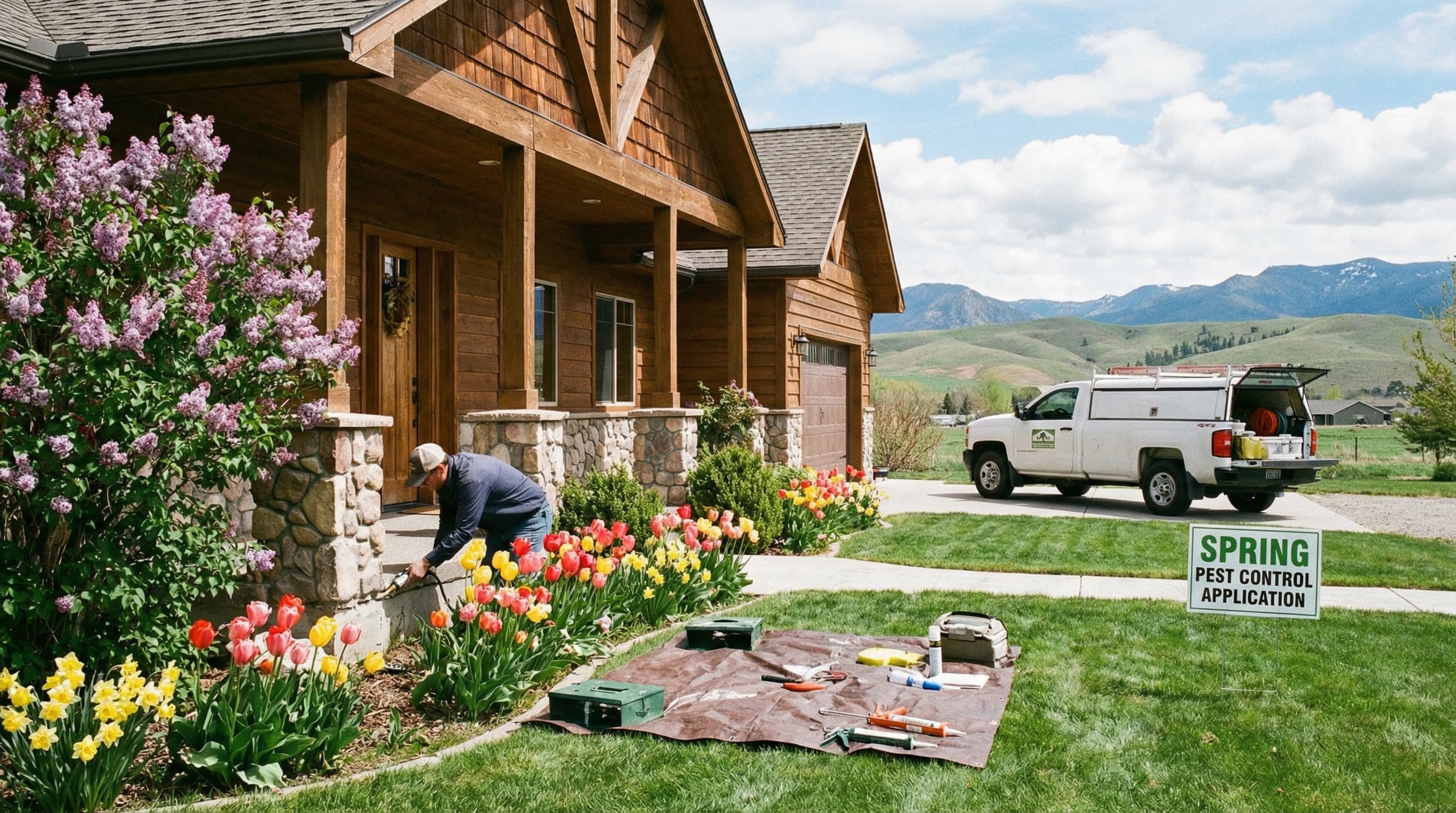
Green Guard's quarterly plan starts at $119 per treatment for homes up to 2,500 square feet. That includes a pet-safe exterior perimeter spray that targets the shaded zones where ticks wait, plus rodent control to knock down the host population. We use organic-based, hospital-grade products safe for kids and pets once dry.
If pests come back between scheduled visits, we come back free. No charge, no questions. That's the re-service guarantee, and it's the right policy for ticks because the worst yards need a second hit in May after the first round of eggs hatches.
Call (208) 297-7947 or start with our $49 initial service. Subscription customers only at that price. After that, quarterly visits run from $119, with free re-service between visits, while a one-time treatment runs $200 to $250 by home size.
What Pest Control Costs in the Treasure Valley
| Plan | Home size | Price |
|---|---|---|
| Initial Service with a quarterly or bimonthly plan | Any home size | $49 |
| Quarterly Service | Up to 2,500 sq ft | $119 |
| 2,501 to 4,000 sq ft | $139 | |
| 4,001 to 5,500 sq ft | $159 | |
| Bimonthly Service | Up to 2,500 sq ft | $99 |
| 2,501 to 4,000 sq ft | $119 | |
| 4,001 to 5,500 sq ft | $139 | |
| One-Time Service | Up to 2,500 sq ft | $200 |
| 2,501 to 4,000 sq ft | $225 | |
| 4,001 to 5,500 sq ft | $250 |
Your Spring Tick Control Checklist
Print this. Stick it on the fridge. Run through it the last weekend of April.
- Mow the lawn under three inches and clear leaf litter from fence lines and the foundation
- Move the woodpile 20 feet from the house
- Schedule (or DIY) a perimeter spray for late April or early May
- Refill the dog's vet-recommended tick preventative for the season
- Buy permethrin spray and treat hiking pants, socks, and shoes for the family
- Stock the medicine cabinet with fine-tipped tweezers and small ziplocs for tick saves
- Add a 'tick check after outside' rule for kids during May and June
Frequently Asked Questions
How much does professional tick control cost in Idaho?
Quick answerGreen Guard's quarterly plan starts at $119 per treatment for homes up to 2,500 square feet, which includes a perimeter spray that targets ticks along with the other common Idaho pests.
The $49 initial service covers a full property inspection plus the first treatment for subscription customers. One-time tick treatments are not the most cost-effective route because tick populations rebuild quickly without ongoing pressure.
When should you start tick treatments in the Treasure Valley?
Quick answerThe last week of April or the first week of May is the right window.
Adult ticks become active once daytime temperatures hold above 45 degrees, which usually happens in mid to late March in Boise, but the egg-laying surge doesn't start until May. Treating the yard right before egg-laying gives you the biggest population suppression for the rest of the season.
What is the safest tick spray for yards with kids and pets?
Quick answerProfessional perimeter sprays based on bifenthrin or permethrin are family-safe once they dry, which takes 30 to 60 minutes.
Both bind to the top inch of soil and degrade naturally rather than leaching into groundwater. They are the same active ingredients used by every reputable yard tick service, including ours. Avoid products marketed as natural that rely only on cedarwood or essential oils. They wash off in the first rain.
How often should you spray your yard for ticks?
Quick answerOnce in late April or early May covers most Treasure Valley yards through the worst of the season.
Properties that back up to BLM, foothills, or agricultural land usually need a follow-up in mid-June. Quarterly pest control covers ticks in the same routine as ants, spiders, and wasps, which is why most local families bundle it.
Are tick collars or oral medications better for dogs?
Quick answerDepends on the dog and the family.
Oral isoxazoline preventatives like NexGard or Bravecto kill attached ticks within 12 hours and have no residue on the coat. Permethrin-based topicals like K9 Advantix II repel ticks before attachment, which matters if your dog hits foothills trails weekly. Seresto collars last up to eight months and are the easiest set-it-and-forget-it option. Your vet picks the right fit based on lifestyle and any health considerations.
Does Green Guard treat ticks across the Treasure Valley?
Quick answerYes.
We service Boise, Eagle, Meridian, Nampa, Caldwell, Star, Kuna, Garden City, and Middleton. Tick treatment is included in our quarterly and bimonthly plans. Call (208) 297-7947 or start with the $49 initial service to get on the schedule for the spring application window.
Do ticks in Idaho carry Lyme disease?
Quick answerLyme disease is rare in Idaho.
The blacklegged tick that carries it lives mostly in the Idaho panhandle and is not established in the Treasure Valley. The diseases to actually watch for here are Rocky Mountain spotted fever, Colorado tick fever, and tularemia. The Idaho Department of Health and Welfare reports most local Lyme cases come from people who traveled to the Northeast or Upper Midwest.
When does tick season start in Boise?
Quick answerTick activity in the Boise foothills typically starts in March, ramps up through April, and peaks late April through June.
Activity drops off in July as the Valley dries out and stays low through winter. Higher elevations can run a few weeks behind.
How do I get rid of ticks in my yard?
Quick answerMow grass short, clear leaf litter from fence lines and foundations, and put a three-foot barrier of wood chips or gravel between your lawn and any brush.
Control rodents, since juvenile ticks feed on mice and voles. A pet-safe exterior perimeter treatment at the start of tick season suppresses the population in the zones closest to your house.
What's the right way to remove a tick?
Quick answerUse fine-tipped tweezers.
Grab the tick as close to the skin as possible, right at the mouthparts. Pull straight up with steady pressure. No twisting, no matches, no petroleum jelly. Clean the bite, drop the tick in a ziploc with the date, and watch for fever or rash for two weeks.