Initial Treatment
Full inspection + treatment included

Serving Meridian, ID
Professional wasp removal for Meridian homes. $49 to start. Family & pet safe. Free re-service guarantee.
Tap your pest problem to get started
$49 to start
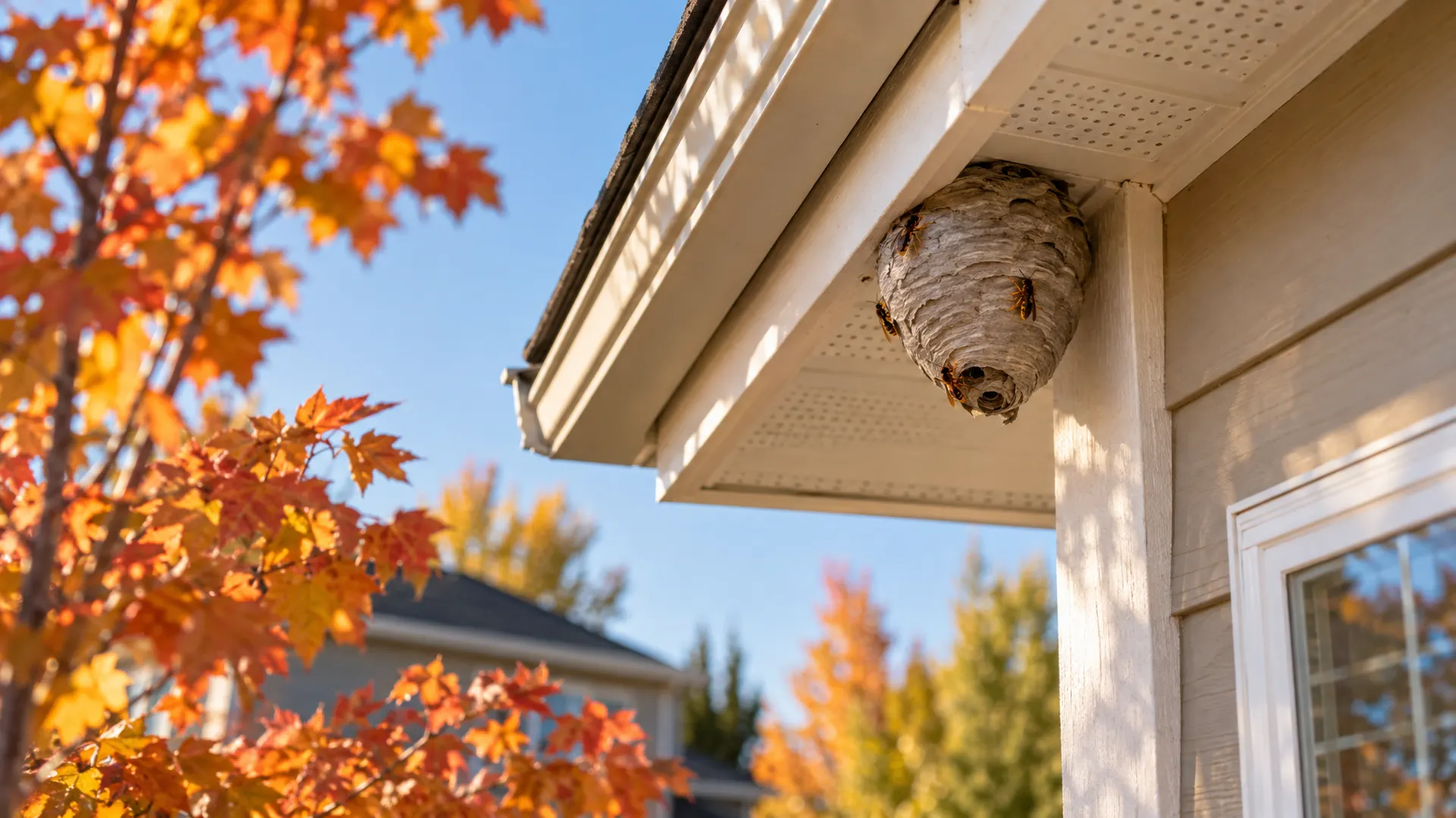
Wasp removal in Meridian changes character at the end of September. The yellow jacket nests along the Five Mile and Ten Mile Creek pathways and the paper wasp nests under your eaves are winding down, and the first hard frost (usually mid-to-late October in the Treasure Valley) will kill every worker. But right now, every healthy colony is also releasing next year's queens. Those mated queens want a dry crack to sleep in until April. Idaho's second-largest city has thousands of fresh eaves, gable vents and siding seams to offer them.
So the fall job is simple. Get the nest treated before a queen overwinters in your wall. Once the colony is dead, caulk the gap she'd use (that part's on you or a handyman). One nest handled in October is one less queen starting a new nest on your porch next spring. Not sure what's hanging off your house? Our guides to paper wasps, yellow jackets and bald-faced hornets will sort it out in about a minute.
Green Guard runs both Meridian ZIP codes (83642 and 83646) every week, from Old Town and Pine Avenue out to the new builds off Lake Hazel Road. Your first treatment is $49 for any home size with a quarterly or bimonthly plan. That visit covers accessible nest knockdown, entry-point treatment for yellow jackets, and a treated barrier around the foundation and eaves.
Quarterly service starts at $119, and if wasps come back between visits, so do we, free. We usually get out within 24 to 48 hours, and same-day service is often available. Call (208) 297-7947. For everything else we treat in town, see our Meridian pest control page, or read about wasp and hornet removal across the Valley.
Meridian keeps building. Out by Ustick and McDermott, along the Ten Mile corridor, and south of I-84 around Lake Hazel and Locust Grove, new subdivisions go up next to lots that are still under construction. New homes have builder-grade gable vents, soffit seams and trim gaps that nobody has gone back to caulk yet. Paper wasp queens tuck into exactly those gaps in October. Next door, stacked lumber, pallets and debris piles give yellow jacket and hornet queens a sheltered winter spot within easy flying distance of your eaves.
Much of Meridian was hay ground and dairy pasture not long ago. Western yellow jackets love to nest in old vole and mouse burrows, and new sod, bark mulch and sprinkler boxes give them plenty of fresh cavities. By late September those ground nests are at full size, often next to landscape edging or a valve box. In our experience, the lawnmower is how most Meridian homeowners find them.
The Ridenbaugh Canal, Five Mile Creek and Ten Mile Creek run right through Meridian neighborhoods, and the city's pathway system follows long stretches of them. Water, flies and caterpillars along those corridors keep yellow jackets fed late into the season. Homes that back onto a canal or creek path tend to see foragers at the patio table weeks after the rest of town has quieted down.
The older neighborhoods around Old Town and Pine Avenue have big, mature shade trees. Bald-faced hornets hang their gray, football-shaped nests high in those trees all summer, and the leaves hide them. In October the leaves fall and homeowners spot the nest for the first time. A busy nest near a walkway or play area is still worth treating, and even an empty one has already sent its queens off looking for a spot on someone's house. That's why our fall eave and perimeter treatment matters.
Queens start nests in April, colonies peak in August and early September, and workers die at the first hard frost in mid-to-late October.
Mated queens hunt for winter shelter from late September into November.
Meridian gives wasps two things at once. The Ridenbaugh Canal and the Five Mile and Ten Mile creeks keep colonies fed with water and insects all summer, and the city's steady stream of new homes gives their queens plenty of fresh gaps to hide in come fall.

Step one
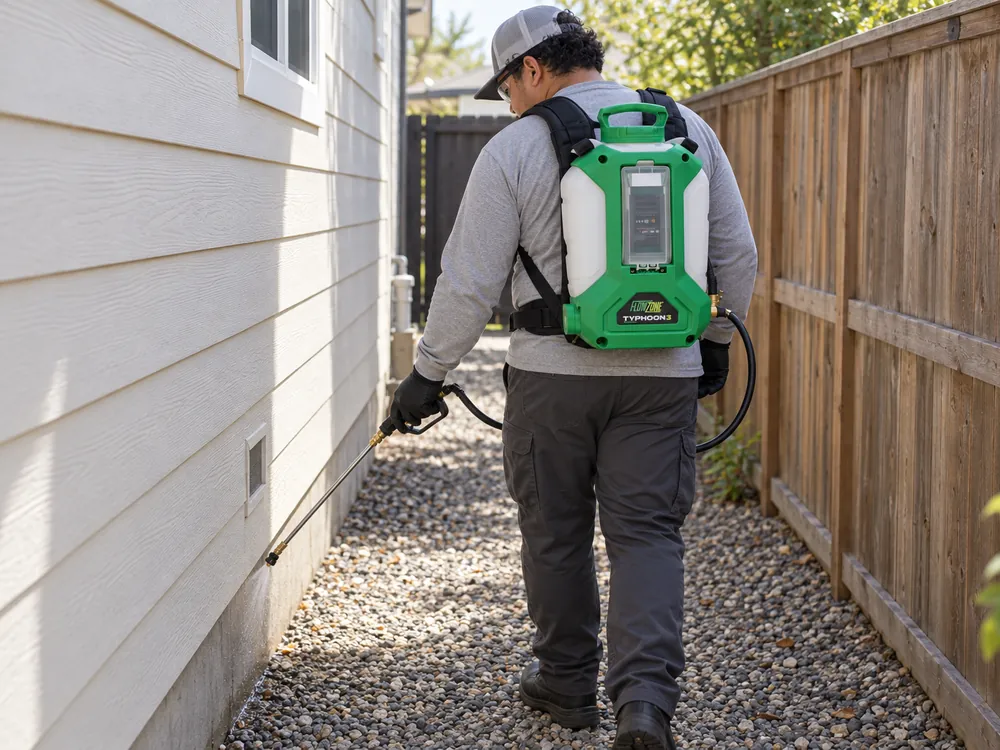
Our technician walks your eaves, soffits, fence lines, playsets, lawn and trees.
Step two
Accessible paper wasp and hornet nests get treated and knocked down.

Step three
We treat the foundation perimeter plus the eaves, soffit edges, window trim and gable vent openings from the outside.
Step four
Your spring visit catches founding queens while their nests are still walnut-sized, which is the easiest time of year to stop a colony.
Paper wasps, yellow jackets and bald-faced hornets each need a different approach, so we identify before we treat. We don't remove honeybee hives or bumblebee nests. For honeybees, we'll point you to a local beekeeper.
Yellow jacket nests in the ground or in a wall get a residual dust at the entrance, so returning workers carry it back to the queen. Leave that entrance open for 10 to 14 days while the dust works through the colony. Still seeing activity? Call and we'll come back free.
That's where fall queens try to settle in. We don't treat attics or seal holes. Once the colony is dead, sealing the gaps is a job for you or a handyman.
Between scheduled visits, re-service is always free.

"After three other companies couldn't keep ants out of our kitchen, Green Guard solved it in one visit. Six months later, still zero ants."
"I was skeptical at first, but Green Guard exceeded every expectation. They found entry points I never knew existed and haven't seen a spider since."
"After two other companies failed, Green Guard solved our ant problem in one visit. Professional, thorough, and actually effective."
Transparent pricing. No hidden fees. A 1-year agreement locks in your rate, then service continues quarter by quarter.
Full inspection + treatment included
Talk to our local office team, Monday to Friday, 9am to 5pm.
Call (208) 297-7947Quick answerYour first treatment is $49 for any home size with a quarterly or bimonthly plan, and it includes treating accessible nests.
The plan comes with a 1-year agreement that locks in your rate. After that, quarterly service is $119 for homes up to 2,500 sq ft, $139 for 2,501 to 4,000 sq ft, and $159 for 4,001 to 5,500 sq ft. If you only want a one-time service, it's $200 for homes up to 2,500 sq ft ($225 and $250 for larger homes) and comes with a 30-day warranty.
Quick answerYes, if the nest is still active near a door, deck or play area.
Late-season workers are hungry and defensive, and the colony is releasing the queens that will start next year's nests. The bigger fall win is treating your eaves and perimeter so those queens don't overwinter in your walls. An old nest won't be reused, but its queens are already shopping for a new spot, so call (208) 297-7947 and we'll get the fall treatment done.
Quick answerThose are almost always paper wasp queens that crawled into a wall gap, attic vent or window frame in the fall.
A warm winter afternoon wakes them up and they wander toward the light. They're slow and rarely sting, so a vacuum takes care of the one on your windowsill. It's still a sign your eaves have gaps, so seal them in spring and let our quarterly exterior treatment keep the next round of queens outside.
Quick answerAugust and September.
Colonies are at their biggest, natural food is drying up, and yellow jackets go after anything sweet at your patio table. Activity drops after the first hard frost in mid-to-late October. Until then, a nest near the patio is worth treating, and we can usually get out within 24 to 48 hours.
Quick answerPeppermint, clove, lemongrass and geranium oils have shown some repellent effect in research.
They wear off fast outdoors, and they won't move a colony that's already built. Use them on a patio table if you like, but an active nest needs treatment. Call (208) 297-7947 and our team will take care of it, starting at $49 with a plan.
$49 first service with a quarterly or bimonthly plan. Free re-service guarantee.
Tap your pest problem to get started
You picked Wasps.
Prefer to talk? Call (208) 297-7947
Expert tips & guides. Local pest knowledge from Boise's trusted exterminators