Quick answer
Pantry moths (Indian meal moths) explode in Boise kitchens in August because 90-plus degree Idaho heat cuts their egg-to-adult cycle to about 2 weeks. To actually end an infestation, you have to empty the whole pantry, throw out every open bag of grain, flour, cereal, nuts, dried fruit, pet food, and bird seed, deep-clean the shelves with hot white vinegar and water, and set 2 to 3 pheromone traps to monitor for stragglers. Most Boise pantry moth cases are a discard-and-clean job, not a pest control call. Green Guard helps when moths are showing up in multiple pantries at once, when you can't find the source, or when you need an exterior barrier to cut off new arrivals.
Key Takeaways
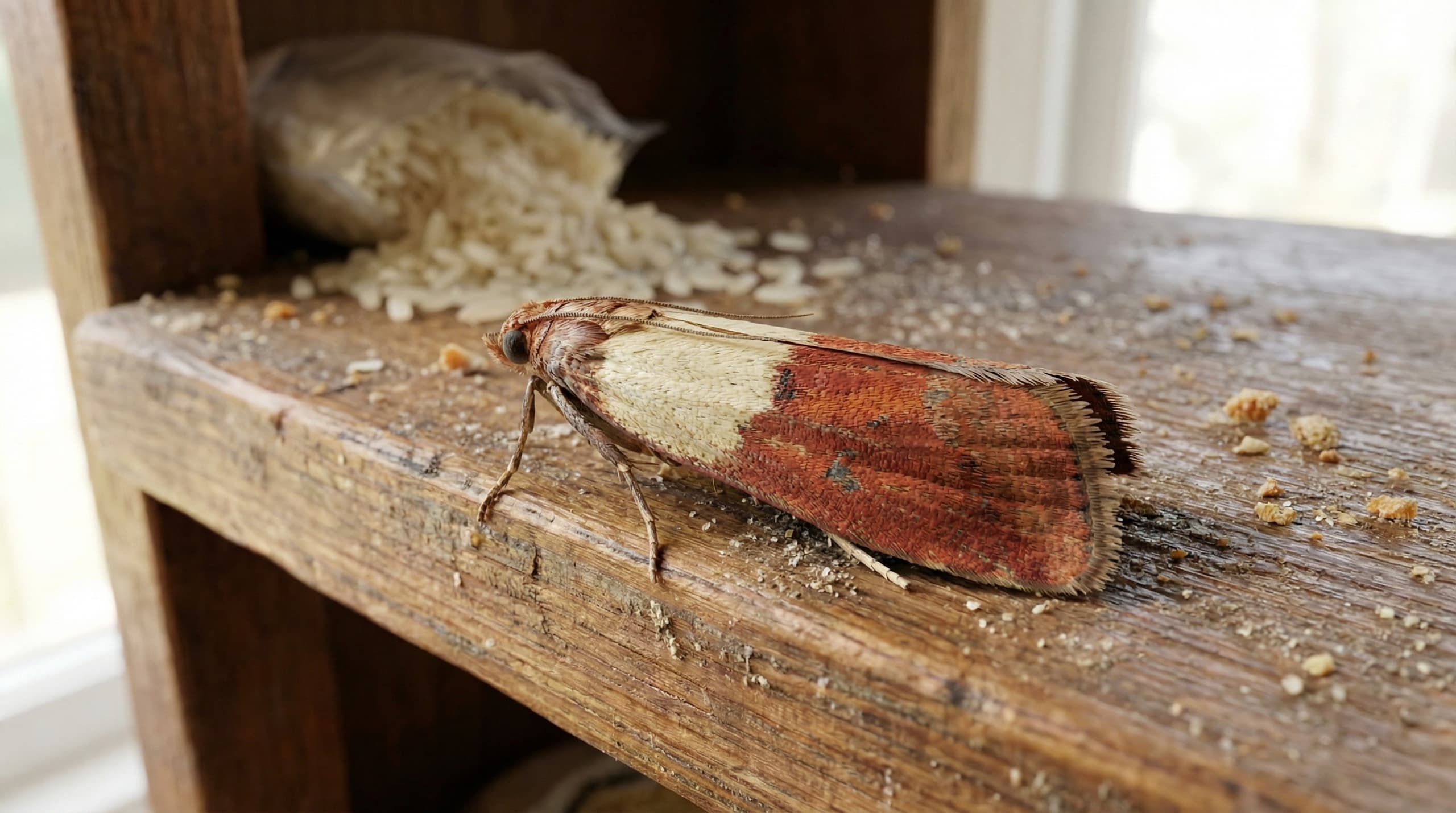
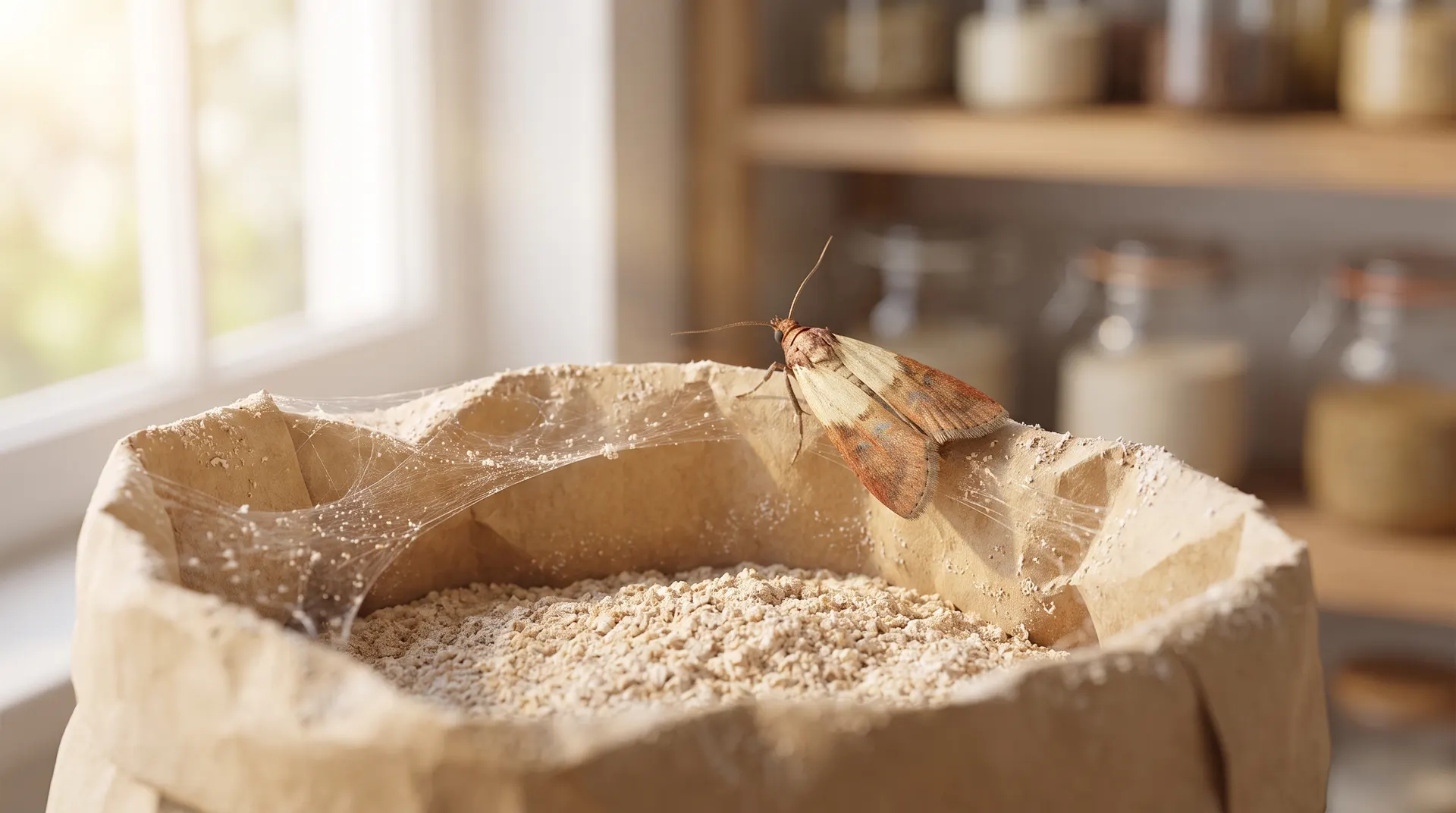
- Adult pantry moths are about 3/8 inch long with copper or bronze outer wings and a cream inner half. If you see small moths in your kitchen and the wings look two-toned, that's what you have.
- The problem isn't the flying moths. It's the cream-colored larvae hidden in your grains, cereals, dried fruit, nuts, pet food, and bird seed. Killing adults changes nothing until you find the source.
- In Boise summer heat, egg to adult takes about 2 weeks. That's why what looks like 3 moths on August 1st becomes hundreds by Labor Day.
- The fix has 4 steps: empty the pantry completely, throw out anything open in cardboard or thin plastic, deep-clean shelves and cracks with hot water and white vinegar, and run pheromone traps for 6 to 8 weeks to catch any new adults.
- Call a pro when the infestation covers multiple pantries or rooms, when you can't find the source, when it comes back after a full clean-out, or when you need help finding entry points around a rural or foothill property. Our $49 initial service includes the full inspection.
In this article

You Went on Vacation and Came Home to Moths in the Flour
You dropped the kids at grandma's, hit McCall for a week, and walked back into your Boise kitchen on a Sunday night. First trip to the pantry for a bowl of cereal, and there they are. A few tiny moths fluttering out of the cupboard. Copper-colored wings. Slow, floppy fliers. And when you look closer at the flour bag, there's webbing along the top seam.
Welcome to the peak of pantry moths Idaho season in the Treasure Valley. This is their season across Boise, Meridian, and the foothills.
These are Indian meal moths (Plodia interpunctella), and August is exactly when they peak. The reason is math. In 95-degree Idaho heat, their egg-to-adult cycle drops to about 2 weeks. So while you were gone, 3 moths turned into 30, and 30 laid the eggs for the next 300. Coming home to a full-blown infestation after a week away is a common pantry moth story.
Here's the honest truth up front: pantry moth control is mostly discard-and-clean. There's no magic spray that fixes it. But the part where a pro helps is real, and we'll get to that. First, let's make sure you actually have pantry moths and then walk through the exact plan that ends the cycle.
How to Know You Have Indian Meal Moths (Not Something Else)
The good news is Indian meal moths are one of the easiest household pests to ID once you know what to look for. The wings are the giveaway.
- Size. About 3/8 inch long with a wingspan around 5/8 inch. Small, but bigger than a fruit fly.
- Wings. Two-toned. The inner half (closer to the body) is cream or pale gray. The outer half is copper, bronze, or reddish-brown. Nothing else in your kitchen looks like this.
- Flight pattern. Slow, floppy, and drunk-looking. They flutter from cupboard to ceiling and often land on walls or the underside of cabinets.
- Where you see them. The kitchen. Especially near the pantry, cereal cabinet, dog food bin, or bird seed bag. If they're in your bathroom, they're not pantry moths.
- Larvae. Cream-colored caterpillars about 1/2 inch long with a brown head. Often crawling on the ceiling or up walls looking for a spot to pupate. This freaks people out more than the moths.
- Webbing. The dead giveaway. Silky webbing along the top of a flour or oat bag, in the folds of a cereal box liner, or clumping together bird seed. If you see webbing, you have larvae feeding in that package.
Why Pantry Moths in Idaho Explode in Boise Kitchens Every August
Pantry moths are a year-round pest, but they are most noticeable between mid-July and early September. Four things stack up to create the August explosion:
- Heat speeds up the life cycle. At 70 degrees, egg to adult takes about 6 weeks. At 90 degrees (a typical Boise August pantry temperature), that drops to 2 weeks. A week-long vacation is enough for a whole new generation to hatch.
- Summer bulk shopping. Families load up at Costco, WinCo, and Sam's Club with 25-pound flour, oats, rice, and pet food bags for kid snacks and canning season. Bigger bags sit open longer, giving moths time to establish.
- Bird seed and pet food in the garage. That 40-pound sack of black oil sunflower seed in the garage or that big bag of dog food from the feed store is almost always where the infestation starts. Warm garages in July and August are moth incubators.
- Vacation homes and second properties. A cabin in McCall or Cascade left closed for weeks in July heat, with a bag of pancake mix in the pantry, comes back to a full-blown infestation. August is when these turn up.
- Home canning and dry goods. Boise foothill and rural properties often store more grains, flour, and seed than a city kitchen. More food equals more targets.
The Lifecycle That Makes Them So Hard to Kill
Understanding the life cycle is what separates people who solve this in a weekend from people who fight moths for 6 months. The adult moth you see flying around isn't the problem. It's the tail end of a much bigger process.
- Eggs. A single female lays 100 to 400 tiny white eggs directly on or in food. You will never see them with the naked eye.
- Larvae (the caterpillars). Eggs hatch in 2 to 14 days. The larvae eat and grow for 2 to 4 weeks, tunneling through grains and dry goods, spinning silk webbing as they go. This is the destructive stage. This is what contaminates your food.
- Pupae. Full-grown larvae leave the food and crawl surprising distances (up walls, across ceilings, into cabinet hinges) to find a spot to spin a cocoon. This is when you find a caterpillar on your ceiling, which is deeply unsettling and completely normal.
- Adult moth. The moth emerges from the cocoon, mates within a day or two, and lays the next batch of eggs. Adults don't eat. They live 1 to 2 weeks with the sole job of reproducing.
- Total cycle. 4 to 6 weeks in cool conditions, 2 weeks in Boise summer heat. That is why it feels like the population doubles every time you turn around.
What to Throw Away (Do Not Skip Anything)
This is the part people try to shortcut and then wonder why the moths came back. When you find pantry moths, you've got to empty the entire pantry and inspect every single package. Anything that's open, anything in a cardboard box or thin plastic, and anything you can't see clearly through, goes in the trash.
Take the trash bag straight outside to the can. Don't leave it in the kitchen garbage or the garage overnight. The moths will just hatch out and come back.
- Throw out (no exceptions). Any open bag or box with visible webbing, larvae, or moths. Even if the food itself looks fine.
- Throw out (probably contaminated). Any open bag or box of flour, cornmeal, cake mix, pancake mix, oatmeal, rice, quinoa, barley, breadcrumbs, granola, cereal, crackers, nuts, seeds, dried fruit, dried beans, popcorn, or spices.
- Throw out (frequently overlooked). Pet food (especially open kibble and treats), bird seed, chicken feed, decorative dried corn or seed pods, potpourri, dried flower arrangements, and holiday decorations that use grains.
- Inspect carefully. Anything in a sealed glass or metal container. If you see no webbing or larvae inside, and the seal was never broken, it's fine. When in doubt, throw it out. A $6 bag of flour isn't worth the next round of moths.
- Freeze to be safe. Anything you want to keep from a bulk bin (flour, grains, oats, nuts) can be sealed in a bag and frozen for 7 days. That kills any eggs or larvae that might be in it. Then transfer to an airtight glass or hard plastic container.
- What's safe. Canned goods, sealed jars, oils, condiments, sauces, and anything in the fridge or freezer. Moths can't infest liquids, canned foods, or refrigerated items.
The White Vinegar Deep Clean (Step-by-Step)
Once the pantry is empty, you have to clean every surface, every crack, every corner. Larvae and pupae hide in the tiniest cracks: under shelf edges, in the hinges of cabinet doors, behind wire shelf brackets, and under peeling shelf liner. White vinegar is the right tool here because it kills eggs on contact and cuts through the greasy film that food dust leaves behind.
Give yourself an hour. Here is the plan:
- Vacuum first. Use a hose attachment to vacuum every shelf, corner, and crack. Get inside the hinges, along the trim, under the shelf lips, and along the ceiling of the pantry. Suck up every stray grain, crumb, and any larvae or pupae you can see. When you're done, take the vacuum canister or bag straight outside to the trash. Don't leave it in the garage.
- Mix your cleaner. One part hot white vinegar to one part hot water in a spray bottle. Add a teaspoon of dish soap. That's it. Skip bleach for this job. It kills the surface but doesn't get into the cracks where the eggs and larvae hide.
- Spray everything. Every shelf top and bottom, every wall, the ceiling, the door interior, the hinges, the trim. Don't just wipe. Spray until surfaces are visibly wet.
- Scrub the cracks. Use an old toothbrush or a stiff bristle brush along every seam, every joint where shelves meet walls, every hinge, and every corner. This is where the pupae hide. Don't skip this step.
- Wipe with clean cloths. Fresh microfiber or paper towels. Don't reuse a dirty rag or you spread eggs around.
- Remove and clean shelf liner. If you have shelf liner or paper down, pull it out and throw it away. Don't put new liner down for at least a month. You want to be able to see any activity.
- Spray one more time and let it air dry. A second light spray of vinegar solution, then leave the pantry door open until everything is completely dry.
Set Pheromone Traps (Your Early Warning System)
Pantry moth pheromone traps are the one product worth buying. They are sticky triangular cardboard traps baited with the female moth's pheromone. Male moths fly in, get stuck, and never mate. Because females need males to reproduce, breaking the reproduction chain slowly starves out any survivors.
Traps do two things: they kill remaining males, and they tell you whether your clean-out worked. If you empty and clean the pantry and then catch 20 moths in the trap over the next week, you missed a source and need to look again. If you catch 2 or 3 total over 6 weeks, you got them.
- Buy. Any brand from Amazon, Home Depot, or D&B Supply works. Look for Indian meal moth (IMM) pheromone traps. Roughly $10 to $15 for a 6-pack.
- Where to place them. One in the pantry, one on the top shelf of the kitchen cabinets, and one in the room where you store pet food or bird seed (often the garage). Do not put them right next to each other or the pheromone plumes cancel out.
- How high. At or above eye level. Pantry moths fly high, so a trap on a low shelf catches less than one on a top shelf or hung from the ceiling.
- How long. Leave them in place for 6 to 8 weeks minimum. Replace when the pheromone lure loses potency (most brands say 90 days).
- Track your count. Write the install date on the trap in Sharpie. Check weekly and jot down how many moths are stuck. Trap count should drop steadily. If it's climbing after week 2, something is still infested.
When to Call Green Guard (and When Not To)
We'll be straight with you: most pantry moth infestations are a Saturday afternoon of empty-inspect-clean, then 6 weeks of pheromone traps, and you're done. You don't need to pay us for that.
Call a pro when any of these are true:
- Moths in multiple rooms. Larvae in the pantry, larvae in the garage pet food, and moths in the guest bathroom means the infestation has moved beyond one source. That is a full inspection job.
- You did the full clean-out and they came back within a month. That usually means you missed a hidden source (a cabinet you didn't check, a decorative dried arrangement, a bag in the garage) or they're coming in from an exterior source.
- You can't find the source. You see the moths but there's no visible webbing, no visible larvae, and every package looks clean. It's somewhere, and we're good at finding it. We check spots homeowners don't think to check: HVAC returns, dropped ceiling tiles, and appliance motors. See our related fruit fly troubleshooting guide if the tiny fliers turn out to be something else entirely.
- You live on a rural or foothill property with active bird feeding. When there are constant new arrivals from outside via feed, seed, or hay, you need an exterior perimeter barrier to reduce moth pressure. That's not a DIY job.
- You're a restaurant, coffee shop, bakery, brewery, or food truck. Commercial kitchens have grain storage and health-code implications that a homeowner recipe doesn't cover. Our commercial pest control team handles these.
- You have overlapping pests. Small flies plus moths plus ants at the same time means a broader issue. See our Idaho pest calendar for the full picture, or just call and we'll sort it out in one visit.
What a Green Guard Pantry Moth Visit Actually Looks Like
Our $49 initial service was built for this exact kind of case. Here is what you get on visit one:
- Full inspection. We walk every kitchen cabinet, pantry, garage, and storage area with a flashlight and find the source or sources. Homeowners often find one. A full walk often turns up more.
- Species confirmation. Indian meal moth is by far the most common, but we occasionally find Mediterranean flour moths, warehouse moths, or clothes moths. Different bugs, different fixes. We make sure you're treating the right pest.
- Targeted crack-and-crevice treatment. Once the food is out and the surfaces are cleaned, we apply an organic-based hospital-grade product to the cracks, hinges, and voids where pupae hide. Same formulation we use in daycares. Safe once dry (30 to 60 minutes).
- Exterior perimeter barrier. A 3-foot-up, 3-foot-out barrier around the whole foundation reduces the odds of new moths arriving from outside sources like bird feeders, compost piles, or neighboring garages.
- Pheromone trap placement. We set commercial-grade traps in the right spots and show you exactly what to watch for.
- Quarterly protection. The 90-day quarterly plan keeps a fresh barrier in place and catches new problems early. If pests come back between visits, we come back free.
How to Never See Pantry Moths Again
Once you've fought a pantry moth infestation, you don't want a repeat. A few permanent habit changes make this a one-time problem:
- Airtight containers, no exceptions. Every dry good goes into glass jars, hard airtight plastic (like OXO Pop containers), or metal tins. Cardboard boxes, twist-tied plastic bags, and ziplocks are not moth-proof.
- Freeze new bulk purchases for 7 days. Any bag of flour, grain, rice, oats, nuts, or bird seed from a bulk bin gets sealed and frozen for a week before it goes in the pantry. Kills any hitchhiking eggs.
- Buy pet food and bird seed in smaller quantities. That 40-pound bag lasts 3 months and gives moths a full lifecycle to establish. Buy smaller, use faster.
- Store bird seed in a sealed metal can, in the garage or shed, not the kitchen. A galvanized trash can with a lid holds 50 pounds of seed and stops moths cold.
- Rotate stock (first in, first out). Put new purchases behind old ones. Anything that has been in the pantry more than 6 months either gets used or tossed.
- Keep a pheromone trap in the pantry year-round. Replace every 90 days. Any moth caught is an early warning that something is starting. Better than finding webbing in September.
- Clean the pantry quarterly. Full empty, vacuum, wipe-down every 3 months. Ten minutes of prevention beats a Saturday of demolition.
Ready to Get Your Pantry Back?
Try the discard-and-clean plan first. Almost every pantry moth case in a Boise home is a one-Saturday fix if you do it thoroughly. Set the traps, watch the count drop, and you are done in 6 to 8 weeks.
If you cannot find the source, if it keeps coming back, or if the infestation is bigger than one cabinet, we can help. Green Guard serves Boise, Meridian, Eagle, Nampa, Caldwell, Kuna, Star, and the rest of the Treasure Valley. Just $49 to start, no long sales pitch. Call (208) 297-7947 or book online. Same-day service is often available.
Frequently Asked Questions
How do you get rid of pantry moths in Idaho?
Quick answerThe 4-step plan works in every Idaho home: empty the entire pantry, throw out any open bag or box of grain, flour, cereal, nuts, dried fruit, pet food, or bird seed, deep-clean every shelf and crack with hot white vinegar and water, and set 2 to 3 pheromone traps for 6 to 8 weeks to catch remaining adults.
Skip any step and they come back. Most Boise homeowners solve it in one Saturday afternoon.
What are the small moths in my kitchen in Boise?
Quick answerIf they are about 3/8 inch long, fly slow and floppy, and have two-toned wings (cream inner half, copper or bronze outer half), you have Indian meal moths (pantry moths).
This is by far the most common small moth in Boise kitchens, especially in July and August. If the wings are solid gray or brown with no copper, you might have clothes moths, which is a different problem.
Are pantry moths dangerous?
Quick answerNo.
Pantry moths do not bite, do not sting, and do not carry the diseases houseflies do. If you accidentally ate cereal with a few larvae or eggs in it before noticing, you are fine. They are a gross-out and a food waste problem, not a health problem. Just throw out the contaminated food and clean up.
Why did I suddenly get pantry moths?
Quick answerAlmost every Boise pantry moth infestation starts with a single package brought in from outside.
The most common sources are bulk-bin flour or grain, bird seed, and pet food. The moth eggs are microscopic and already in the food when you buy it. Idaho summer heat accelerates the hatch cycle to about 2 weeks, so what starts as a few eggs in July becomes hundreds of moths by August.
What kills pantry moths instantly?
Quick answerNothing kills the source instantly, which is the honest answer nobody wants to hear.
You can knock down adults with a fly swatter or a vacuum, but that changes nothing because the larvae are still in your food. The only real fix is finding and throwing out every infested package, deep-cleaning the shelves, and running pheromone traps for 6 to 8 weeks. Sprays and bug bombs do not work on pantry moths.
Will I ever get rid of pantry moths for good?
Quick answerYes.
Once you do a thorough clean-out and switch every dry good to airtight glass or hard plastic containers, pantry moths are a one-time problem. Add a permanent pheromone trap in the pantry (replace every 90 days) as an early warning system, and you will catch any new arrivals before they establish. Recurring pantry moth problems almost always trace back to skipping the airtight-container step.