
Quick answer
Rats and mice look similar for two seconds. The differences that matter: adult rats are 6 to 10 inches long (not counting tail) versus 3 inches for a mouse. Rat droppings are capsule-shaped and 1/2 to 3/4 inch long, ten times the size of a mouse's rice-shaped 1/8 inch pellet. Rats gnaw hardwood and plumbing lines; mice chew softer material. In Boise, the rat you're most likely seeing is a Norway rat, and they cluster along the Boise River corridor, older Nampa and Garden City neighborhoods, and near commercial dumpsters. Rats are almost always a professional job because trap sizing and bait station placement are different from mouse control. Rats inside your home are covered by a Green Guard plan that starts with a $49 first visit. Rats living only outside are usually a separate service. Call (208) 297-7947.
Key Takeaways
- Rats are 3x the body length of a house mouse and 10x the weight. If you saw something bigger than a golf ball, it was a rat.
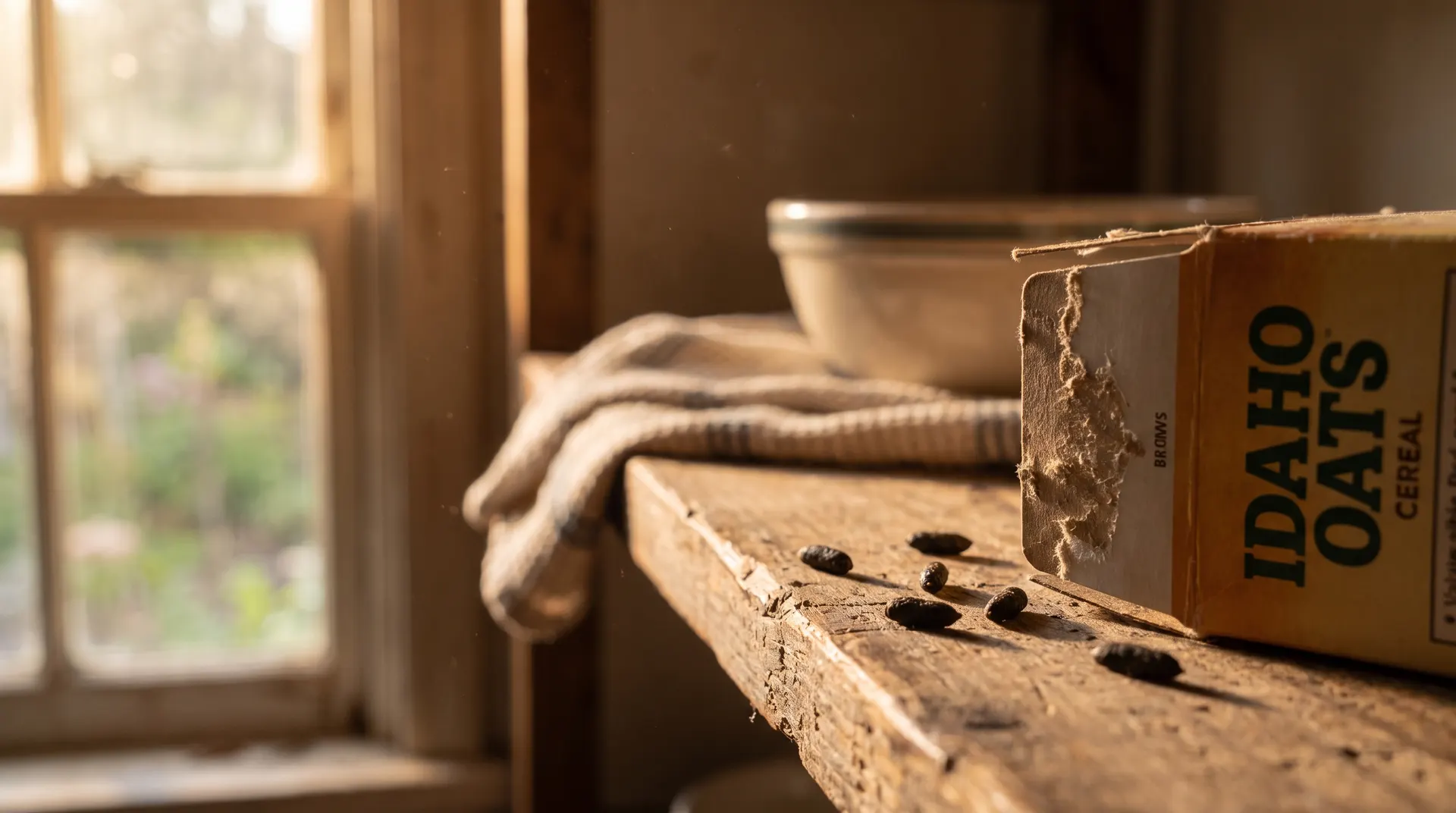
- Rat droppings are 1/2 to 3/4 inch, capsule-shaped, and blunt on the ends. Mouse droppings are 1/8 inch and pointed like rice grains.
- Norway rats are the primary species in Boise. They burrow at ground level (foundations, woodpiles, dumpster pads) rather than nesting in walls like mice.
- Rat pressure is highest along the Boise River corridor, older Garden City and Nampa neighborhoods, and near commercial dumpsters.
- Rats are almost always a professional job. Snap traps for mice will not close on a rat, and store-bought bait blocks routinely leave dead rats in wall cavities and crawlspaces.
In this article

Rats or Mice in Boise? Here is the Fast Answer
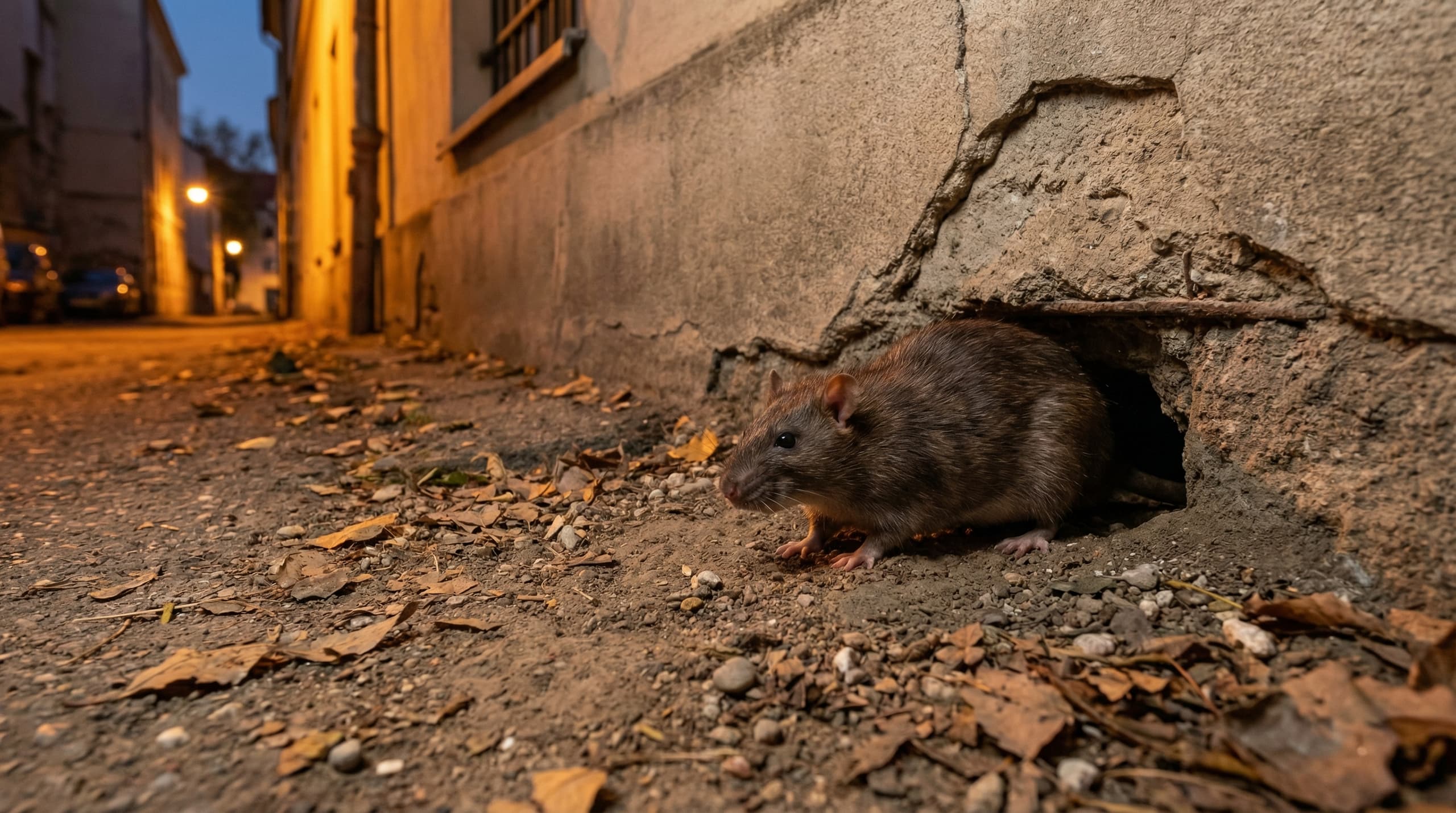
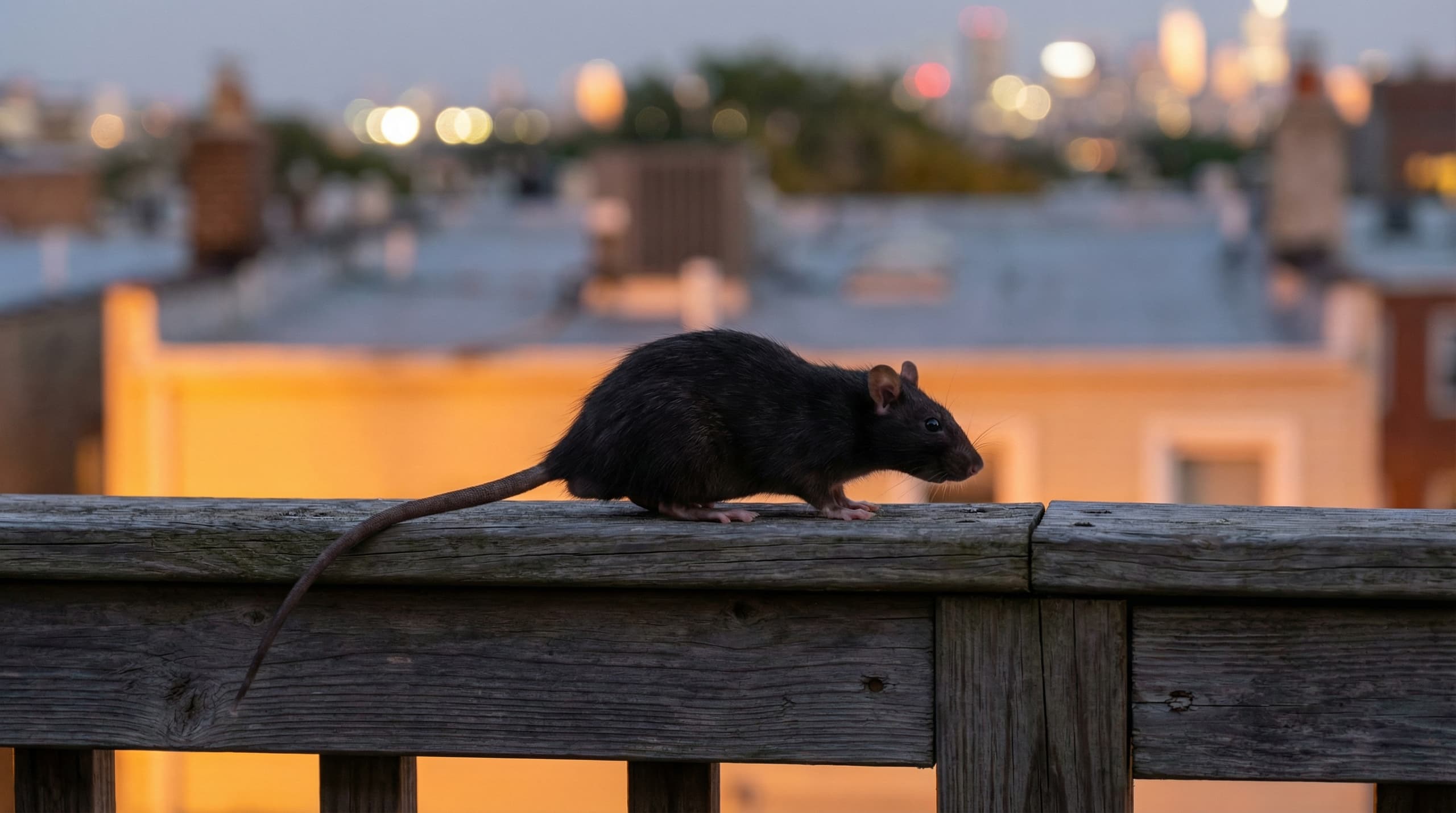
If the animal you saw was bigger than a golf ball, it was a rat. If it was smaller than a walnut, it was a mouse. That's the fast version most Boise homeowners need. Adult Norway rats run 6 to 10 inches in the body alone, not counting the tail, and weigh 10 to 16 ounces. A full-grown house mouse tops out at 3 inches and weighs less than an ounce. There's no in-between.
Rat sightings in Boise are less common than mice, but they're climbing. The Idaho Statesman and KTVB have both reported rising rat activity across the Treasure Valley over the last two years, especially near the river corridor and in older Garden City neighborhoods. If you're seeing signs and you're not sure which one you have, here's the side-by-side.
Rats vs. Mice: The Comparison Table
| Feature | House Mouse | Norway Rat |
|---|---|---|
| Body length | 2.5 to 3.5 inches | 6 to 10 inches |
| Weight | 0.5 to 1 ounce | 10 to 16 ounces |
| Color | Light gray or brown, lighter belly | Brown or grayish-brown, pale gray belly |
| Ears | Large relative to head | Small, thick, close to head |
| Tail | As long as the body, thin, sparsely haired | Shorter than the body, thick, scaly |
| Droppings | 1/8 inch, rice-shaped, pointed ends | 1/2 to 3/4 inch, capsule-shaped, blunt ends |
| Gnaw marks | Small paired grooves in soft materials | Deep chew marks in hardwood, plastic pipe, and drywall |
| Where they nest | Inside walls, attics, drawer voids, appliance motors | Ground burrows at foundations, woodpiles, and dumpster pads |
| Track size | Front feet under 3/8 inch | Front feet 3/4 inch or larger |
| Entry point size needed | Any gap bigger than a dime (1/4 inch) | Any gap bigger than a quarter (1/2 inch) |
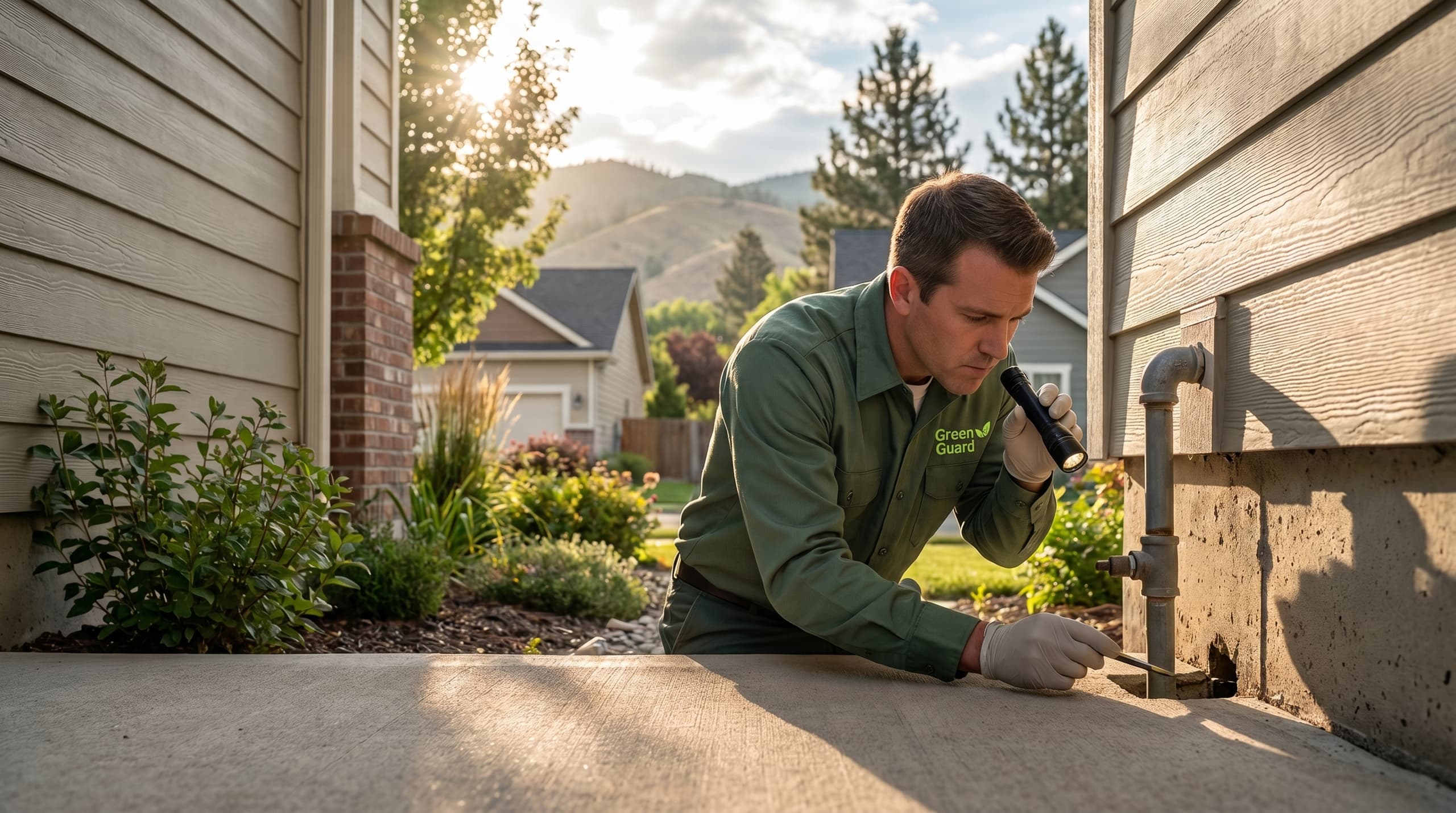
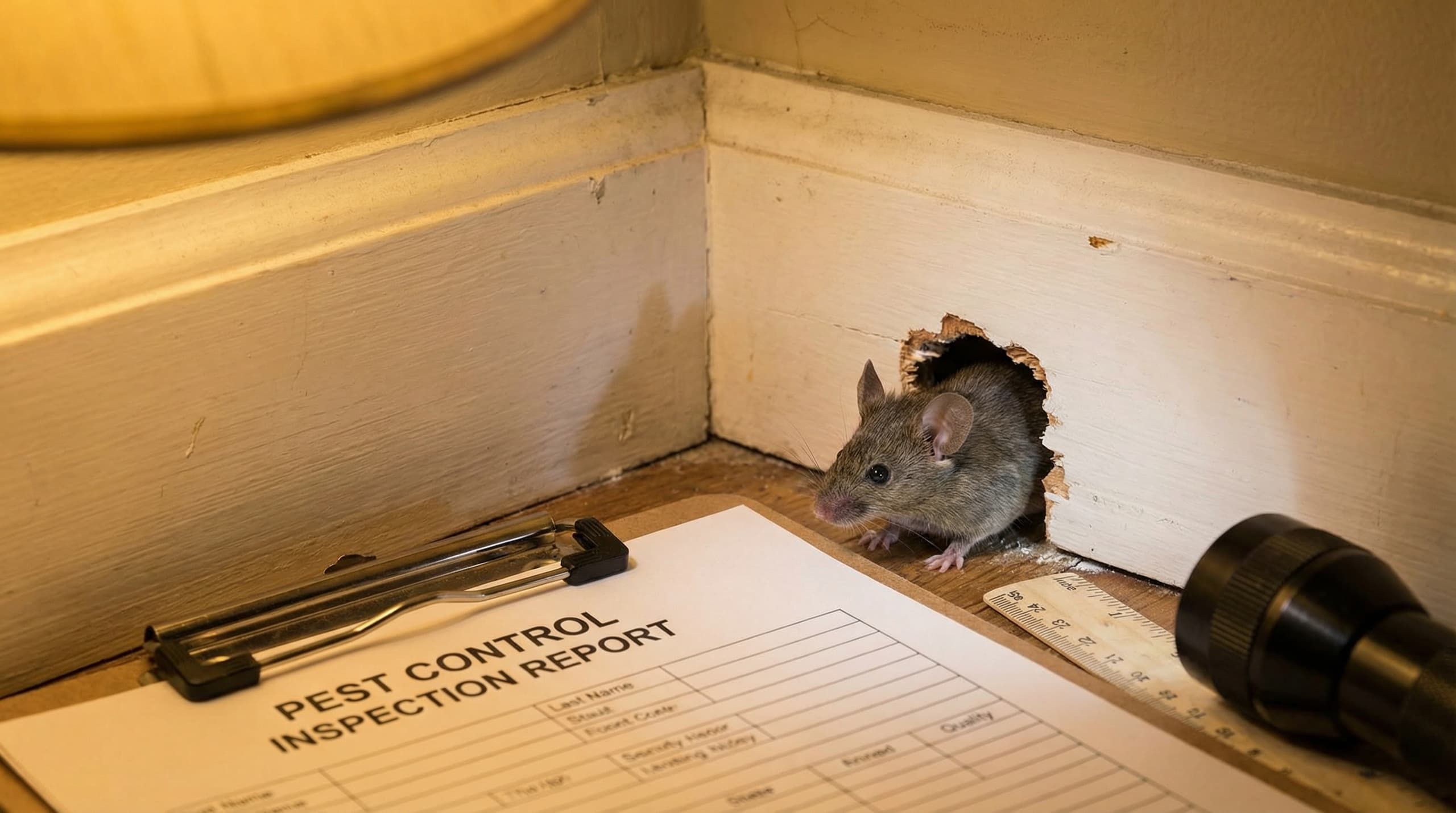
The droppings alone are the single most reliable clue. Grab a flashlight, look along baseboards, in the pantry, in the garage against walls. Rice grain, pointed on the ends? Mouse. Fat brown capsule the size of an olive pit? Rat. You don't need to guess.
Which Rats Actually Live in Boise, Idaho?
The rat you almost certainly have in Boise is a Norway rat (Rattus norvegicus). Also called the brown rat, sewer rat, or dumpster rat. Roof rats are rare in Idaho because our winters are colder than they prefer, and we don't see them regularly in the Treasure Valley the way coastal cities do. Roof rat sightings get reported now and then, but the rat in a Boise, Meridian, Nampa, or Garden City home is almost always a Norway rat.
Norway rats are ground-dwellers. They burrow. That's the single most important behavioral difference between rats and mice for a homeowner to understand. Mice climb walls and nest inside the structure. Rats dig at ground level. You'll find rat burrows next to foundations, under decks, at the base of woodpiles, behind sheds, and along the concrete pad of a garbage dumpster. Look for a hole 2 to 4 inches wide with smooth, packed edges (that's a fur-worn opening) and a fan of loose soil out the front.
The other thing to know: Norway rats travel further than mice. A house mouse rarely leaves a 30-foot radius from its nest. A Norway rat will run 100 to 300 feet between a burrow and a food source. That means the rat you're seeing in your Garden City backyard could be nesting three houses down, near a canal, or under a neighbor's shed. Trapping just your property won't solve the problem if you don't address where they're coming from.
Where Is Rat Pressure Highest in the Treasure Valley?
Rats don't spread evenly across Boise. Risk runs higher in four kinds of zones.
- The Boise River corridor. Norway rats need water daily and follow waterways. The stretch from Garden City through downtown Boise, along the Greenbelt, and out to Barber Park is prime rat habitat. Homes close to the river or a connecting canal are the most exposed. This includes parts of Warm Springs, the North End close to the water, and river-adjacent stretches of Boise Bench.
- Older Garden City and Nampa neighborhoods. Pre-1980 housing stock has more foundation gaps, more detached outbuildings, and more accessible crawlspaces. Combine that with proximity to the river or the Nampa canal system and you have textbook Norway rat habitat. If your home is older than 45 years and has a crawlspace, walk it with a flashlight in September.
- Anywhere near commercial dumpsters. Restaurants, apartments over ground-floor businesses, mini-storage facilities, and construction sites all support resident rat populations that spill into neighboring homes. Downtown Boise, State Street, and the Nampa Karcher Road corridor all fit this pattern. A dumpster 200 feet from your house is a food source, not a boundary.
- Properties with backyard chickens, rabbits, or bird feeders. Spilled feed under a bird feeder or a chicken coop that isn't cleaned daily is one of the biggest rat attractants on Treasure Valley properties. Rats find the feed within a week, burrow nearby, then move into the shed, the garage, and eventually the house.
What Rat Damage Actually Looks Like (And Why It Costs More)
Rat damage is different from mouse damage in scale and severity. A mouse will chew a pencil-sized hole in a pantry box and gnaw baseboards. A Norway rat will chew through a 3/4 inch plywood subfloor, a PEX water line, or a rubber HVAC boot in a single night. That's not exaggeration. Their incisors grow 4 to 5 inches per year and they need to grind them constantly. Building materials are the grindstone.
The most common rat damage patterns on Boise properties:
- Chewed water lines. Especially PEX and older copper-to-PEX transitions in crawlspaces. A pinhole leak from a rat chew can dump 20 to 50 gallons a day into a crawlspace before you notice.
- Gnawed electrical wiring. Rats chew Romex jacketing, exposing the copper. This is a real fire hazard, and it is the leading cause of unexplained rodent-related house fires nationally. If your breaker is tripping intermittently on a circuit that was fine last year, get a rat inspection.
- Structural chew-throughs. Deck ledger boards, garage door bottom rails, plywood sheathing, and shed floors. Norway rats will widen a natural gap into a passage several inches across in a matter of nights.
- Damaged HVAC ductwork. Flexible duct in a crawlspace is a highway. Torn duct means you are heating and cooling the crawlspace and drafting rodent air into your living space.
- Nested insulation. Torn fiberglass or shredded blown cellulose in a crawlspace or attic is a nesting sign. Insulation contaminated with urine and droppings has to be removed and replaced. It cannot be cleaned in place.
Why Rats Are Almost Always a Professional Job
Green Guard handles rats inside your home as part of our general pest control plan. Rats living only outside, in the yard or under a shed, are usually a separate service with separate pricing. We say this up front because we get the DIY question a lot, and with rats specifically, the honest answer is that store-bought equipment is rarely enough. A few reasons.
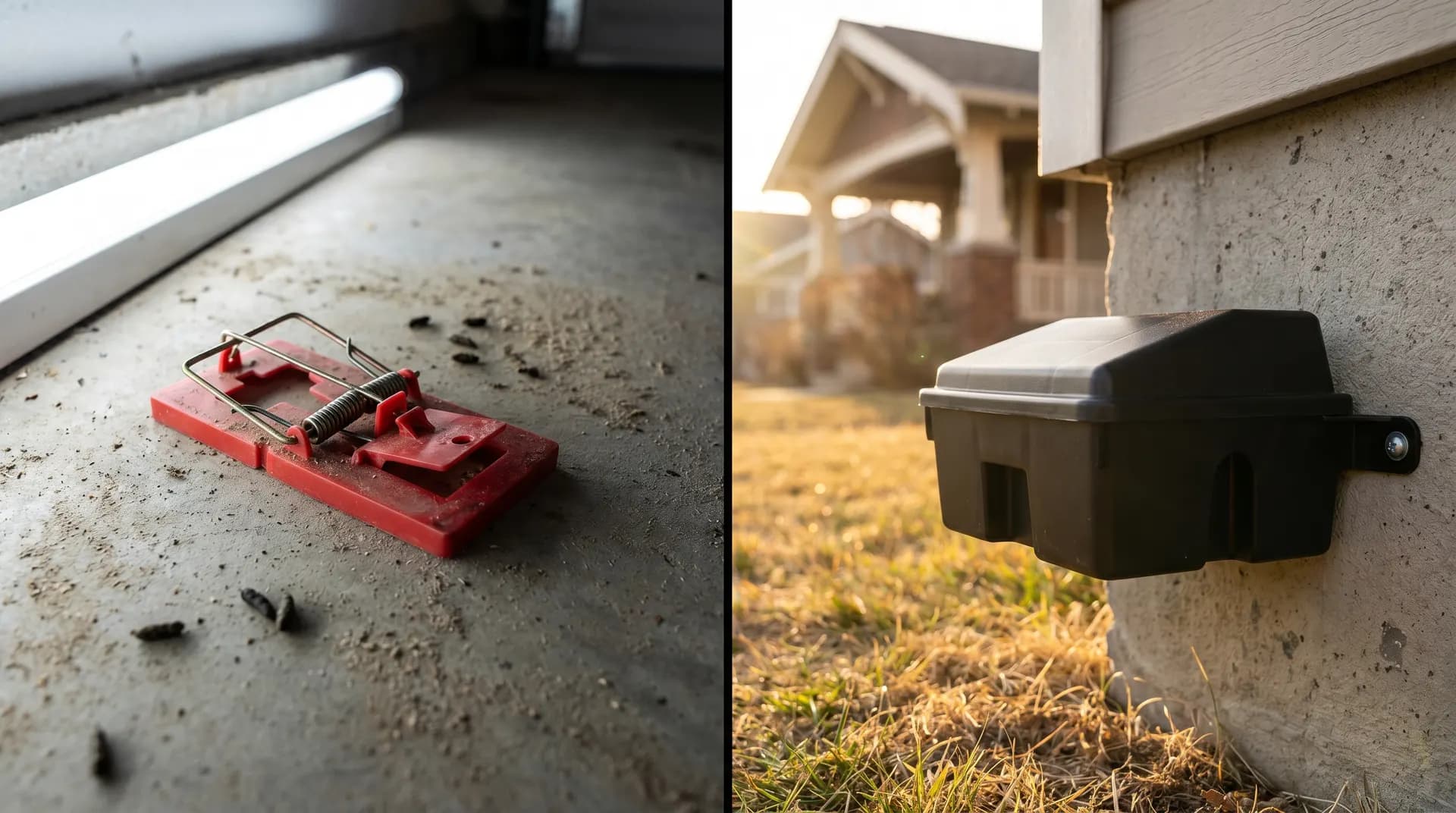
- Trap size matters and store shelves default to the mouse size. A standard mouse snap trap won't close hard enough on a Norway rat to kill or capture cleanly. You need rat-sized T-Rex or Victor Pro traps, and you need them placed correctly against travel paths, not in open floor space where rats won't go.
- Bait station placement is a code and safety issue. Professional rat baiting requires tamper-resistant, weighted, locked stations placed every 25 to 50 feet along the exterior, anchored so wildlife and pets can't move them. Loose bait blocks in a garage are a poisoning risk to dogs, and they're also a legal issue in Idaho if you have children on the property.
- The rat you saw is rarely the only one. Norway rats burrow at foundations, under decks, and in woodpiles, and a homeowner rarely spots most of the burrows in a real Norway rat problem.
- Dead-rat-in-the-wall calls are almost all DIY poisoning gone wrong. Consumer rat poison is the wrong formulation for professional work. Rats often survive long enough to crawl into a wall cavity or crawlspace to die. The smell lasts 2 to 4 weeks and there is no way to remove the carcass without opening drywall. That's a drywall contractor's job, not ours, and it's a big reason we keep bait in locked stations outside.
- Exclusion for rats requires heavier materials than mouse exclusion. Mouse-proofing uses copper mesh and steel wool. Rat-proofing needs hardware cloth (1/4 inch or smaller), sheet metal flashing, or mortar. Rats will chew through anything softer, including cured spray foam and standard weatherstripping. Closing those gaps for good is a job for you or a contractor.
What to Do This Week If You Think You Have Rats
If you saw a rat, or you found droppings the size of an olive pit, or you spotted a smooth-edged hole in your yard, here is the exact order we recommend for a Boise homeowner. This works whether you end up calling us or going the DIY route.
- Confirm the ID. Photograph the droppings next to a coin or a pencil for scale. Rat pellet next to a dime looks like the pellet is bigger than the coin. Mouse pellet next to a dime looks lost.
- Remove the food source. Pull all bird feeders for 30 days. Store chicken feed in a metal trash can with a locking lid. Clean up fallen fruit under trees. Take garbage out in the morning of pickup day, not the night before.
- Walk the perimeter and flag every burrow. Look for holes 2 to 4 inches wide with packed edges and a fan of loose soil. Rats reuse burrows, so old ones with cobwebs across the opening are inactive. Fresh soil at the entrance means active.
- Don't seal anything yet. Wait until trapping and baiting confirm zero activity. Sealing while rats are still inside forces them to chew new exits.
- Call a professional if you found more than one burrow, saw the rat inside your home, or found droppings in more than one room. Any of those three signs means the population is past what DIY snap traps can handle.
How Green Guard Handles Rat Control in Boise
As of August 2026, our rodent service starts with a $49 initial visit, and that covers rats inside your home. A rat call typically covers a full property inspection, exterior tamper-resistant bait stations (rat-sized where needed), and copper mesh in the obvious gaps. Snap traps come out only rarely, when a situation calls for it. Rats living only outside are usually a separate service with separate pricing. Quarterly service keeps the pressure down after the population is knocked out.
A few things that matter about how we work rats specifically:
- Organic-based products where possible. The same hospital-grade formulations we use across the general pest control line. For rats, we do use professional rodenticides when the situation requires it, always in locked exterior stations that pets and kids cannot access.
- Same-day service is often available. Active rat activity isn't a next-week problem. Call (208) 297-7947 and we can usually get a tech to your Boise, Meridian, Nampa, Eagle, or Garden City property within 24 to 48 hours.
- Free re-service between quarterly visits. If rat activity restarts before your next scheduled treatment, we come back at no charge. That's the guarantee.
- Local team, not a call center. The techs running your inspection have worked rat calls along the Boise River, in older Nampa neighborhoods, and near Garden City commercial districts. We know where the pressure comes from.
- Handoff to a specialist when needed. We don't do wildlife trapping, we don't treat termites, and we don't do bed bugs. If your inspection turns up something we don't handle, we tell you and point you to the right vendor.
Rat Control Cost and Timeline in Boise
Rat control in Boise starts with a $49 initial service at Green Guard when you start a quarterly or bimonthly plan. That covers rats inside your home. Rats living only outside are usually a separate service, priced on its own. That first-visit price is the same for all home sizes. From there, ongoing quarterly service is what actually holds a rat problem down long term.
- Quarterly, up to 2,500 sq ft: $119 per treatment, four visits per year.
- Quarterly, 2,501 to 4,000 sq ft: $139 per treatment.
- Quarterly, 4,001 to 5,500 sq ft: $159 per treatment.
- Bimonthly, up to 2,500 sq ft: $99 per treatment, six visits per year. A good fit for river-corridor homes with steady rat pressure.
- One-time service, up to 2,500 sq ft: $200 flat with a 30-day warranty. Not a real fix for an established burrow system, but it works for a single confirmed sighting caught early.
Frequently Asked Questions
Should I worry if I see a rat in my garden?
Quick answerYes, one visible rat almost always means more than one nearby.
Rats are secretive and travel primarily at night, so a daytime sighting or a rat comfortable enough to be seen in the open usually signals an established burrow within 100 to 300 feet. Walk your property that same week and look for 2 to 4 inch burrow holes near foundations, sheds, woodpiles, or dumpsters. If you find even one active burrow, book an inspection. Call (208) 297-7947 and we can usually be out same-day. Rats living only in the yard are usually a separate service from your home plan, so ask about pricing when you call.
How do I know if it's rats or mice in my house?
Quick answerLook at the droppings.
Mouse droppings are rice-shaped, 1/8 inch long, with pointed ends. Rat droppings are capsule-shaped, 1/2 to 3/4 inch long, with blunt ends. That size difference (roughly 10x) is the fastest and most reliable ID. Sightings help too: a mouse is smaller than a walnut, a rat is bigger than a golf ball. Gnaw damage in hardwood or plastic pipe points to rats; small chew holes in soft materials point to mice.
What smell do rats hate most?
Quick answerPeppermint oil, ammonia, and mothballs are the most commonly cited rat repellents online, but the honest answer is that no smell reliably clears an established rat infestation.
Rats will tolerate strong odors when the alternative is winter cold or hunger. Scent deterrents can slow first-time investigation of a new area, but they don't remove a burrow. If you have confirmed rat activity, skip the peppermint and get a trap and baiting plan in place.
What repels rats immediately?
Quick answerNothing repels rats immediately in any lasting sense.
Ultrasonic devices, scent sprays, and predator urine are all short-term at best and ineffective at worst. The only reliable way to move rats off a property is to remove the food source (bird feed, garbage, pet food outside), eliminate the harborage (woodpiles against foundations, dense ground cover, open sheds), and treat active burrows with trapping and professional baiting. That combination usually clears a Boise rat problem in 2 to 4 weeks.
Does Boise really have a rat problem?
Quick answerRat activity in Boise is real and rising, but it's nothing like coastal or Rust Belt cities.
Norway rats concentrate along the Boise River corridor, in older Garden City and Nampa neighborhoods, and near commercial dumpsters. If you're outside those zones, mice are still the more likely rodent in your home. State lawmakers and city officials have both flagged rising rat reports over the last two years, so if you're seeing signs, take them seriously and book an inspection.
How much does rat control cost in Boise?
Quick answerGreen Guard rat control starts with a $49 initial service, which covers rats inside your home and includes the full property inspection, locked exterior bait stations, and copper mesh in the obvious gaps.
Ongoing quarterly service runs $119 to $159 per treatment depending on home size. Rats living only outside are usually a separate service with separate pricing. Most Boise rat problems clear in 2 to 4 weeks with a proper bait-station plan, and quarterly protection keeps activity from coming back.