
Insects
House Flies
Musca domestica
IdentificationHow to Identify House Flies
Quick Answer
House flies are medium-sized gray flies, about 6-7mm long, with four dark stripes running down the thorax. They have large reddish-brown eyes and sponging mouthparts (so they don't bite), plus clear wings.
Full identification notes
They're the most common fly people find indoors across the Treasure Valley.
Free
Re-Service Between Visits
4.9/5
Google Rating
9 to 5
Office Hours, Mon to Fri
House Flies Behavior & Habits
Understanding how house flies behave helps prevent infestations
House flies eat by vomiting digestive juice onto food and sucking the mix back up.
More about their habits
That same fly may have just landed on garbage, dog waste, or a dairy lot, which is how they move bacteria onto your kitchen counter. Females lay eggs in rotting organic matter, and maggots can hatch into adults in about a week during Boise summers.
House Flies Risks & Dangers
What house flies can do to your health and property
Health Risks
House flies are real disease vectors as well as a nuisance.
Property Damage
House flies don't chew or damage your home, but a heavy indoor population almost always points to a sanitation or entry-point problem worth fixing before it gets worse.
Full health and property details
Health Risks
They carry Salmonella, E. coli, and over 100 other pathogens picked up from manure, garbage, and animal waste. A single fly landing on a cutting board is enough to contaminate it.
Signs of House Flies Infestation
Look for these indicators in your home
Signs You Have House Flies
What homeowners spot first
- Flies buzzing around the kitchen sink, dining table, or trash can
- Clusters of flies on south-facing windows or ceiling light fixtures
- Maggots in the garbage can, compost bin, or pet waste outside
More signs to look for
- Dark fly specks (regurgitation and feces) on walls, blinds, and counters
- A sour, rotting smell near a trash area or drain where flies linger
House Flies in Boise & the Treasure Valley
Boise summers and Treasure Valley irrigation ditches keep house fly pressure high from June through September, with peaks near dairies.
More on what we see locally
Across our 2,500+ Treasure Valley homes, the worst kitchen and trash fly calls cluster in Garden City, the Boise Bench, Meridian, and along the Boise River corridor. Homes within a few miles of farms, dairies, or backyard chicken coops get hit hardest, which is why we like to start exterior barrier treatments before Memorial Day for just $49.
How We Handle House Flies
What our approach looks like
We tackle house flies with integrated pest management: find and remove the breeding source, point out the torn screens and door gaps letting them in, and add a perimeter barrier to cut down the flies coming in.
Our full approach
New customers start service for $49, and our quarterly plan at $119 keeps summer fly pressure down all season.
How to Prevent House Flies
Steps you can take to reduce the risk of infestation
- Bag your garbage and keep cans tightly sealed, especially June through September
- Pick up pet waste from the yard daily
- Cover food on the counter and don't leave dirty dishes out overnight
More prevention steps
- Repair torn window screens and add a door sweep if light leaks under your door
- Wash out garbage cans and recycling bins every few weeks
- Move compost piles and backyard chicken coops as far from the house as you can
House Flies Questions Answered
Common questions about identification, prevention, and treatment
Call (208) 297-7947Why are there so many flies in my Boise kitchen?
Quick answerFlies need rotting organic material to breed, so check for uncovered garbage, pet waste in the yard, compost piles close to the house, and torn window screens.
In the Treasure Valley, late-summer kitchen flies often drift in from nearby farm fields, chicken coops, or dairy lots, so an outdoor barrier treatment matters as much as cleaning indoors.
Are house flies actually dangerous, or just gross?
Quick answerBoth.
House flies carry over 100 pathogens including Salmonella and E. coli, and they spread bacteria every time they land on food, a counter, or a cutting board. They don't bite, but the contamination risk is real, especially around kids and pets in the kitchen.
Do bug zappers actually work on house flies?
Quick answerNot well, and they can make things worse.
Zappers pull flies in from a wider area and can spray bacteria-laden particles when they kill them, which is the last thing you want over a patio table. Sealed indoor light traps plus a Green Guard exterior barrier are a cleaner fix. Call us at (208) 297-7947 to set one up.
Similar Pests
Learn about other pests in this category
Related Guides
Expert articles related to house flies in Idaho
 Pest Identification
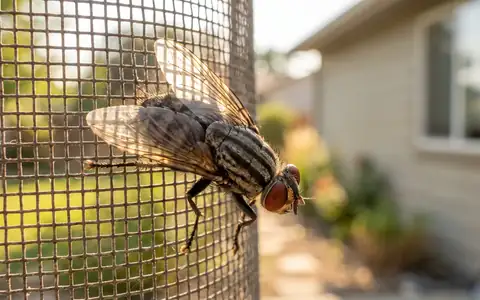
House Flies in Boise: Why Summer Brings an Explosion of Flies and How to Eliminate Them (2026)
Read Article Seasonal Guide
Pest-Proofing Your Boise Backyard for Summer BBQs and Patio Season (2026 Idaho Guide)
Read Article Seasonal Guide
Why Ants Invade Boise Kitchens Every Spring (And How to Stop Them)
Read Article
Think You Have House Flies?
Call and we'll talk through your options. We usually get out within 24 to 48 hours.
Quarterly plans starting at
$119/quarter
- No-Obligation Quote
- Locally Owned
- Free Re-Service Between Visits
Our Pest Control Services
Complete pest protection. Professional solutions for every pest problem, on a quarterly plan or a one-time visit.
General Pest ControlLearn More
Year-round protection packages
Ant ControlLearn More
Carpenter & pavement ants
Spider ManagementLearn More
Black widows & hobo spiders
Rodent ControlLearn More
Mice, rats & voles
Wasp & HornetLearn More
Nest removal & prevention
Mosquito & OutdoorLearn More
Mosquitos, ticks & fleas
Eco-FriendlyLearn More
Pet & kid safe options
CommercialLearn More
Business & warehouse
Proudly Serving the Treasure Valley
Local technicians from the Treasure Valley, in Boise, Meridian, and surrounding communities.
Pest Control Resources
Expert tips & guides. Local pest knowledge from Boise's trusted exterminators