Quick answer
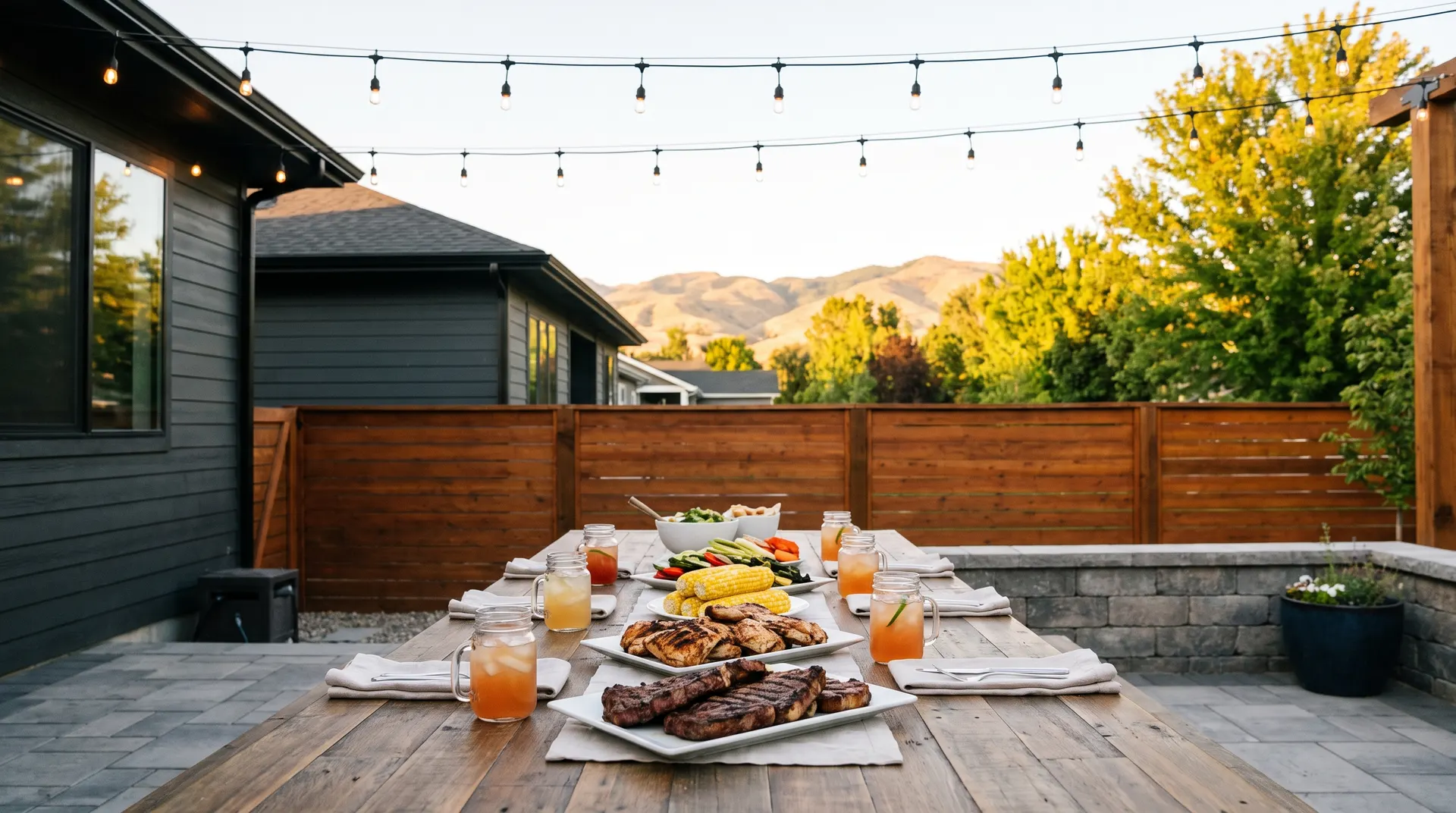
Boise backyards crowd up with wasps, mosquitoes, ants, and flies the minute you fire up the grill. Do a 10-minute standing-water audit 48 hours out, knock any wasp scouts before nests form, sweep a granular bait line 3 feet off the foundation, and book a barrier treatment 72 hours before your event. Quarterly backyard pest control in Boise starts with a $49 first visit and locks the perimeter for the rest of summer.
Key Takeaways
- The single biggest win is a 48-hour standing water audit. Kiddie pools, plant saucers, blocked gutters, and sump pump runoff drive 80% of mosquito complaints in the Treasure Valley.
- Knock scout wasps the first week you see them. One scout in May means an established nest by July, and yellow jacket colonies in Boise can top 5,000 workers by late August.
- Time treatments to your event. Full barrier sprays need 72 hours to dry and bond. Spot treatments work 24 hours out. Same-day spraying right before guests arrive does almost nothing.
- Patio pavers are the #1 ant hot spot. A granular bait sweep 3 feet from the foundation, plus regular sweeping of paver edges, cuts trail formation more than any indoor spray.
- Quarterly service ($119) plus a seasonal mosquito add-on covers most Boise yards through Labor Day. The $49 initial visit is the cheapest way to get the first barrier down before your next party.
In this article

The 7-Step Backyard Pest Checklist (Run This Before Every Party)
Short answer: work the perimeter, not the patio. The pests crashing your BBQ are coming from somewhere within 30 feet of your back door. If you cut off water, food, and shelter at the edge, the middle of the yard cleans itself up.
Here is the priority order we use on our own service calls. Do these in sequence, not in random order. The first three matter most.
- Empty standing water 48 hours before. Kiddie pools, dog bowls, plant saucers, the wheelbarrow in the side yard, the bucket under the downspout. Mosquito eggs hatch in 24 to 72 hours in Boise heat.
- Sweep your paver edges and foundation line. If you see a trail of small dark ants, you have a colony already. Knock the trail down with soapy water and lay a granular bait 3 feet out from the foundation.
- Knock wasp scouts before nests form. One paper wasp checking out your eave is a scouting queen. Spray her with a soapy-water bottle. Do not wait. By July she will have 50 workers backing her up.
- Book a barrier treatment 72 hours before the event. The active ingredient needs time to dry, bond to surfaces, and start killing on contact. Same-day spraying is mostly theater.
- Lid your trash cans and keep them 20 feet from the seating area. Yellow jackets and house flies will find any uncovered protein within an hour. The 20-foot rule is the easiest single fix.
- Cover food until plates are made. Mesh tents are $8 at Ace. They keep yellow jackets off chicken and watermelon, which is where they get aggressive.
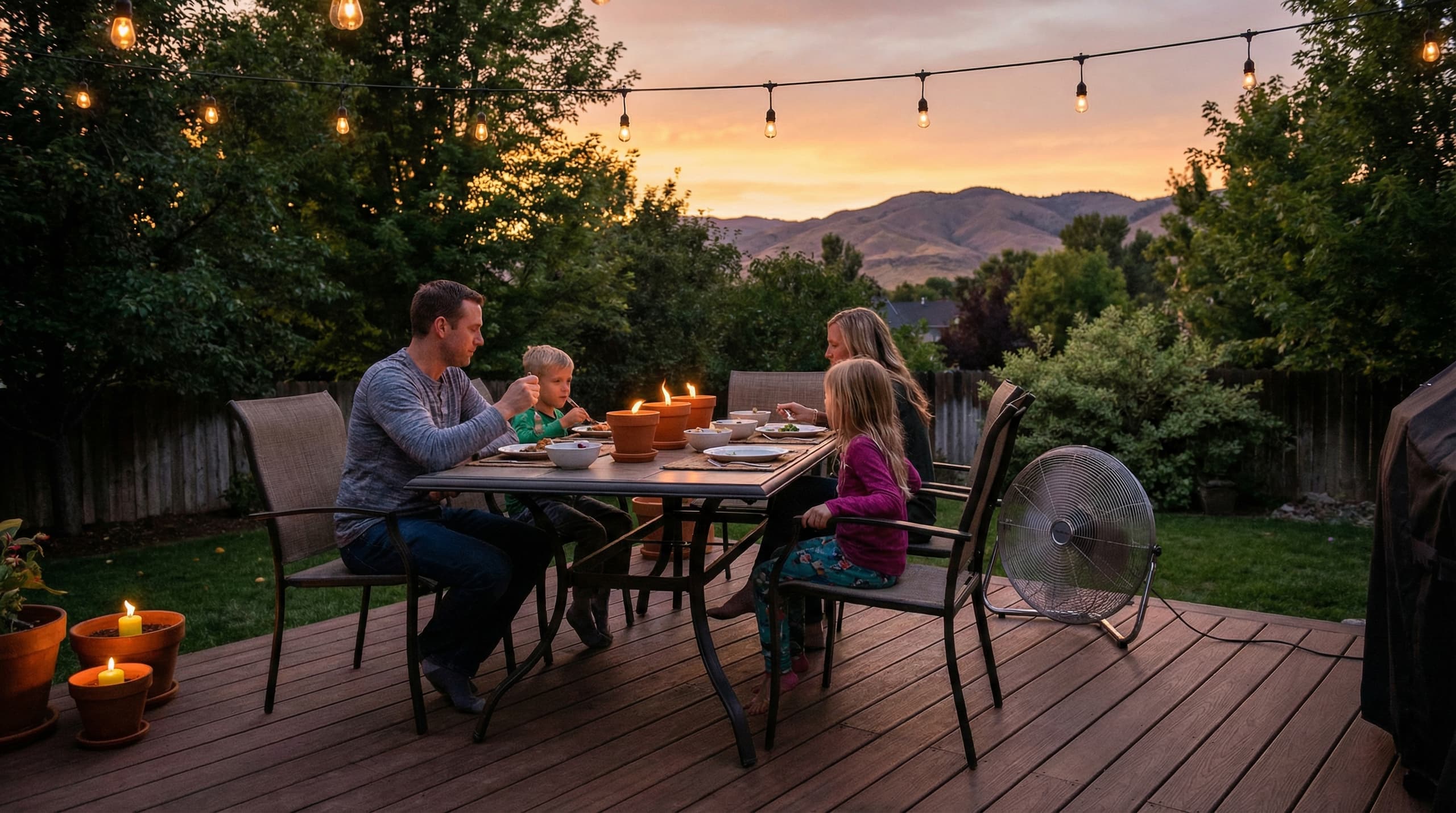
- Run a box fan or oscillating patio fan. Mosquitoes are weak fliers. A breeze over 4 mph on the seating area makes you invisible to them. This trick alone changes how comfortable an evening party feels.
Why Boise Backyards Get Slammed in June, July, and August
The Treasure Valley sits at the bottom of a high-desert basin with a giant network of irrigation canals running through it. That combination is rough on a homeowner trying to host outside. Irrigation laterals keep the soil moist enough for mosquito breeding and ant nesting all summer, while the dry overhead air pushes pests toward whatever water source they can find. That source is usually your yard.
Boise backyards follow the same pattern every summer. Memorial Day kicks off the first wave of mosquitoes and ants. By the Fourth of July, wasps are everywhere. By August, yellow jackets are flat-out aggressive at backyard cookouts. If you want the deeper seasonal breakdown, our Idaho pest calendar covers the full month-by-month picture. Across the Treasure Valley, pest pressure tends to jump in late June and again in early August.
A wet spring and heavy snowpack runoff can stretch canal flows longer than normal. That means more standing water in places homeowners do not check.
Wasps and Yellow Jackets at the Picnic Table
Direct answer: wasps are the #1 reason a backyard party turns stressful. The fix is half prevention (kill scouts in May and June, knock small nests in June and July) and half logistics (lid your trash, cover food, move sweet drinks). By August it is too late for prevention. You manage the colony, not eliminate it.
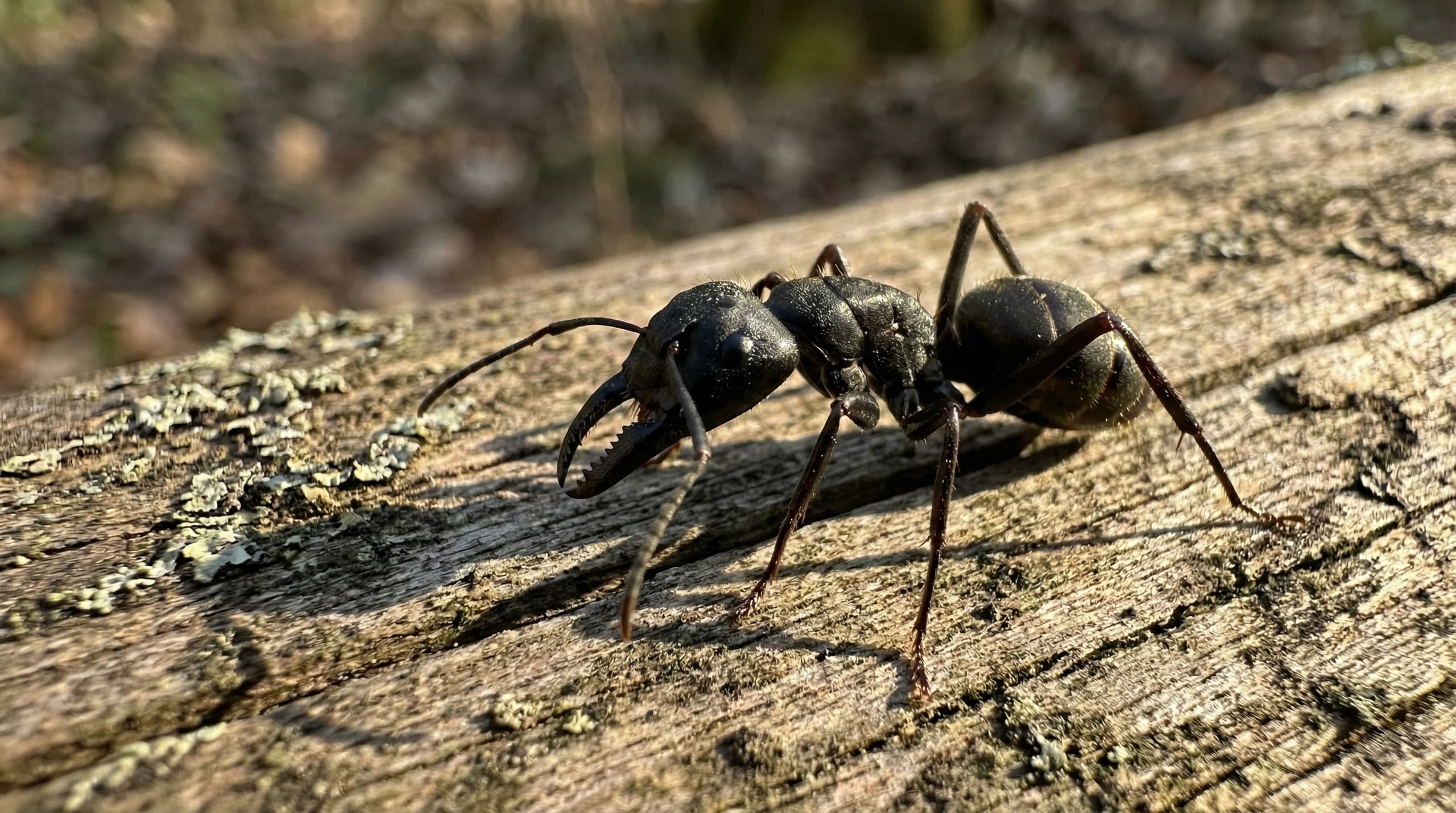
Two species drive most of the Boise complaints. Paper wasps build the umbrella-shaped nests under eaves, in playsets, and behind shutters. They are not particularly aggressive, but a kid running into one nest can end the afternoon. Yellow jackets are the dangerous ones. They nest hidden, often in old rodent burrows in the lawn or in wall voids, and they get aggressive in August and September when their natural food sources crash and they switch to scavenging human food. Our guide to finding yellow jacket nests in walls and lawns in Boise covers exactly where to look (and why you should not seal the entry once you find it).
The 3-Part Wasp Strategy for Outdoor Events
This is what we tell customers who host weddings, graduations, and big birthdays. It works.
- Inspect the perimeter the week before. Walk every eave, the underside of the deck, the kids playset, the BBQ island, and the soffits. Any small nest the size of a golf ball or bigger goes down now. Our wasp nest removal guide covers what is safe to knock yourself.
- Set decoy traps 20 to 30 feet from the party area. Hang them upwind. Bait with a piece of grilled chicken for yellow jackets and a sugar-water mix for paper wasps. The goal is to pull them away from the seating, not to wipe out the colony.
- Move trash cans and recycling 20 feet out, sealed. A single uncovered Coke can will pull 30 yellow jackets in five minutes once they find it. Get the cans away from the seating before they get the chance.
Mosquitoes at Dusk in the Treasure Valley
Direct answer: 80% of backyard mosquito problems in Boise come from standing water you can fix in 10 minutes. The other 20% is irrigation infrastructure (canals, laterals, neighboring fields) that you cannot fix, but can dampen with a barrier treatment and good fan placement. For the full season picture, see our peak mosquito season in Boise guide.
The two species that matter most in Treasure Valley backyards are Culex tarsalis (the West Nile carrier) and Aedes vexans, the floodwater mosquito that explodes in numbers after irrigation cycles. Both lay eggs in water that sits longer than 5 days. Your job is to make sure no water in your yard sits that long.
The 10-Minute Standing Water Audit
Walk the yard with a notepad. Tip out, drill a drain hole in, or refresh the water in every container you find. The hot spots most homeowners miss are not the obvious ones.
- Plant saucers and pot trays. Especially the ones tucked behind the patio set. A 3-inch tray can hatch 100 mosquitoes.
- Kiddie pools and water tables. If the kids will not be using it this week, dump it and store it upside down.
- Gutters and downspout boots. Clogged sections hold water for weeks. This is the single biggest hidden source in Boise homes.
- Sump pump discharge runoff. If your sump pumps daily and the water pools on the side yard, that pool is breeding territory. Run the discharge to a dry well or into landscaping that absorbs it.
- Tarps, kayaks, wheelbarrows, sandbox lids. Anything with a curve that holds half a cup of water for a few days.
- Bird baths and pet bowls. Refresh every 2 days. Mosquito eggs need still water, not running water.
- Old tires, jugs, buckets in the side yard. The forgotten zone. Every Boise yard has one.
Barrier Treatments and the Box Fan Trick
When the audit is not enough (or when canal pressure is high in Eagle and Star), the next step is a backyard barrier treatment on landscaping. We hit the underside of shrubs, the lower 5 feet of trees, fence lines, and shaded ground cover. That is where adult mosquitoes rest during the day. A treatment 72 hours before an event knocks the resting population down, and it keeps working for the next 21 to 28 days. For DIY prevention work between visits, our Boise yard mosquito prevention guide walks through every step.
The other low-cost trick that actually works: a 20-inch box fan aimed at your seating area. Mosquitoes cannot fly through a steady breeze over 4 mph. You do not need to spray people with repellent if you put one fan at each end of the patio. We use this at our own family BBQs and it is the cheapest mosquito fix in the Treasure Valley.
Pavement Ants and Odorous House Ants on the Patio
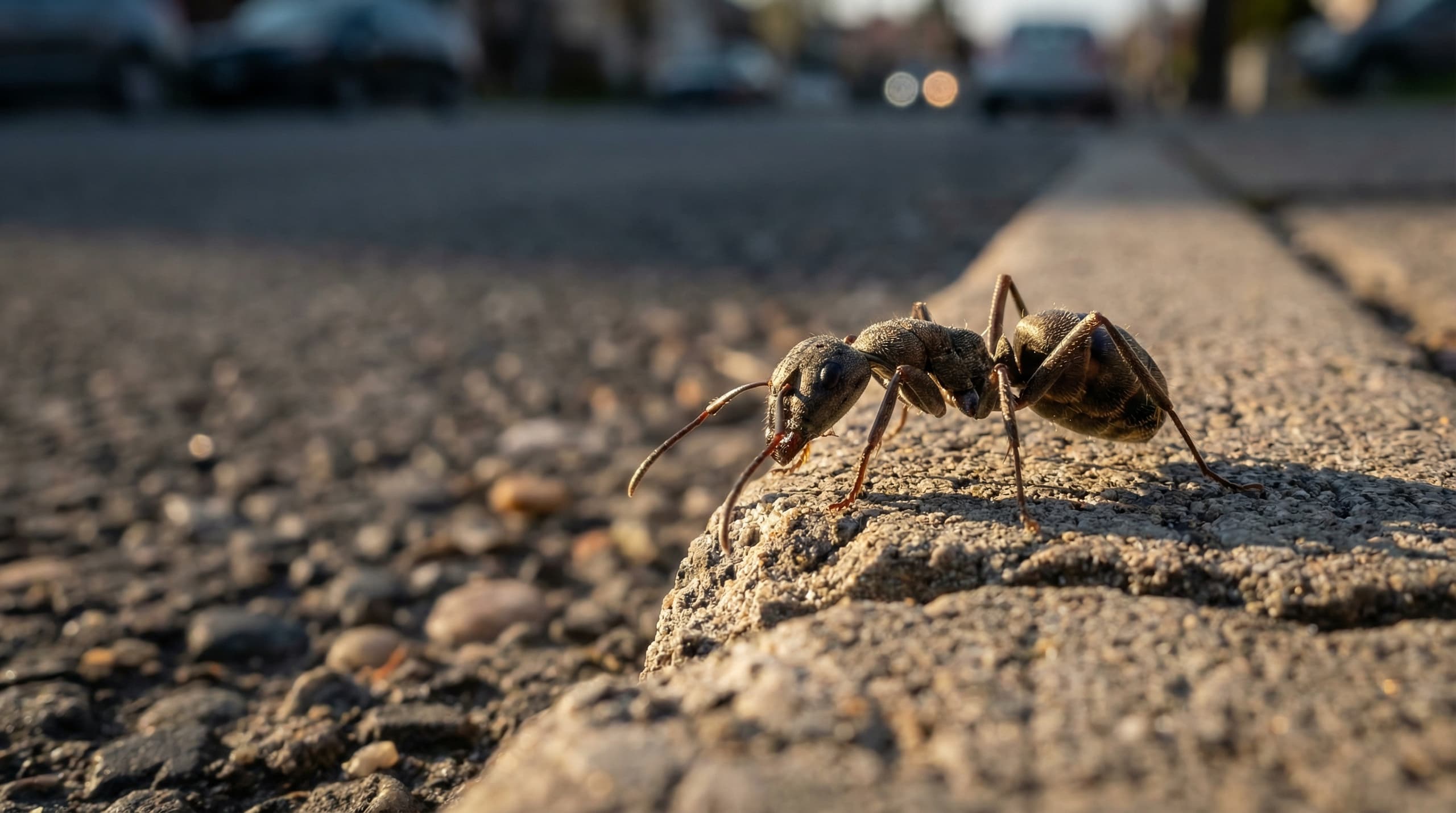
Direct answer: the small dark ants you see streaming across your patio pavers are either pavement ants or odorous house ants. Both nest in the sand under your pavers and in the soil along your foundation. The fix is a granular bait perimeter, sealed expansion joints, and consistent crumb cleanup. For the full breakdown including bait selection, see our ants in patio pavers Boise guide.
What most homeowners get wrong: they spray the visible ants on the pavers. The visible ants are 10% of the colony. Killing them does nothing to the 5,000 ants still under the pavers, and the trail just reroutes to a different paver gap. You have to bait, not spray.
The 3-Foot Granular Bait Perimeter
Pick up a bag of granular ant bait (we use professional formulations, but Maxforce Complete or Advion at the hardware store works fine for DIY). Apply a light, even ring 3 feet out from the foundation on all sides of the house, plus around the patio edges. Wait 7 to 14 days. The workers carry the bait back to the queen and the colony collapses from the inside.
- Apply on a dry day, not before rain. Granular bait dissolves and loses potency once it gets wet.
- Avoid spraying any non-bait pesticide on the same area for 2 weeks. It kills the workers before they can deliver the bait.
- Sweep paver joints clean of crumbs, pet kibble, and spilled drinks. Ants follow scent trails to food sources. Cut the food and the trail dies.
- Re-seal cracked paver joints with polymeric sand every 2 to 3 years. That sand cures hard and blocks the entry holes ants use.
House Flies and Trash-Can Flies Around the Grill
Direct answer: flies are a sanitation problem before they are a pest problem. Clean your grill grates, seal the trash, and create a 15-foot buffer between the food prep area and the fly source. The pests do the rest.
House flies are drawn to two things: protein decay (grease drippings, raw meat juice, last week's chicken bones in the trash) and dog waste. Fly pressure is worst in yards where the trash can sits next to the patio and the dogs use a corner that does not get scooped daily. Both fixes are free.
- Scrape the grill before each cook. Old grease pulls flies from neighboring yards. A wire brush takes 90 seconds.
- Trash can lid and 20-foot buffer. Same rule as wasps. The lid matters more than the buffer.
- Scoop dog waste daily during summer. One pile pulls 50 flies in a hot afternoon.
- Run a fly tape boundary 15 feet from the food. Hang 2 or 3 strips upwind of the prep area. Cheap, effective, and the flies that find your yard end up on the tape instead of the burgers.
- Try the ginger and clove trick. Flies hate the smell. Put a few cloves stuck into a halved lemon on the table. Cheesy, but it works.
Crickets and Earwigs Hiding in Mulch Beds
Direct answer: crickets and earwigs do not bite people, but they freak guests out when they jump onto a sandal or wriggle up a planter at twilight. The fix is reducing harborage (deep mulch, dense ground cover, leaf piles) and treating the perimeter granular bed.
Both species hide in damp, dark spots during the day and come out at dusk, which is exactly when your party is happening. Our cricket control guide for Boise and earwig control guide for Boise cover the long-term fixes. For event prep, work the perimeter.
- Pull mulch back 6 inches from the foundation. A bare strip of soil dries out fast and discourages both species from nesting against the house.
- Sweep granular insect bait into the mulch bed. Same product as the ant ring, applied a little heavier. Crickets and earwigs feed at night and die before dawn.
- Replace high-wattage porch bulbs with yellow bug bulbs. Crickets are drawn to white light. A warm yellow bulb cuts the porch swarm by half on a July evening.
- Move firewood stacks away from the patio. Earwigs love the dark gaps under stacked wood. Stack at least 20 feet from any seating area.
Neighborhood-Specific Pest Pressure (Boise, Eagle, Meridian)
We treat homes across the entire Treasure Valley and the pest pressure is genuinely different street to street. If you are hosting a backyard event, here is what we know about each area.
Boise North End and Foothills
Mature trees and dense overhead canopy create wasp nest hot spots. Bald-faced hornets are common in the foothills (Hidden Springs, Boise Heights, Avimor) because they need tall trees and cavities. Walk every eave, soffit, and tree branch overhang the week before your party. North End specifically has high paper wasp pressure due to older homes with weathered eaves and lots of nest-friendly hardware (decorative shutters, garage door tracks, light fixtures). For the safest removal approach see our wasp nest removal guide.
Eagle and Star Along the Irrigation Laterals
This is mosquito country in the Treasure Valley. Properties on or near a lateral, ditch, or canal see 3 to 5 times the mosquito pressure of homes a few blocks away. If you are in Eagle off Hill Road, Star along the Phyllis Canal, or any acreage with a flood-irrigation pasture nearby, plan on a barrier mosquito treatment in addition to the standing water audit. The audit alone will not be enough. Schedule the treatment 72 hours before the event and ask us about back-to-back applications for weekly evening gatherings.
New Meridian and South Boise Subdivisions
Construction in a subdivision disturbs underground ant colonies for years after the bulldozers leave. New Meridian developments (anything built since 2020 in Lochsa Falls, Bainbridge, Linder Village, plus south Boise areas off Lake Hazel) see high pavement ant pressure on patios for the first 5 years. The ants are not coming from your yard. They are coming from the lot next door that is still being graded. Plan on monthly granular bait sweeps through the first three summers, and lock in quarterly service so the colony pressure never builds up.
When to Treat: 72 Hours, 24 Hours, or Forget It
Direct answer: the timing of a treatment matters more than the product. A great treatment applied 4 hours before guests arrive does almost nothing. A decent treatment applied 72 hours out can knock pest pressure way down for the rest of the month.
Here is how we time treatments for our customers who host events.
- 72 hours before: Full barrier spray on the perimeter, eaves, soffits, foundation, and patio edges. Mosquito barrier on shrubs and the lower tree canopy. Granular bait in mulch beds. The product needs this window to dry, bond, and start working before guests arrive.
- 24 hours before: Spot treatments on any new wasp nests, ant trails that pop up after the main treatment, and visible mosquito harborage. This is also when you do the standing water walk-through one more time.
- Day of: Logistics only. Set fans, set decoy traps, set fly tape, lid the trash, cover the food. No fresh spraying. The chemistry needs time you do not have at this point.
What Standard Service Covers vs Backyard Add-Ons
A common question we get: "Does my regular pest control cover the mosquito stuff for my BBQ?" Short answer: not all of it. Here is the line.
Included in standard quarterly or bimonthly service: full perimeter barrier spray, eave sweeping for spider webs and wasp nest starts, foundation treatment, granular bait in landscape beds, garage and utility area, and any visible ant trails. This handles most of what shows up at a backyard party. If you are on quarterly service ($119 per visit for homes up to 2,500 sq ft) or bimonthly ($99 per visit for the same size), this is already locked in.
Backyard event add-ons (not included by default):
- Mosquito barrier treatment. Add-on service, lasts 21 to 28 days per application. Most clients book a mid-June application and a mid-August application to cover the whole season.
- Full-yard ant treatment. Goes beyond the perimeter to treat the lawn and landscape itself. Useful for properties with persistent pavement ant pressure on patios and walkways.
- Wasp/yellow jacket nest removal. If a nest is bigger than a golf ball or located in a hidden spot (wall void, ground burrow, soffit), we handle it as a separate service. Same-day service is often available.
- Pre-event spot treatment. If you are hosting a wedding, graduation, or major event, we can schedule a targeted treatment 72 hours out as a one-off.
How Much Does Backyard Pest Control in Boise Cost (And When to Book)?
If you are reading this in late June or early July, the smartest move is to start service now and have the first barrier down before your next event. Here is how the pricing works for Boise backyard pest control.
- $49 initial service. Same for any home size. Includes the first full perimeter treatment, eave sweep, and inspection. This is your first barrier and it covers the rest of the summer.
- $119 quarterly for homes up to 2,500 sq ft, billed per visit. Four treatments a year, one a season. Free re-service between visits if pests come back.
- $99 bimonthly for the same size home if you want six visits a year and the tightest coverage possible during the hot months.
- Add the mosquito barrier if you have any irrigation pressure or you host frequently. Most Eagle, Star, and west Meridian customers add it. Boise Bench and South Boise customers often do not need to.
What Standard Pest Plans Cost
| Plan | Home size | Price |
|---|---|---|
| Initial Service with a quarterly or bimonthly plan | Any home size | $49 |
| Quarterly Service | Up to 2,500 sq ft | $119 |
| 2,501 to 4,000 sq ft | $139 | |
| 4,001 to 5,500 sq ft | $159 | |
| Bimonthly Service | Up to 2,500 sq ft | $99 |
| 2,501 to 4,000 sq ft | $119 | |
| 4,001 to 5,500 sq ft | $139 | |
| One-Time Service | Up to 2,500 sq ft | $200 |
| 2,501 to 4,000 sq ft | $225 | |
| 4,001 to 5,500 sq ft | $250 |
Frequently Asked Questions
How much does it cost to have my yard sprayed for bugs in Boise?
Quick answerGreen Guard starts quarterly or bimonthly plans with a $49 first treatment, then $99 to $159 per visit depending on home size.
A one-time spray with no subscription runs $200 to $250. A backyard mosquito barrier add-on is priced separately and lasts 21 to 28 days per application. Call (208) 297-7947 for an exact quote on your property.
How do I get rid of pests in my yard before a BBQ this weekend?
Quick answerRun the 10-minute standing water audit today (dump every container that holds water).
Knock any visible wasp nests with a long-reach product or call us to handle hidden ones. Book a full perimeter barrier treatment for at least 72 hours before guests arrive so the product has time to dry and bond. Last-minute spot treatments work 24 hours out, but same-day spraying right before the party does almost nothing.
What kind of pest control is safe to use around kids and pets at a backyard party?
Quick answerGreen Guard uses organic-based, hospital-grade products that are safe for kids and pets once dry (about 30 to 60 minutes).
For mosquitoes on skin, stick to EPA-registered repellents like picaridin or oil of lemon eucalyptus. Avoid spraying insecticide on food prep surfaces, food, or guest seating. The barrier products are designed for landscape and structural surfaces, not skin or plates.
Why do wasps keep showing up at my Boise patio every August?
Quick answerLate summer is when yellow jacket colonies hit peak size (often 2,000 to 5,000 workers in the Treasure Valley) and their natural food sources crash.
They switch to scavenging human food, which is why August and September are the most aggressive months. Knock scout nests in May and June, lid your trash 20 feet from the patio, cover protein dishes, and set decoy traps 20 to 30 feet upwind to pull them away from guests.
Do I need a separate mosquito treatment or does regular pest control cover it?
Quick answerMosquito treatment is a separate add-on, not part of standard quarterly or bimonthly service.
The standard plan handles the perimeter, eaves, foundation, and landscape beds. For mosquitoes you need a barrier spray on shrubs and the lower 5 feet of trees, which targets resting adults. One treatment lasts 21 to 28 days. If you live near an irrigation lateral in Eagle, Star, or west Meridian, the add-on is worth it. Boise Bench homes usually do not need it.