Quick answer
Mud daubers in Idaho are slender, solitary wasps with a thread-thin waist that build small clay tubes under eaves, in garages, and inside open sheds across the Treasure Valley. They almost never sting people and they hunt spiders for a living, including black widows. A nest in a quiet corner isn't an emergency. You still don't want them building on your house, though. If a tube cluster is in a doorway or active work area, knock it down at night with gloves and a putty knife, or call Green Guard at (208) 297-7947. Our quarterly plan starts with a $49 first visit.
Key Takeaways
- Mud daubers are solitary wasps. One female builds the whole nest. There is no colony to defend, no swarm, and almost no risk of getting stung.
- The tell is the nest. Stacked, finger-sized mud tubes built side by side or in a small clump. Paper wasps and hornets do not build with mud.
- Idaho mud daubers hunt spiders. A single nest can store 500+ paralyzed spiders, including black widows, as food for their young.
- Nests on outbuildings, fences, and quiet eaves are low risk. Knock them down right away when they are over a doorway, a patio, or a play area. You still don't want them building on the house, and our quarterly eave sweeps clear new nests.
- Removal is easy. At night, with gloves, scrape the dry mud off with a putty knife. Soapy water on the spot keeps a new female from rebuilding.
In this article
What Mud Daubers Look Like in Idaho
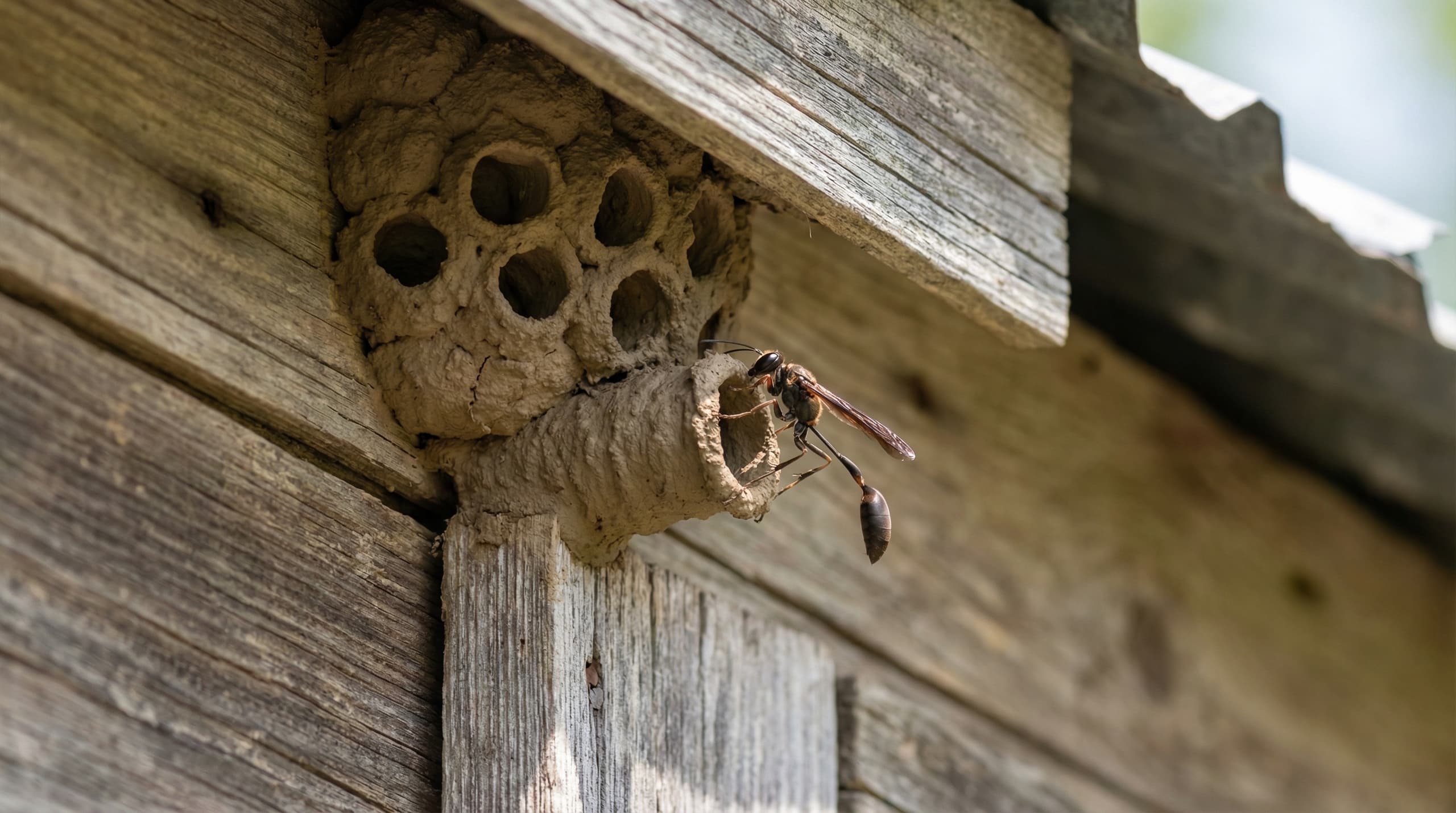
Mud daubers are slender, solitary wasps with a thread-thin waist that connects the thorax to the abdomen. That wire-like waist is the field tell. Nothing else flying around a Boise yard has a segment that narrow. Most mud daubers run about a half inch to an inch long, with long legs that hang loose in flight.
Two species cover almost every mud dauber in the Treasure Valley. The black and yellow mud dauber (Sceliphron caementarium) is dull black with bright yellow legs and yellow patches on the thorax. The blue mud dauber (Chalybion californicum) is shiny metallic blue, all over, no markings. Both show up across Boise, Meridian, Eagle, and Nampa from late May through early September.
If you see one in your garage or hovering near a south-facing wall, it is almost certainly one of those two. They fly slow and a little wobbly. They look more like a flying ant on stilts than a yellow jacket. Mud daubers are easy to mistake for more dangerous wasps, so the ID often comes as a surprise.
Mud Dauber Nests: Those Clay Tubes Are the Real ID
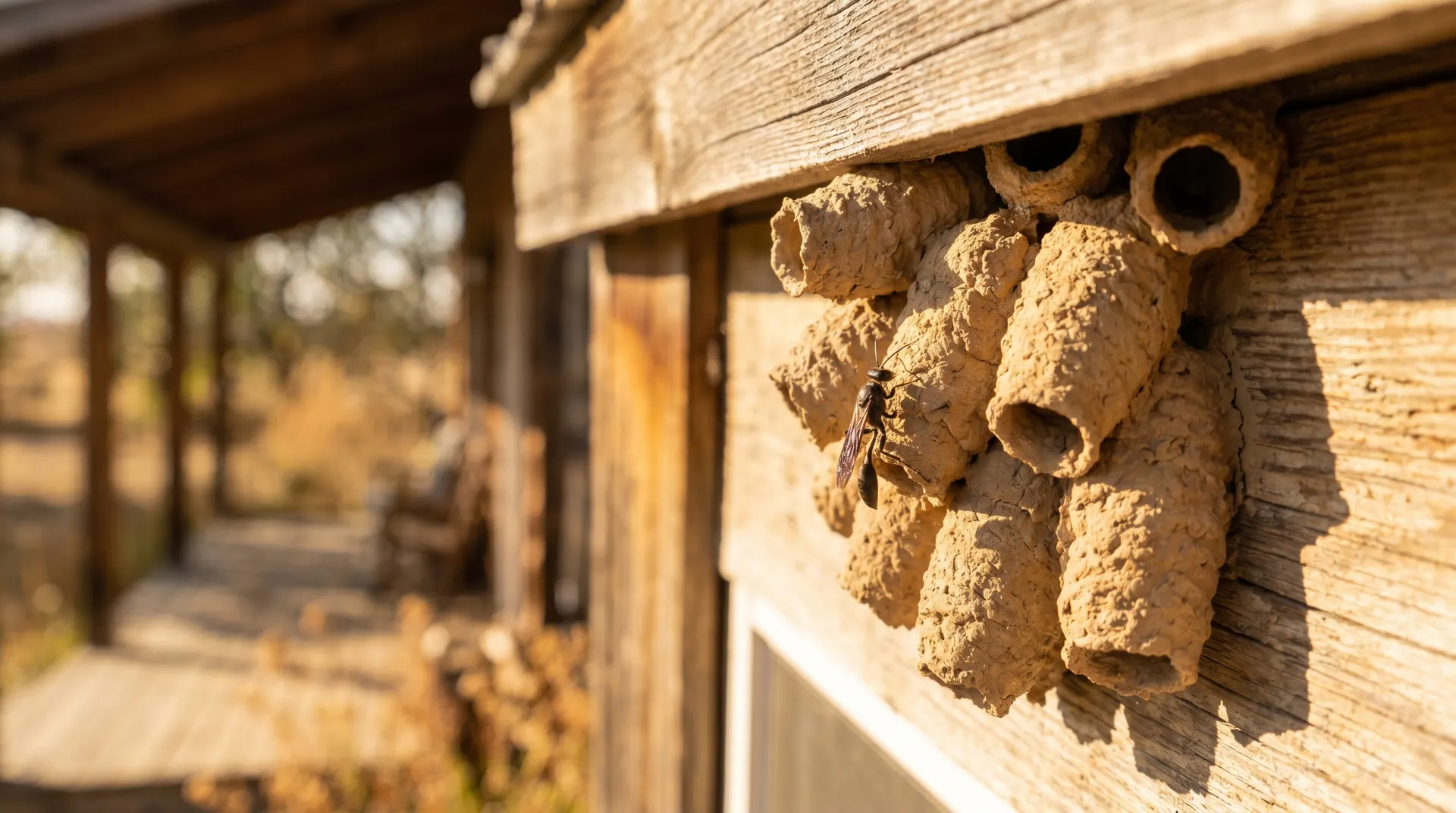
The nest tells you more than the wasp does. Mud daubers build small clay tubes, about an inch long and the thickness of your pinky finger, stacked side by side or clumped together. The color matches the local dirt, so most Treasure Valley mud dauber nests are a dusty tan or grayish brown.
The black and yellow species builds messy little clusters that look like clay sausages glued together. The blue mud dauber is the cheater of the group. She does not build her own nest. Instead, she finds an abandoned black and yellow nest, cleans it out, restocks it with fresh spiders, and lays her own eggs inside.
- Under eaves on the south and west sides of the house. The sun warms the wall and the mud dries fast
- Inside garages and sheds left open during the day. A favorite spot, because the walls stay dry and out of the weather
- Under porches, deck overhangs, and patio covers. Quiet corners with no foot traffic
- On the back of barns, pump houses, and outbuildings. Common across Star, Kuna, and rural Caldwell properties
- Tucked into the rafters of carports and pole barns. Often missed for a full season
- Inside open BBQ covers and unused garden tools. Check before you fire up the grill
Mud Dauber vs Paper Wasp vs Yellow Jacket vs Bald-Faced Hornet
This is where most homeowners get tripped up. All four wasps show up on Idaho homes in summer, but only one of the four is mostly harmless. Getting the ID right saves you from a panicked spray on a nest that was doing you a favor. You still don't want any of the four nesting on your house. Our quarterly eave sweeps knock down new nests before they grow.
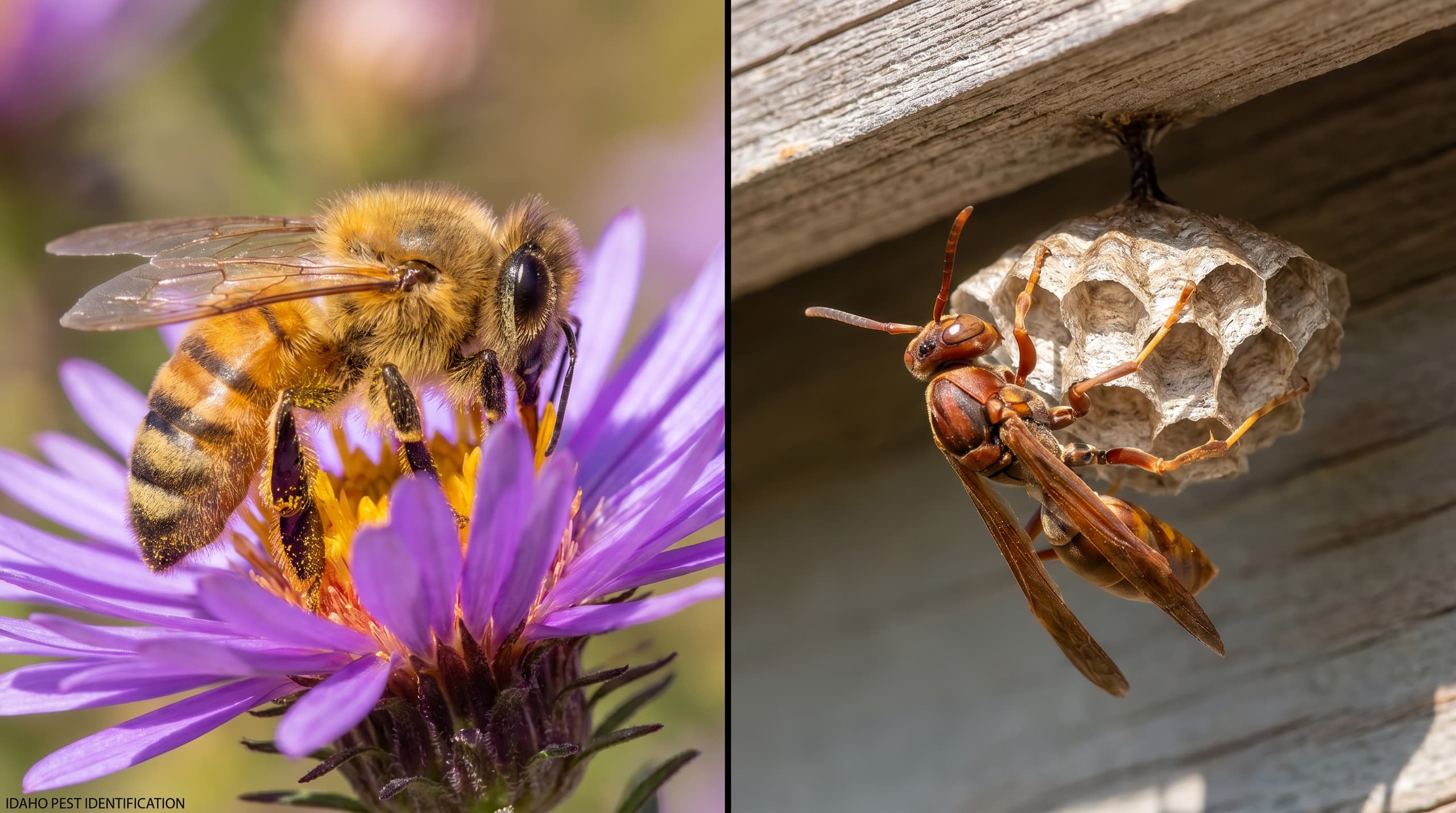
- Mud dauber. Thread-thin waist, slow wobbly flight, dull black with yellow legs or shiny blue. Builds clay mud tubes stacked side by side. Solitary. Almost never stings. See our bee vs wasp guide for Idaho for the full visual breakdown.
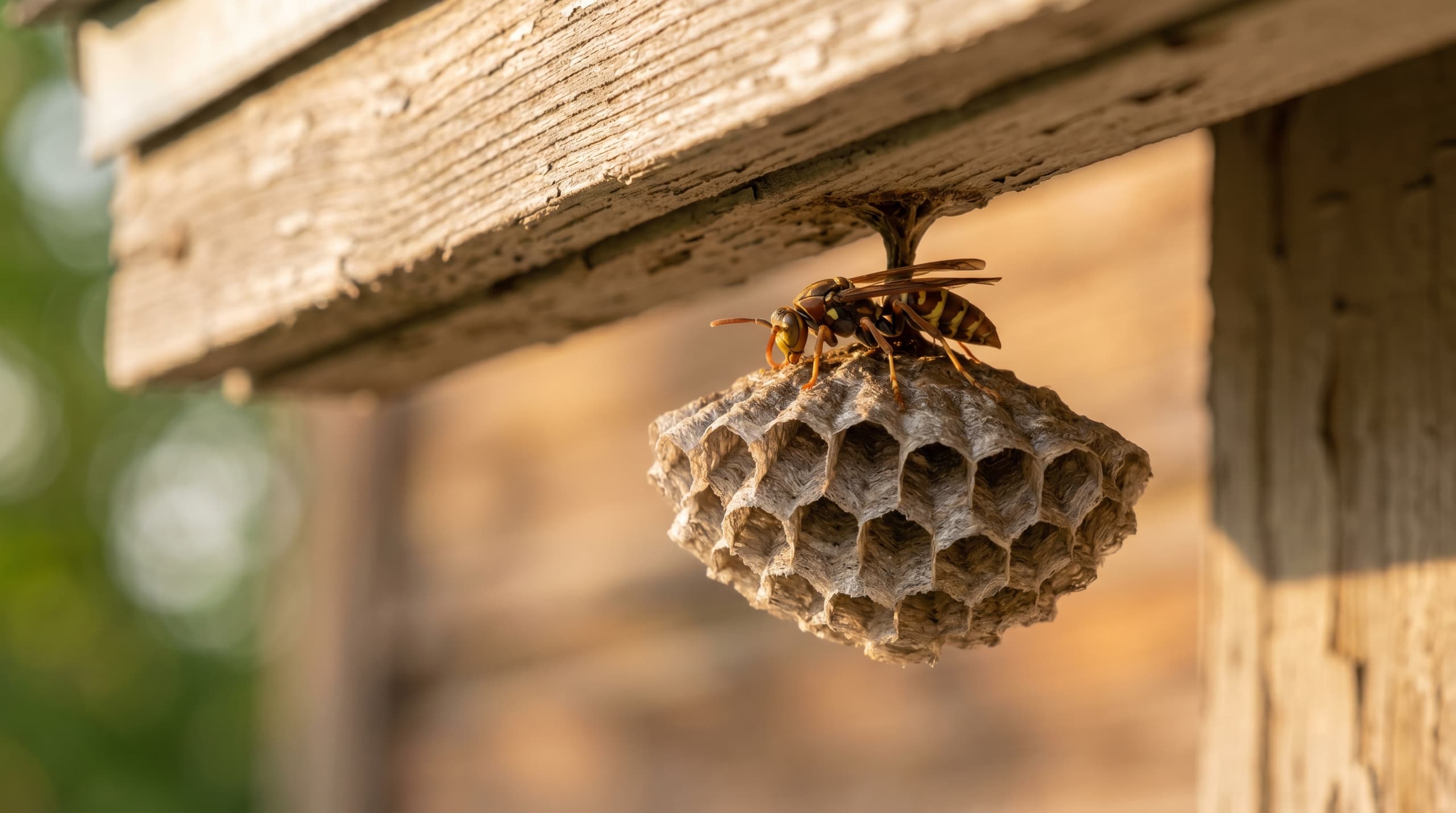
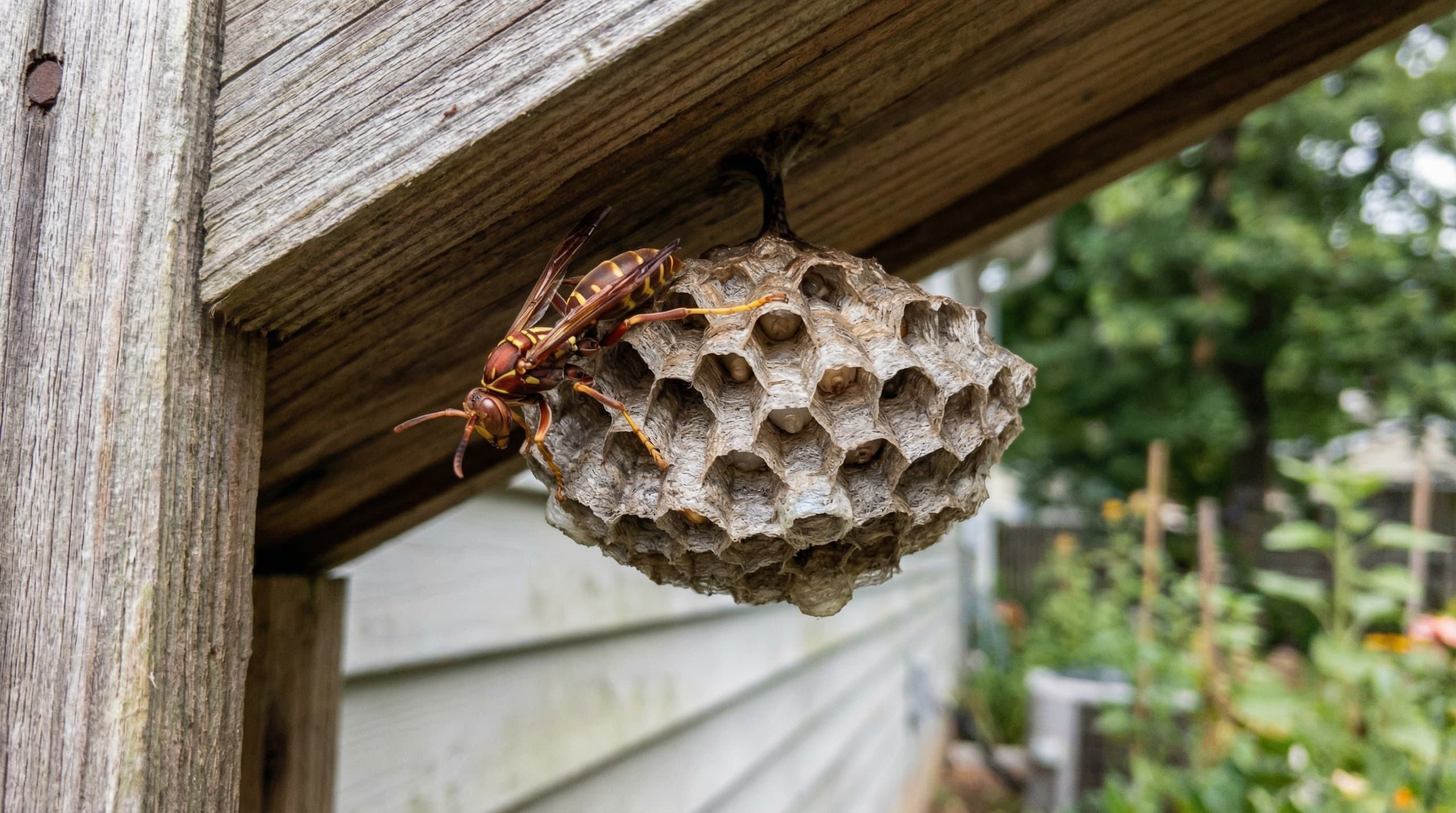
- Paper wasp. Slender brown body with yellow rings, legs dangling in flight. Builds open umbrella-shaped paper nests under eaves. Defends the nest if disturbed. Read our paper wasps in Idaho guide for treatment timing.
- Yellow jacket. Stocky, bright yellow and black, fast direct flight. Nests in the ground, wall voids, or inside soffits. Very aggressive when defending a colony.
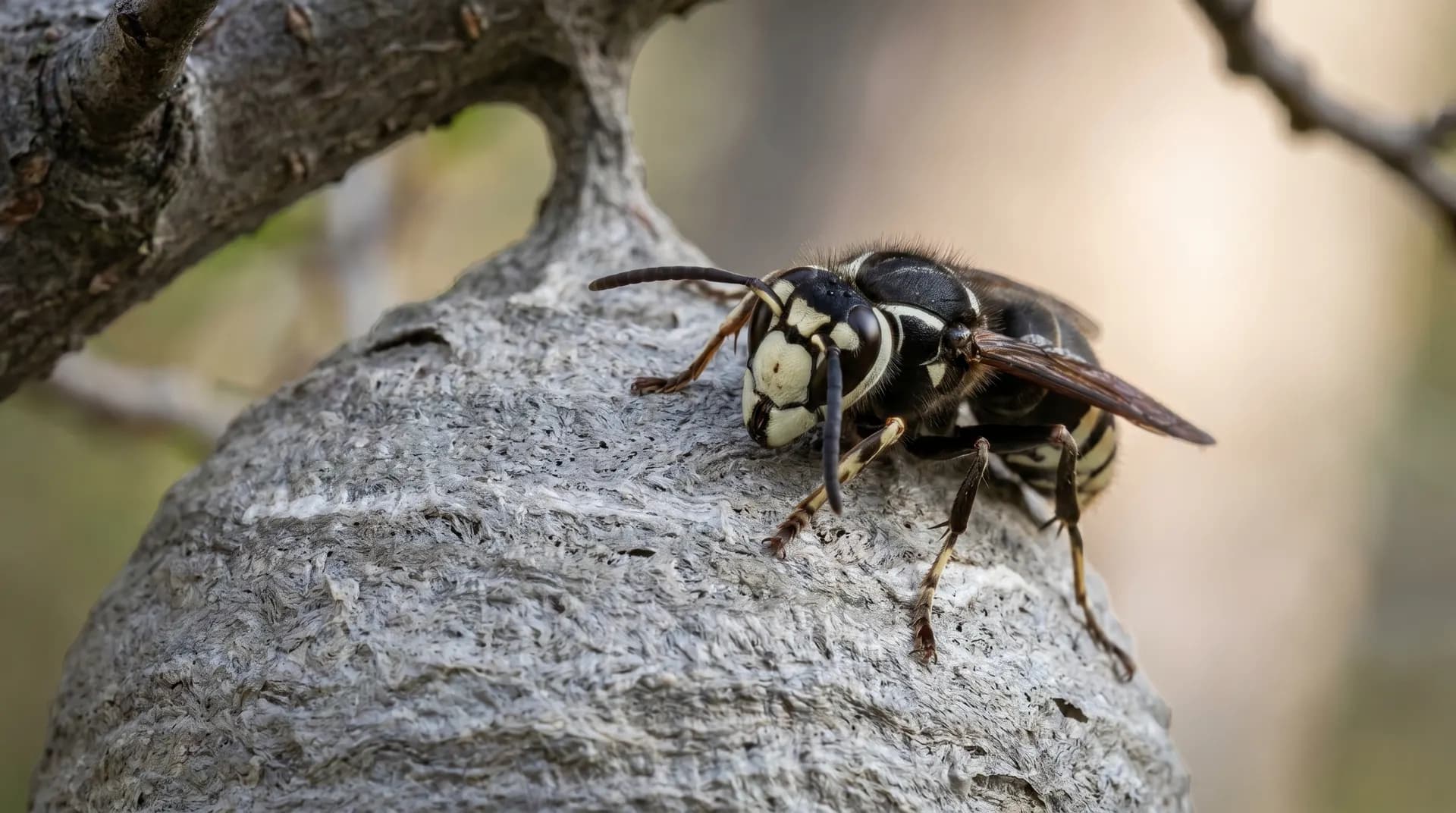
- Bald-faced hornet. Black with a white face. Builds a big football-shaped gray paper envelope hanging from a tree limb or eave. Aggressive. See the bald-faced hornet guide if your nest is paper, not mud.
Are Mud Daubers Dangerous? The Short Answer Is No
Mud daubers are one of the least dangerous flying insects in Idaho. They are solitary wasps, which means there is no colony for them to defend. One female builds her nest by herself, stocks it, lays eggs, and leaves. No workers, no swarm, no chemical alarm signal that calls in 30 more wasps when you walk by.
Her stinger is built for paralyzing spiders, not fighting off mammals. She will almost never use it on a person. The pest control industry tracks sting reports, and mud daubers come in near the bottom. The University of California puts the lifetime odds of a mud dauber sting at vanishingly small unless you grab one in your bare hand.
Compare that to a yellow jacket nest in your siding, which can put out 20 stings in 10 seconds if you bump the wall with a lawn mower. The difference is real. A mud dauber on the porch and a yellow jacket in the wall are not in the same category of problem, even though they are both technically wasps.
Why Mud Daubers Are Actually Good for Your Yard
Here is the part that surprises every Boise customer we explain this to. Mud daubers hunt spiders for a living. The female catches a spider, stings it, paralyzes it, and stuffs it into one of her mud cells. Then she lays an egg on top, seals the cell, and moves on to build the next one.
One mud dauber nest can hold 15 to 20 sealed cells. Each cell can contain 25 to 30 paralyzed spiders. Do the math. A single nest tucked under your eave can represent 500 or more spiders pulled out of your yard. And mud daubers are not picky. The black and yellow species is one of the few predators in North America that regularly takes black widow spiders, which are the most dangerous spider in the Treasure Valley.
If your foothills home has a black widow problem and you also have a mud dauber nest on the back of the garage, the two facts are connected. The mud daubers are quietly working on your widow population while you sleep. That is why an out-of-the-way mud dauber nest isn't an emergency. Your house is still no place for a wasp nest, though. Our perimeter service goes after the spiders directly, so you don't need the mud daubers doing that job. See our black widow safety guide for Idaho if you want the bigger picture on spider pressure here.
When You Should Actually Remove a Mud Dauber Nest
Most mud dauber nests are not an emergency. We will tell a customer that on the phone before we ever drive out. But there are a handful of real reasons to take a nest down.
- The nest is directly above a doorway, mailbox, or patio chair where people pass within arm's reach every day
- It is in a kid's play area, on a swing set, or near a trampoline
- Someone in the home has a serious wasp or bee allergy
- The cluster is on a vent, exhaust louvre, or any spot that needs to stay clear
- It is on the eave of a rental or commercial property and tenants are nervous
- You have so many tubes building up that the visual is becoming a problem on the front of the house
How to Remove a Mud Dauber Nest Safely
The good news is that mud dauber removal is the easiest wasp job a homeowner can do. There is no colony defending the nest. Once the female has sealed her cells, she has usually moved on. Even on an active nest, the worst case is one slow wasp.
- Wait until dusk or after dark. The female is less active. If she is still on the nest, she is calm.
- Wear gloves, long sleeves, and safety glasses. Not because the wasp is dangerous. Because dried mud and dead spider parts are about to fall on your face.
- Place a plastic bag or bucket under the nest. The whole cluster will drop in one piece if you do it right.
- Use a putty knife or stiff scraper. Push the blade between the wall and the nest base. Pop the cluster off in one motion.
- Wipe the spot with soapy water. Mud daubers pick nest sites by scent. Soapy water erases the chemical cue and the same female will not rebuild on that exact spot.
How Green Guard Handles Mud Daubers in the Treasure Valley
If you are not sure what kind of wasp you are looking at, send us a phone picture. We will tell you whether it is a mud dauber that can wait for your next visit, a paper wasp you should treat, or a yellow jacket nest hidden in your siding that needs a pro. No charge for the ID.
When a mud dauber nest does need to come down, we handle it as part of our regular wasp and hornet service. That covers Boise, Meridian, Eagle, Nampa, Caldwell, Kuna, Star, and the surrounding Treasure Valley. We scrape the cluster, treat the attachment spot to block rebuilds, and sweep eaves and soffits for paper wasp and hornet nests at the same time. Our wasp and hornet removal service page lays out the full scope.
Products are organic-based, hospital-grade, and family-safe once dry. The first treatment is $49 for new subscription customers. Quarterly plans after that run $119, $139, or $159 based on home size, with our free re-service guarantee. If wasps come back between visits, so do we, no charge.
Call (208) 297-7947 or book online. Same-day service is often available. We are locally owned in Boise, 4.9 stars across 170+ Google reviews, and 2,500+ Treasure Valley families on the books.
Frequently Asked Questions
What are those mud tubes on the side of my house in Idaho?
Quick answerThose are mud dauber nests.
Mud daubers are solitary wasps that build small clay tubes about an inch long, stacked side by side, usually under eaves, in garages, or on south-facing walls. The two species we see across the Treasure Valley are the black and yellow mud dauber and the blue mud dauber. Despite the size of the nest, the wasp itself is rarely a threat.
Are mud daubers in Idaho dangerous?
Quick answerNo, not for most people.
Mud daubers are solitary, not colonial, so there is no swarm to defend a nest. A female mud dauber will almost never sting a person. The exception is anyone with a known severe wasp or bee allergy, who should treat every wasp on the property with caution and call a pro for removal.
Should I leave a mud dauber nest alone?
Quick answerFor now, usually yes.
Mud daubers hunt spiders for a living, including black widows, and a single nest can clear 500 or more spiders out of your yard. Nests on outbuildings, fences, quiet eaves, and the back of the garage can wait. Remove a nest right away if it is above a doorway, in a play area, near a vent that needs to stay clear, or anywhere a person passes within arm's reach every day. Long term, the goal is no wasp nests on your home. Our quarterly service clears new nests and treats the spiders directly.
How do I tell a mud dauber nest from a paper wasp or hornet nest?
Quick answerTouch the nest material.
Mud dauber nests are dried clay, the color of local dirt, and they crumble dry between your fingers. Paper wasp and hornet nests are gray, shred like wet paper, and feel cardboard-light. Mud daubers also stack short tubes side by side, while paper wasps build open umbrella shapes and bald-faced hornets build big football-shaped enclosed paper envelopes.
How do you get rid of an old mud dauber nest?
Quick answerWait until after dark.
Wear gloves and safety glasses. Place a bucket or bag below the nest, slide a putty knife between the wall and the base of the cluster, and pop the whole thing off in one piece. Wipe the spot with soapy water to erase the scent cue that tells the next female to build there. Total time is about a minute per nest.
Do mud daubers really eat black widow spiders?
Quick answerYes.
The black and yellow mud dauber, one of our two common Treasure Valley species, is one of the few North American predators that regularly takes black widows. The female stings the widow, paralyzes it, and seals it into a mud cell as food for her larva. If your foothills home has a black widow problem and a mud dauber nest on the garage, the wasps are quietly helping you. Still, you don't want either one living on your house. Our quarterly perimeter treatment goes after the widows directly and knocks down new mud dauber nests.